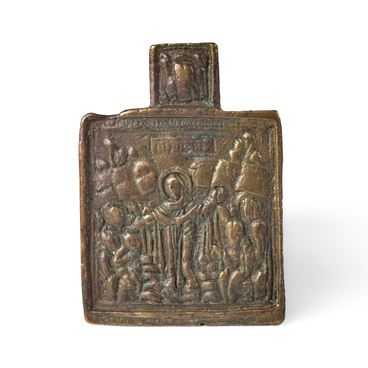
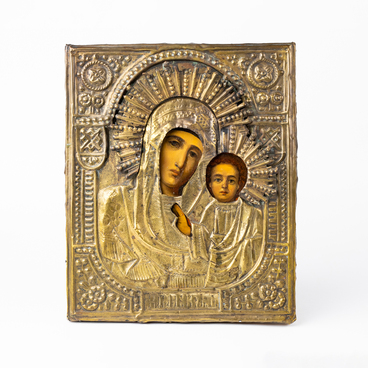
This plaque icon, a cast image of an almost square shape with a protruding narrow frame, was created in the 19th century. The icon depicts Saints Metropolitan Philip, Nicholas the Wonderworker and John the Apostle in a three-quarter turn to the right. In the hands of each there is a closed Gospel with an oval on the cover.
Metropolitan Philip is dressed in a richly decorated sakkos, an upper vestment, and an epitrachelion — a long ribbon. On St. Nicholas, one can distinguish a phelonion, a sleeveless vestment. John the Apostle is depicted in flowing robes. The pozem, that is, a symbolic depiction of the earth on the icon, was made by the craftsman in the form of hills. The background was filled with semicircles and colored enamels: white, dark blue, green, light blue. Copper icons, like painted ones, were made with a protruding frame and a recessed main central part of the image, the so-called kovcheg (ark).
Copper casting is a conventional term used in modern museum studies. Pure copper was not used at that time — alloying additives were implemented. Already in Kievan Rus, crosses and icons were cast from various alloys consisting of several components: copper, tin, zinc and lead in established percentages.
Casting has been the most common method of metalworking since the Bronze Age. The molten mass was poured into a rigid stone or plastic (clay, sand, earth) matrix, mold with or without a wax model. The technique of decorating finished products was diverse. The craftsmen used niello, silver inlay, and polychrome enamels.
Cast crosses, icons and folded icons were sometimes covered with gilding. Cast small plastic made of copper has been known in Russia since the 11th century. It was used throughout the Middle Ages, and at the end of the 17th — beginning of the 18th century it received an unusually wide development, displacing carved plastic made of stone, bone, and wood. It did not go out of use until the beginning of the 20th century.
The forms of copper
casting were formed gradually. The Schism of the Russian Church of the second
half of the 17th century marked a kind of boundary in the development of this
type of applied art. It became an integral part of a separate, Old Believer
culture. This culture, being persecuted and banned, developed in parallel with
the official one.