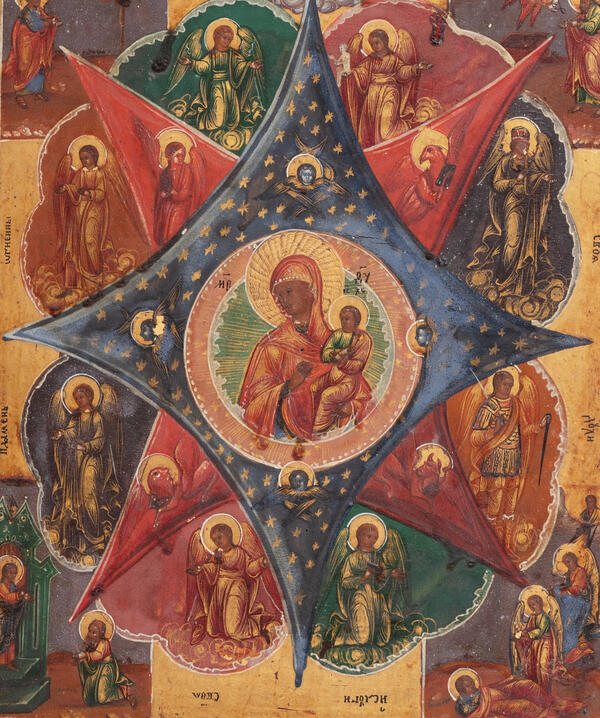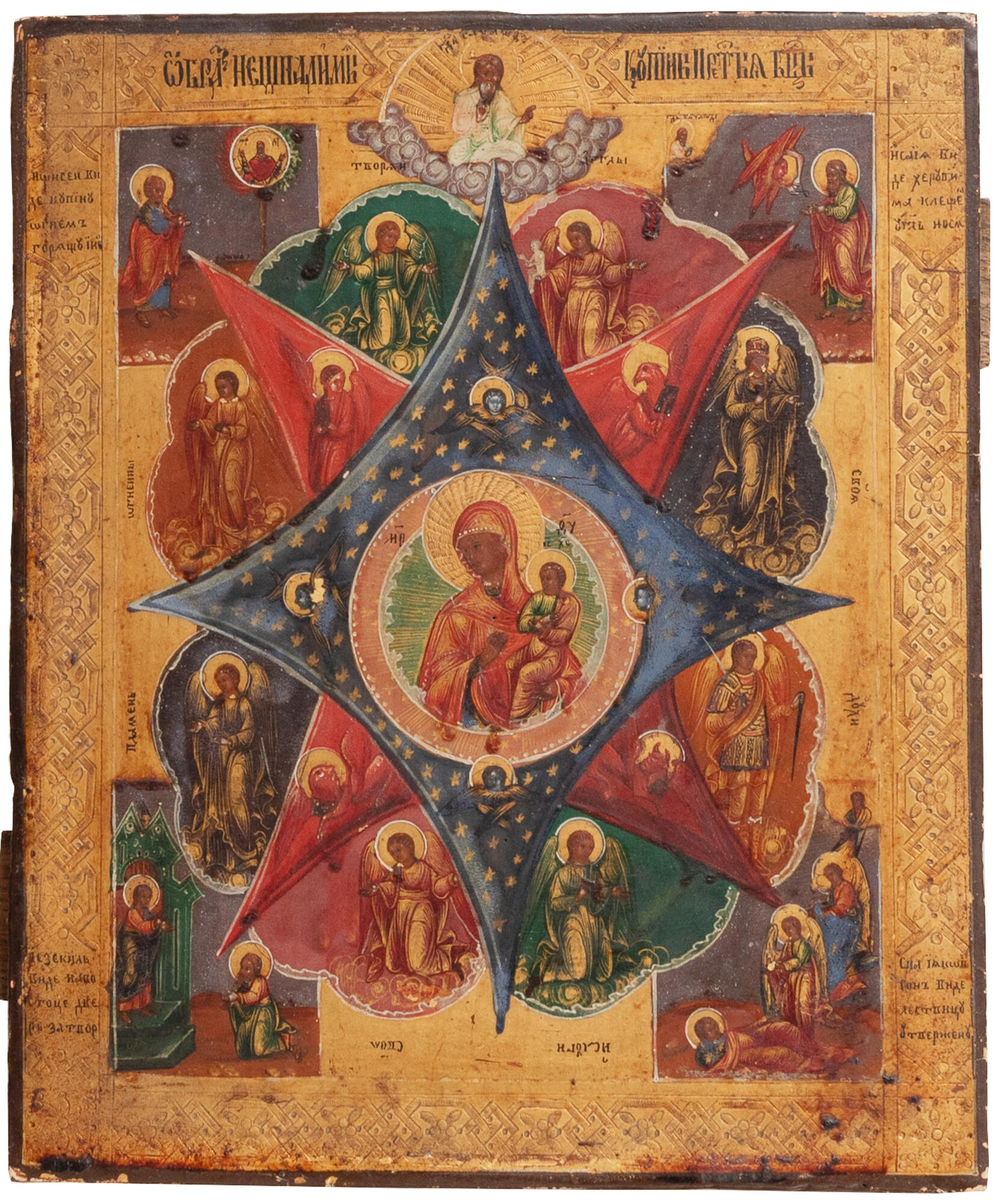


“Our Lady of the Burning Bush” (“Neopalimaya Kupina”) is an image symbolically rendering an Old Testament event described in the book of Exodus. The icon of “Our Lady of the Burning Bush” is considered to be one of the most complex in terms of composition and interpretation of the images contained in it.
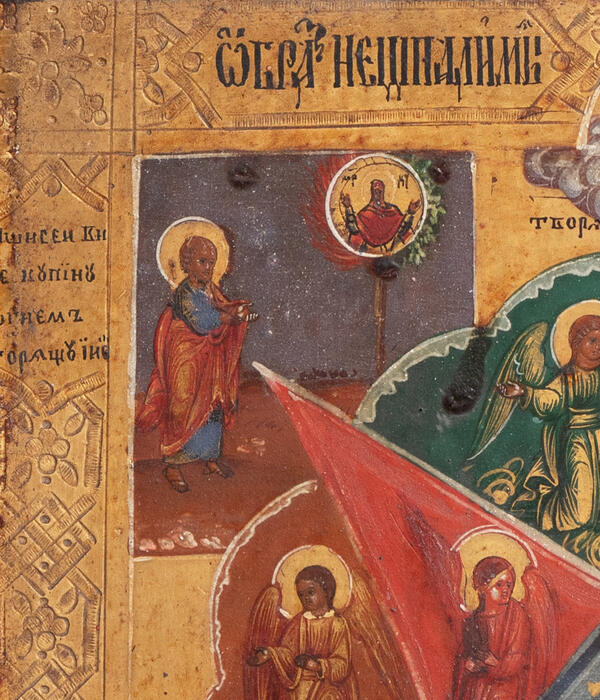
The composition of the icon is formed by two rhombuses of blue and red colors superimposed one on the other. In their center, in a round brown medallion, against a green background with golden rays, is a bust-length portraiture of the Virgin Mary. The Mother of God is holding the Child Jesus on Her left arm. In the corners there are pictures with visions of the prophets: in the upper left corner — a vision to Moses of the Burning Bush in the form of “Our Lady of the Sign” in a burning bush, in the upper right corner — a vision to Isaiah of Seraphim with burning coal in tongs. At the bottom left is the vision to Ezekiel of the shut gates, at the right is the vision to Jacob of a ladder with angels. The icon has a gilded background, the margins are decorated with geometric and floral patterns.
The Burning Bush is a mysterious flaming thornbush in which God appeared to the prophet Moses as the latter was tending sheep near Mount Sinai. Moses saw that the bush was engulfed in flames, yet it never burnt up, for it was a divine flame. God told Moses to lead the people of Israel out of Egypt to the Promised Land.
In Christianity, the burning bush symbolizes the Immaculate Conception of Christ by the Holy Spirit. In Orthodox Christianity, the burning bush is also a symbol of Hesychasm, a tradition of spiritual practice that forms the basis of Orthodox Christian asceticism.
According to legend, one of the icons brought to Moscow by Palestinian monks in 1390 was painted on the rock where the prophet Moses saw the Burning Bush. Initially, the Burning Bush was depicted as a burning bush with the image of the Virgin Mary enclosed therein and the kneeling prophet Moses. Later, in the 16th century, there arose a complex symbolic-allegorical image in the form of an octagonal star surrounding the bust-length portraiture image of the Mother of God and the Child Jesus.
The red rhombus is the symbol of flame; the blue
rhombus is the symbol of life and death. Between the rays, there are angels —
masters of the elements of nature, servants of the Church, and executors of its
will. Before the icon “Our Lady of the Burning Bush”, one would pray for
deliverance from fire and lightning, for healing of ailments.