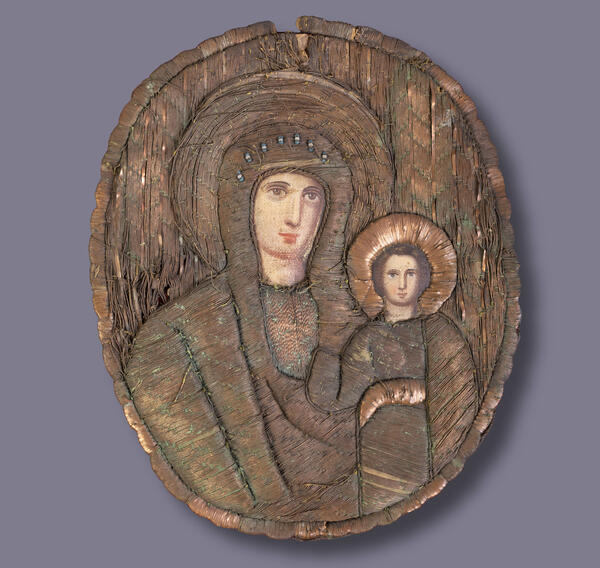
The icon was made by the nuns of the Assumption and Transfiguration Convent in Stary Oskol. It was created presumably at the end of the 18th century. The exhibit joined the museum collection in 1978.
The Assumption and Transfiguration Convent was founded at the end of the 17th century. On the territory of the convent there were two wooden churches which gave the convent its double name — the Church of the Transfiguration of the Lord and the Church of the Assumption of the Blessed Virgin Mary. Abbess Evdokia was the Mother Superior of the convent. At that time 42 nuns aged 17 to 100 lived in the convent. Widows of military men retired to the cloister. The convent was abolished in 1764. The building of the Assumption Church was the oldest stone church building in the city. It was located on Kurskaya street and was rebuilt several times. The temple was destroyed in the 1930s.
The icon of Our Lady of Kazan is one of the most venerated in the Orthodox Church. There are several canonical types of images of the Blessed Virgin Mary, depending on her posture, gestures and attire. This icon belongs to one of the oldest image types — Hodegetria, translated from the Greek as “showing the way”.
The icon is a chest-length image of the Mother of God, with the infant Christ sitting in her arms. The Virgin’s head is slightly tilted toward the child, Christ Himself sits upright and en face. His right hand is folded into a sign of cross made with two fingers, blessing people. In some versions the fingers of Christ are put together so that they stand for the two Greek letters — the first letters of the name Jesus Christ. The Child is the center of the composition: the icon shows the majesty of Christ, who appeared to the world. The Mother of God is depicted in the background, she represents the Son to the people. Unlike the Vladimir icon (“Tenderness”) showing the love of the mother for her Child, the Kazan icon is more majestic and austere. Its mission is to exalt the Son of God and His Mother.
The icon is embroidered with tinsel, a thin metal thread. This needlework tradition came to us from India. The clothes of the Mother of God and Jesus Christ are embroidered with brown beads. Seven beads are sewn on the veil of the Virgin. When making the icon, a few layers of canvas were put under the icon to make the image look more voluminous. The faces on the icon are painted.
The Assumption and Transfiguration Convent was founded at the end of the 17th century. On the territory of the convent there were two wooden churches which gave the convent its double name — the Church of the Transfiguration of the Lord and the Church of the Assumption of the Blessed Virgin Mary. Abbess Evdokia was the Mother Superior of the convent. At that time 42 nuns aged 17 to 100 lived in the convent. Widows of military men retired to the cloister. The convent was abolished in 1764. The building of the Assumption Church was the oldest stone church building in the city. It was located on Kurskaya street and was rebuilt several times. The temple was destroyed in the 1930s.
The icon of Our Lady of Kazan is one of the most venerated in the Orthodox Church. There are several canonical types of images of the Blessed Virgin Mary, depending on her posture, gestures and attire. This icon belongs to one of the oldest image types — Hodegetria, translated from the Greek as “showing the way”.
The icon is a chest-length image of the Mother of God, with the infant Christ sitting in her arms. The Virgin’s head is slightly tilted toward the child, Christ Himself sits upright and en face. His right hand is folded into a sign of cross made with two fingers, blessing people. In some versions the fingers of Christ are put together so that they stand for the two Greek letters — the first letters of the name Jesus Christ. The Child is the center of the composition: the icon shows the majesty of Christ, who appeared to the world. The Mother of God is depicted in the background, she represents the Son to the people. Unlike the Vladimir icon (“Tenderness”) showing the love of the mother for her Child, the Kazan icon is more majestic and austere. Its mission is to exalt the Son of God and His Mother.
The icon is embroidered with tinsel, a thin metal thread. This needlework tradition came to us from India. The clothes of the Mother of God and Jesus Christ are embroidered with brown beads. Seven beads are sewn on the veil of the Virgin. When making the icon, a few layers of canvas were put under the icon to make the image look more voluminous. The faces on the icon are painted.