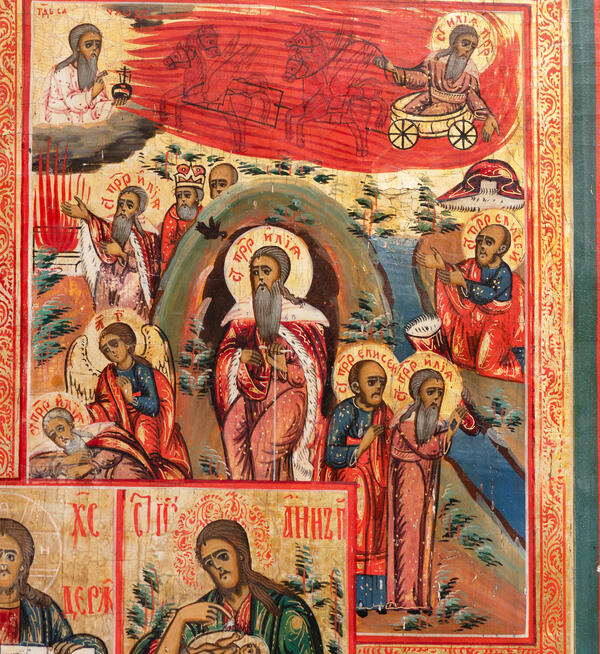
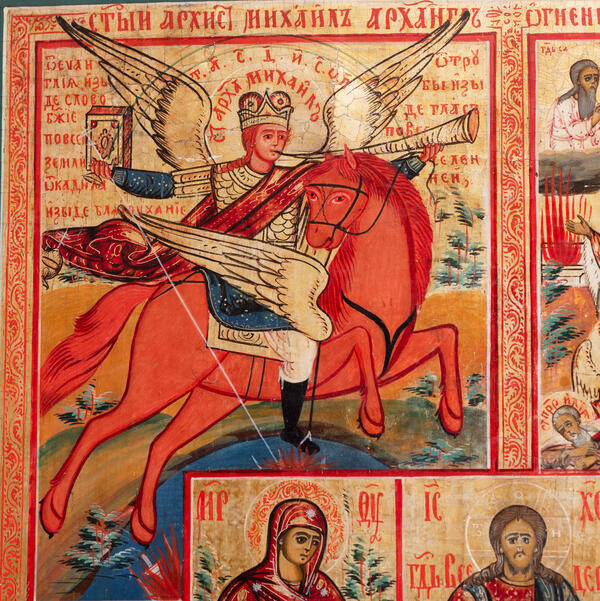
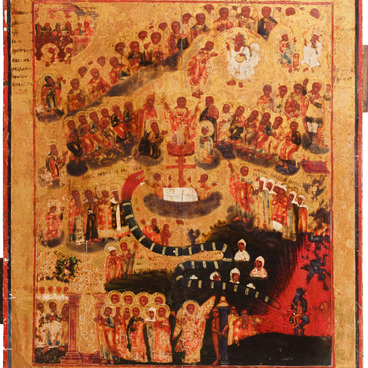
The displayed icon is divided into four sections, framed by red borders with a floral pattern. In the center, there is the Deesis composition with Christ Pantocrator, the Virgin Mary, and John the Baptist. In the top left corner, Archangel Michael is depicted with a red face, dressed in armor and flying on a red winged horse. In his right hand, he holds the Book of the Gospels, and in his left hand, he carries a trumpet that he blows to announce the Last Judgment. His arms are extended, and a rainbow stretches between them. To the right of Archangel Michael is the prophet Elijah against the backdrop of a cave opening. He is surrounded by scenes from his life, including his ascent to heaven in a fiery chariot. Legend has it that Elijah was taken to heaven alive. According to the Book of Kings, “There appeared a chariot of fire, and horses of fire, and parted them both asunder; and Elijah went up by a whirlwind into heaven.”
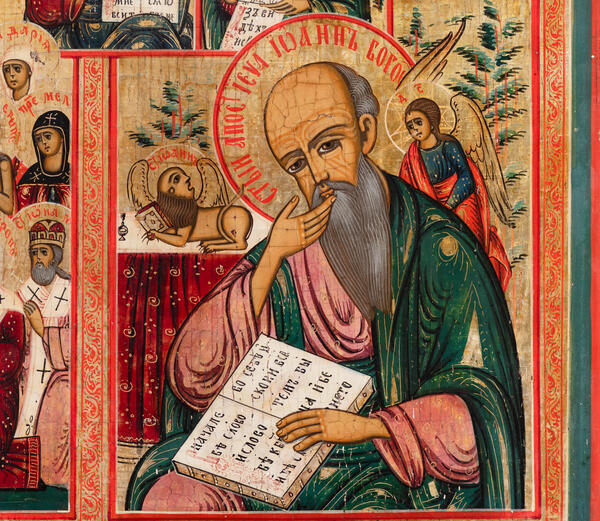
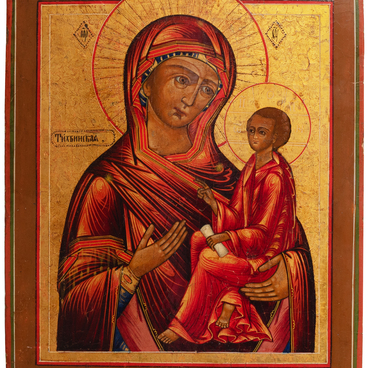
In the bottom left corner, there is the icon of “Our Lady of Bogolyubovo”, holding a white open scroll. In front of her, on the right side, there are three rows of people: the Metropolitans of Moscow Pyotr, Alexiy, Iona, and Filipp, the saints — Mary of Egypt, Melania, and Anne, and the martyr Daria. The icon was painted at the request of Prince Andrey Bogolyubsky in memory of the apparition of the Virgin Mary to him. The image dates back to the 12th century and is one of the earliest Russian icons. In the bottom right corner, there is John the Apostle, holding the Book of the Gospels in his lap. The text on the first page of the book reads, “In the beginning was the Word.” On his shoulder is his symbol, a winged lion.
Multi-part icons included several scenes. They were
common in Byzantium and Russia. The earliest examples of such icons in Russian
art date back to the 14th–15th centuries. Most often,
they depicted feasts and other scenes that formed a liturgical or theological series.
In the 18th–19th centuries, when icons began to be mass-produced,
the composition and design of multi-part icons were usually determined by the
customer. The displayed icon has an unusual layout. It is divided into four
vertical rectangular parts but also has a fifth image — the horizontal Deesis in
the center of the frame. The fifth image seems to seal and protect the four
other icons. This is a rare composition for an old multi-part icon.