

The Church celebrates the memory of the holy martyrs Gurias, Samonas and Abibus on the same day (November 15), they are also painted in icons together. All three lived and suffered for the Christian faith in the city of Edessa, where they were buried together.
Two friends (according to some sources, brothers) Gurias and Samonas, who preached Christianity, were martyred during the reign of Emperor Diocletian (284–305) or, possibly, Maximinus (305–311). Even under torture, Gurias and Samonas refused to make sacrifices to idols, after which they were thrown in prison and then beheaded. Later they were buried by the Christians of Edessa.
Deacon Abibus lived later, under the last pagan emperor Licinius (311–324 years). Having learned that the authorities were looking for him, he himself came to the executioners, as he did not want others to accidentally suffer because of him. Despite his torments, his faith in Christ was strong and when Abibus was burned, he prayed. His mother and other Christians found his body unharmed and buried him next to Gurias and Samonas.
The saints became known as patrons of marriage and deceived wives. Their hagiography describes an episode about a Gothic warrior marrying a pious girl Euphemia from Edessa. At the tomb of the saints, he swore to her mother Sophia that he would never offend his wife in any way. He took Euphemia to his homeland after the service, and gave her into slavery to his first pagan wife. Having endured a lot of suffering, having lost a baby and dying in a crypt, Euphemia prayed to the three martyrs and was miraculously transported to Edessa. The perjurer was punished.
In icons, Saints Gurias, Samonas and Abibus are customary depicted together, full-length. Gurias is traditionally represented as a gray-bearded old man, Samonas — somewhat younger, and Abibus as a beardless young man. Gurias and Samonas are usually dressed in red himations and hold crosses in their hands as signs of martyrs, Abibus is depicted in a sticharion, with a thurible in his right hand and a jar of incense in his left.
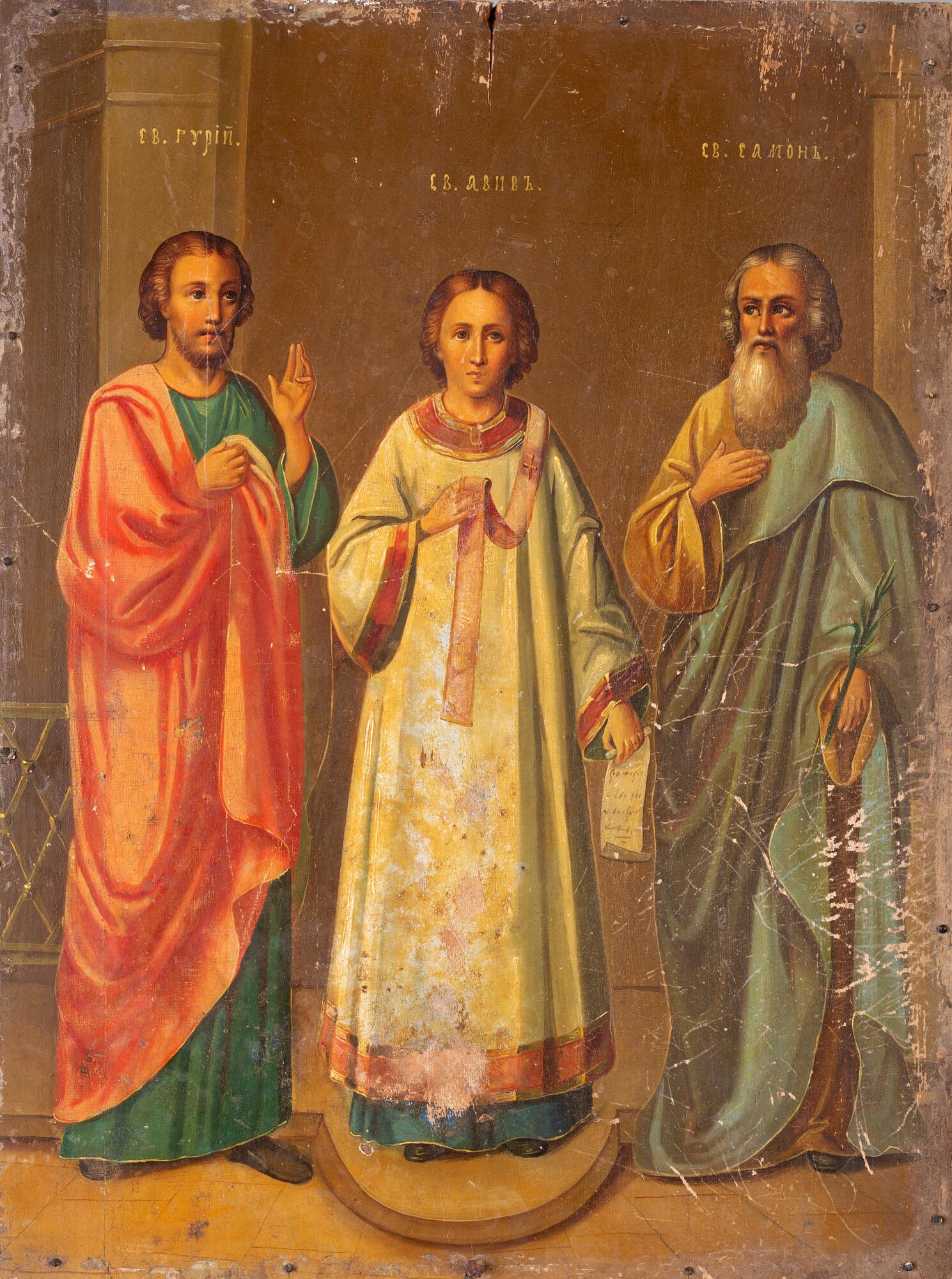
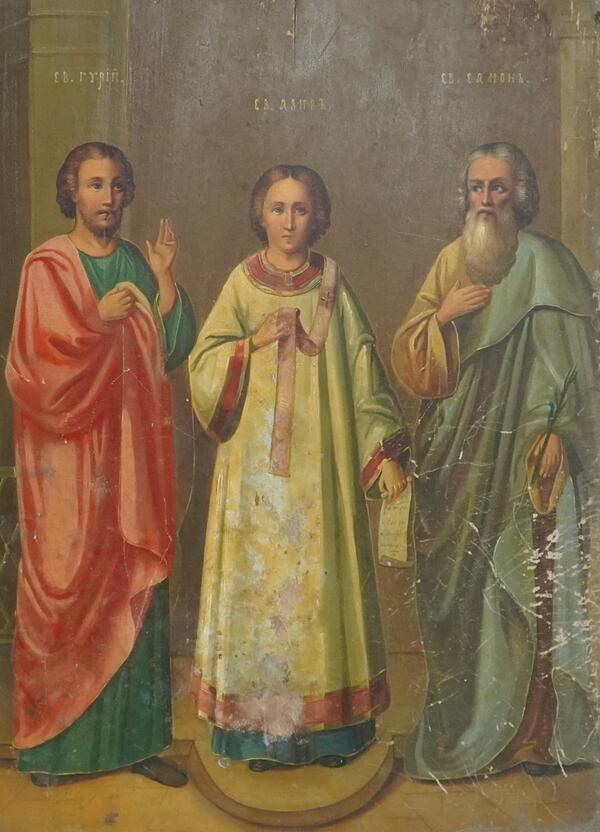
The icon presented in the exhibition is noticeably different from the canonical image. Judging by the inscriptions, Samonas is represented as an elder. The palm branch in his hand symbolizes the victory of life over death and sin, and his belonging to the Kingdom of God. Gurias raises his hand in a blessing gesture (the fingers are folded in the form of the letters “I Х” — Jesus Christ). It is characteristic that the blessing hand is the left one. Such a gesture, which initially was deemed contrary to the canons of Orthodoxy, can be found in Russian icons of the 18th–20th centuries.
Saint Abibus is painted in a diacon’s robe; in terms of attributes, he holds only a scroll — a sign of bringing biblical truth to people.
The first known text dedicated to the martyrdom of these saints is attributed to Theophilus of Edessa.
Two friends (according to some sources, brothers) Gurias and Samonas, who preached Christianity, were martyred during the reign of Emperor Diocletian (284–305) or, possibly, Maximinus (305–311). Even under torture, Gurias and Samonas refused to make sacrifices to idols, after which they were thrown in prison and then beheaded. Later they were buried by the Christians of Edessa.
Deacon Abibus lived later, under the last pagan emperor Licinius (311–324 years). Having learned that the authorities were looking for him, he himself came to the executioners, as he did not want others to accidentally suffer because of him. Despite his torments, his faith in Christ was strong and when Abibus was burned, he prayed. His mother and other Christians found his body unharmed and buried him next to Gurias and Samonas.
The saints became known as patrons of marriage and deceived wives. Their hagiography describes an episode about a Gothic warrior marrying a pious girl Euphemia from Edessa. At the tomb of the saints, he swore to her mother Sophia that he would never offend his wife in any way. He took Euphemia to his homeland after the service, and gave her into slavery to his first pagan wife. Having endured a lot of suffering, having lost a baby and dying in a crypt, Euphemia prayed to the three martyrs and was miraculously transported to Edessa. The perjurer was punished.
In icons, Saints Gurias, Samonas and Abibus are customary depicted together, full-length. Gurias is traditionally represented as a gray-bearded old man, Samonas — somewhat younger, and Abibus as a beardless young man. Gurias and Samonas are usually dressed in red himations and hold crosses in their hands as signs of martyrs, Abibus is depicted in a sticharion, with a thurible in his right hand and a jar of incense in his left.
The icon presented in the exhibition is noticeably different from the canonical image. Judging by the inscriptions, Samonas is represented as an elder. The palm branch in his hand symbolizes the victory of life over death and sin, and his belonging to the Kingdom of God. Gurias raises his hand in a blessing gesture (the fingers are folded in the form of the letters “I Х” — Jesus Christ). It is characteristic that the blessing hand is the left one. Such a gesture, which initially was deemed contrary to the canons of Orthodoxy, can be found in Russian icons of the 18th–20th centuries.
Saint Abibus is painted in a diacon’s robe; in terms of attributes, he holds only a scroll — a sign of bringing biblical truth to people.
The first known text dedicated to the martyrdom of these saints is attributed to Theophilus of Edessa.