

The origin of needle storage devices goes back to the distant past. For example, iron and bronze needle cases were found in the burial complexes of the Palasa-Syrt settlement located in the territory of modern South Dagestan in the 4th–5th centuries. Needle holders are also found in burial mounds of the 11th–13th centuries in Southern Siberia.
One of the items that the archaeologists came across is a narrow leather pouch with small remnants of iron needles inside. “Needle cases on laces were hung from a belt and represented significant material value for the medieval population,” writes the historian Andrei Mikhailovich Ilyushin in his article “Bronze needles of the medieval people of the Kuznetsk Basin”. Needles in those times were considered a luxury, so they were kept as the most valuable household items.
Needlework in Old Russia was considered important and useful. Sewing and embroidery were most widespread. Every woman from her girlhood had her own chest, which was filled with sewing instruments, including a pincushion.
The simplest artisanal needle holders were cushions that were stuffed with cotton, wool, pieces of cloth or other materials. Some pincushions were decorated with fur scraps, beads, ribbons, appliqué, embroidery and other elements. For wealthy needlewomen, these household items were made of expensive materials, such as ivory, precious wood and precious metals. For transportation and storage of needles on a trip, needle holders were produced in the form of a case of cylindrical shape with removable and threaded caps. Since ancient times, needles have always had their own place.
At home, pincushion stands often served a decorative function. They could have a variety of shapes, such as wells, towers, houses, pets or fairy tale characters. Different types of shoes were a popular form of pincushion stands for several centuries. Needles could be stored in “shoes”, “clogs” or “boots”.
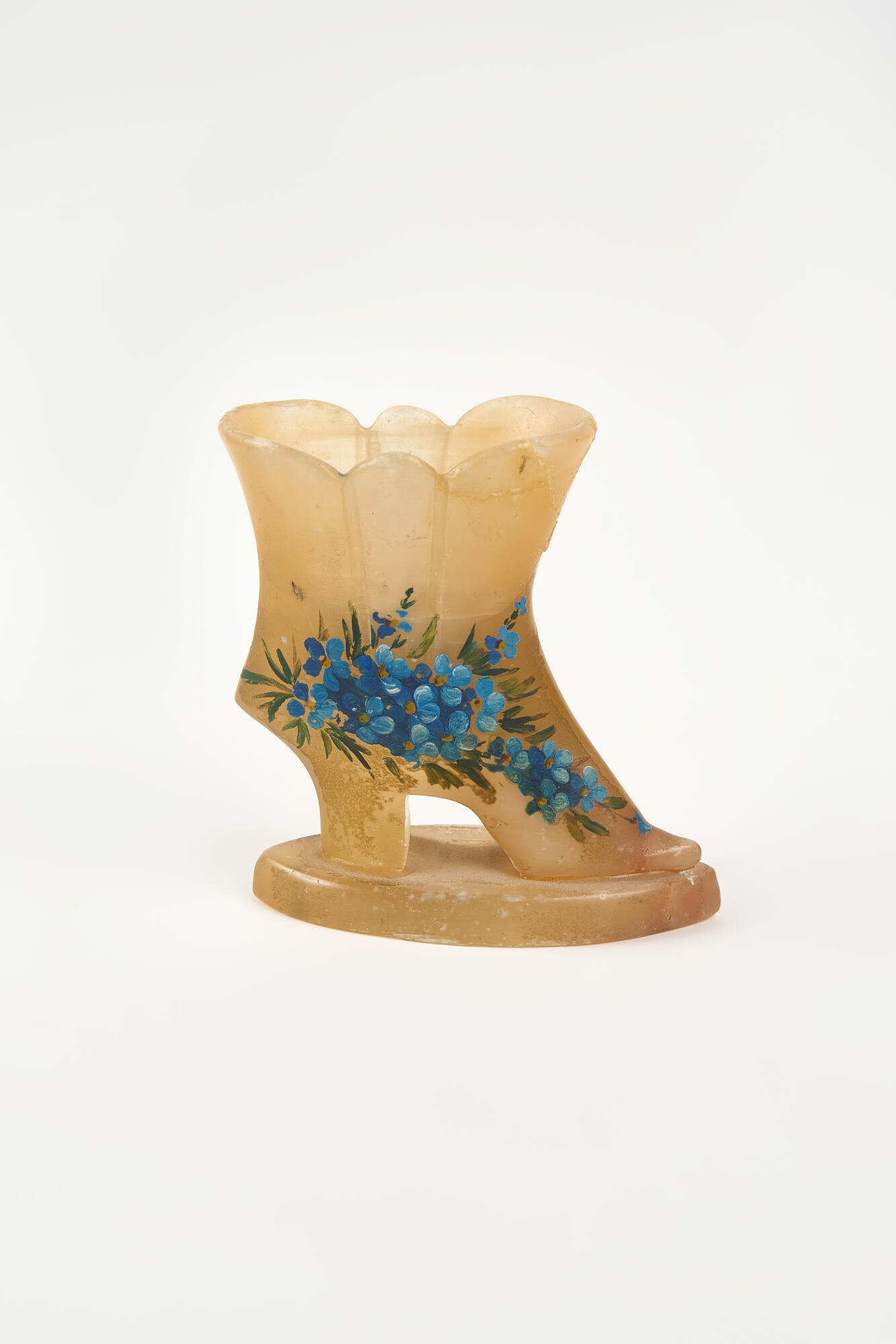
The pincushion stand from the museum’s exhibition is made in the form of a lady’s boot, which is painted with forget-me-nots. This item is made of an inexpensive mineral, Ural selenite, one of the varieties of gypsum. Selenite began to be used for ornamental purposes in the 19th century. It was then that masters of selenite carving began to create various items from it. Today they still make animal figurines, caskets, ashtrays, brooches and beads.