A khorugv is a religious banner. Khorugvs are used on Christian feast days, most often during a Crucession — a solemn procession led by priests. Religious processions are held to commemorate special church or state events, as well as to prevent wars or epidemics. Participants follow a certain route and carry crosses, icons and banners, while offering prayers to the Lord.
On ordinary days, banners are kept in the temple on the kliros — this is the name for the sections on both sides of the altar, where the chanters and singers stand during the service.
Religious banners appeared in the 4th century during the reign of the Roman emperor Constantine the Great. He became famous for having commanded to decorate his labarum (imperial banner) with the sign of the Cross. It is believed that the word “khorugv” came to Russia from the Mongolian language, where a similar term meant a banner. Although more often the warriors used the word “banner”. In Russian, this term has the same meaning as the verb “assemble” since warriors had to assemble during the battle under the banner at the signal. Church banners are still used in this literal sense today: as banners that gather believers around them and signify the victory of the Christian Church in the battle against death and the devil.
Over time, artisans began to make such banners from metal and decorate with the images of the Savior, the Virgin, the saints and sacred events. Sometimes the craftsmen added silver, gold and enamel details. The cloth banner is most often embroidered with gold on expensive high-quality fabric: brocade or velvet. The shafts are usually made quite long so that the banner rises high above the procession. If the banner is heavy, it can be equipped with a special device that allows four people to carry it.
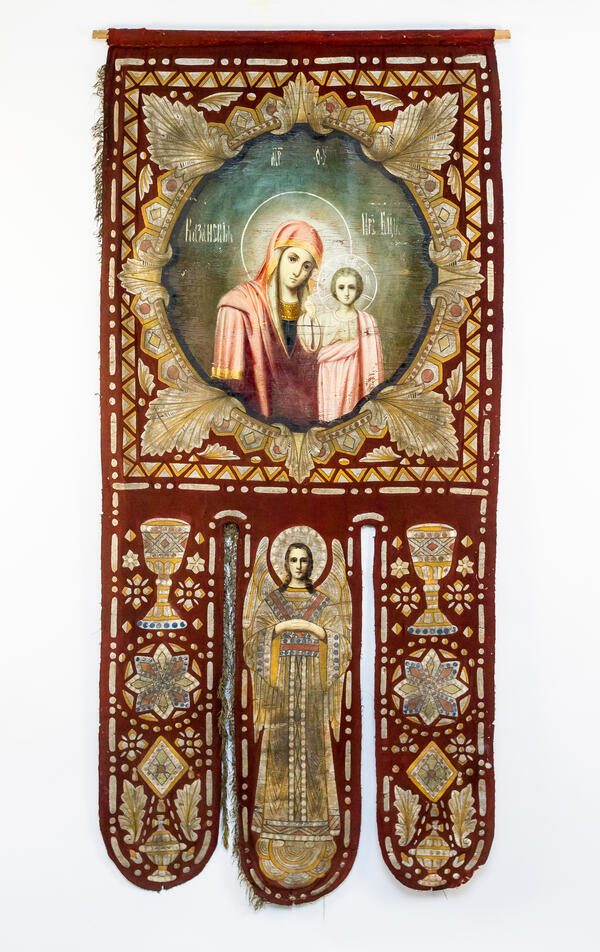
Sometimes artists do not embroider holy images, but rather paint the fabric. The exhibit from the museum collection is an example of this rare version.
In the center of the banner, the artist depicted the Kazan Icon of the Mother of God, which became famous for many miracles. The Guardian Angel is imprinted on the middle tail below, he protects the altar. On the sides, the artist painted chalices — vessels for the consecration of wine and the Sacrament. Here these vessels signify the unity of the entire Orthodox Church in the Sacrament. On the reverse side of the banner, the master depicted the scene of the Baptism of Jesus in the Jordan River.
On ordinary days, banners are kept in the temple on the kliros — this is the name for the sections on both sides of the altar, where the chanters and singers stand during the service.
Religious banners appeared in the 4th century during the reign of the Roman emperor Constantine the Great. He became famous for having commanded to decorate his labarum (imperial banner) with the sign of the Cross. It is believed that the word “khorugv” came to Russia from the Mongolian language, where a similar term meant a banner. Although more often the warriors used the word “banner”. In Russian, this term has the same meaning as the verb “assemble” since warriors had to assemble during the battle under the banner at the signal. Church banners are still used in this literal sense today: as banners that gather believers around them and signify the victory of the Christian Church in the battle against death and the devil.
Over time, artisans began to make such banners from metal and decorate with the images of the Savior, the Virgin, the saints and sacred events. Sometimes the craftsmen added silver, gold and enamel details. The cloth banner is most often embroidered with gold on expensive high-quality fabric: brocade or velvet. The shafts are usually made quite long so that the banner rises high above the procession. If the banner is heavy, it can be equipped with a special device that allows four people to carry it.
Sometimes artists do not embroider holy images, but rather paint the fabric. The exhibit from the museum collection is an example of this rare version.
In the center of the banner, the artist depicted the Kazan Icon of the Mother of God, which became famous for many miracles. The Guardian Angel is imprinted on the middle tail below, he protects the altar. On the sides, the artist painted chalices — vessels for the consecration of wine and the Sacrament. Here these vessels signify the unity of the entire Orthodox Church in the Sacrament. On the reverse side of the banner, the master depicted the scene of the Baptism of Jesus in the Jordan River.