The most popular handicraft material among the Khanty and Mansi peoples has long been birch bark. Dishes, various containers, shoes and belts, materials for boats and summer dwellings (“tiski”), night cradles for children (day cradles were made of wood or were of other designs) were made and skillfully crafted using birch bark. This craft is still practiced today.
Birch bark harvesting has always been done three times a year, when the sap flows most intensively: in spring before the crust melts, in July when rosehip flowers, and during autumn leaf fall. To remove a layer of birch bark, three incisions are made on the tree: one vertical, down to the bast, and two horizontal ones, designating the area intended for cutting; the harvester then uses their hands and removes the bark from right to left. The rough top layer is cleaned by scraping.
Then birch bark pieces are twisted into tubes and placed vertically in boilers and covered with moss. The harvester pours water into the container and boils the bark for 10 to 12 hours. After that, the material becomes pliable and easy to use. When boiled in fish oil, birch bark becomes considerably strong and water-resistant. In addition, it would not crack in the cold.
While working with this material, threads made from deer tendons or horsehair and an awl (in the olden days — a bone) are used for piercing.
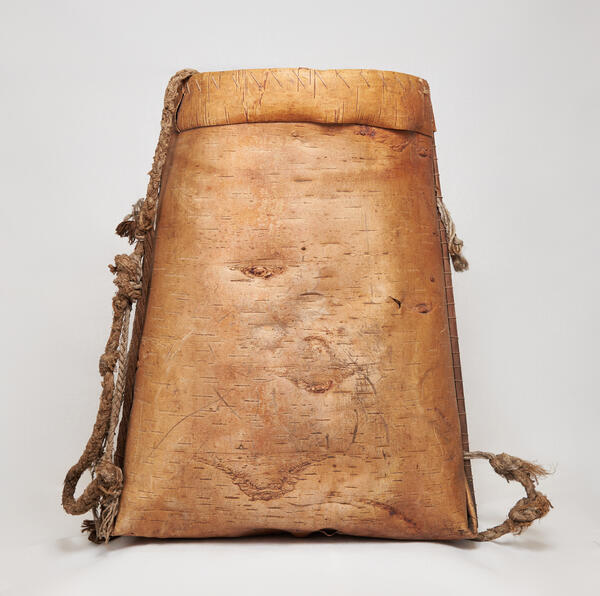
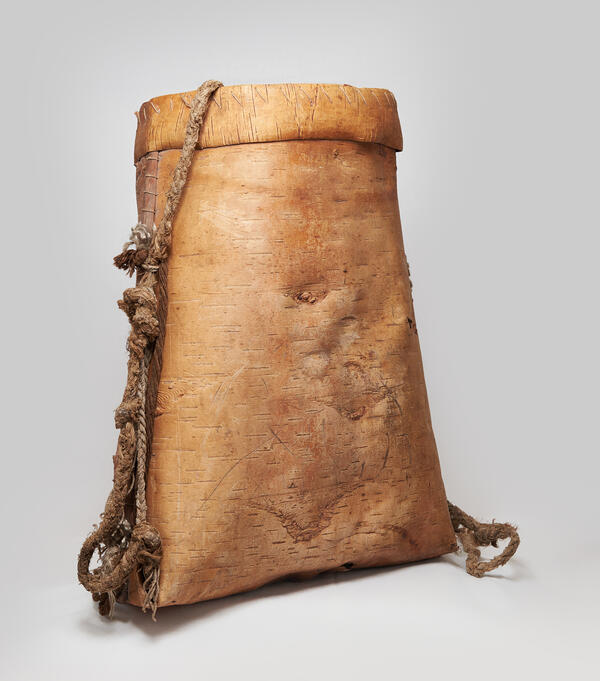
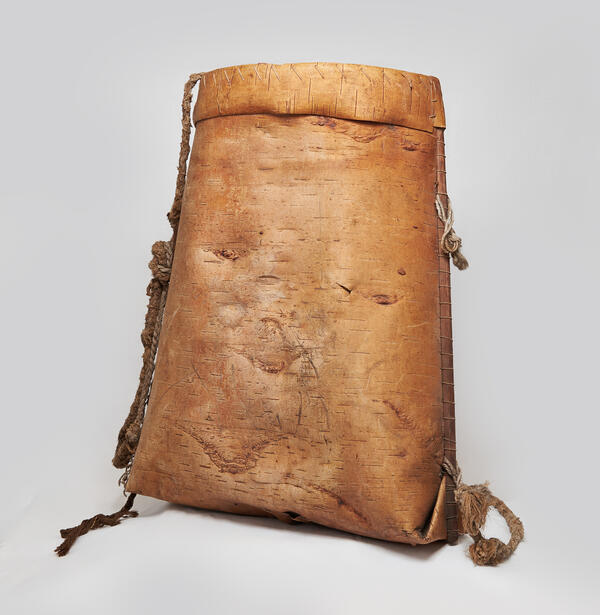
The presented hint is a kind of pack basket for collecting and storing berries or dry products. To create it, one takes two long strips of birch bark, folds them across, with the darker layer facing outward; the lower corners are wrapped in an “envelope” and pressed against the side walls. These walls are overlapped and additionally secured with a bird cherry rod. They are then sewn together with a whip stitch. Loops made of leather or rovduga (hide) are attached to the side walls, into which straps are then inserted.
Often such pack baskets are decorated with an ornament in the form of waves or closed “branched” figures resembling deer antlers. Common decorative techniques are scraping, appliqué, embossing, openwork carving or stamping.
In the first case, the pattern is first scratched with the blunt side of the blade, without using a stencil, then one has to wet the birch bark piece and use a sharp knife to release a white layer of bark from under the brown layer. Such a drawing is usually placed around the perimeter of the container or on its lid.
The blunt end of the knife is also used to create a “grid” pattern. Stamps are made by cutting patterns on elk or deer horns, often of a zoomorphic nature.
The most time-consuming method of decoration is appliqué: the geometric elements of the pattern are cut out on a strip of birch bark, put on top of a pre-smoked background and fixed.