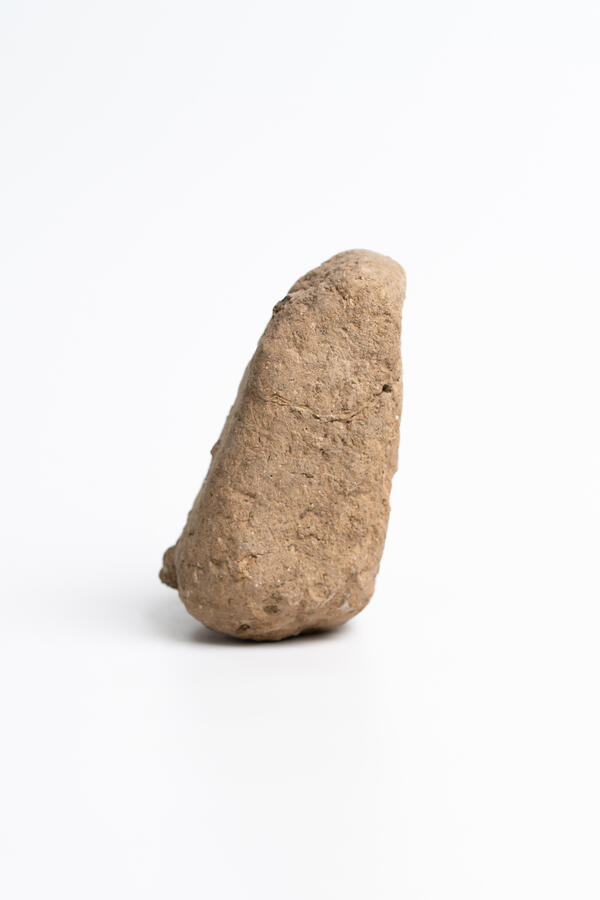
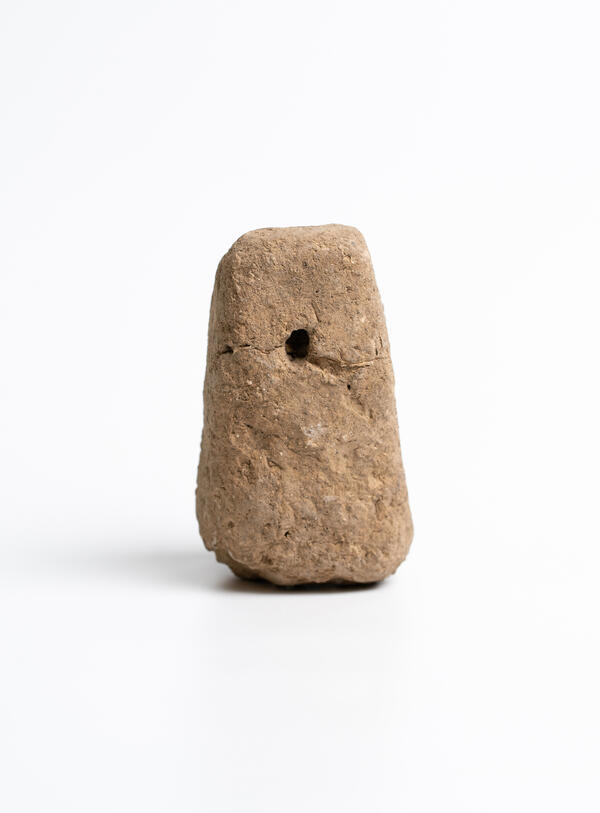
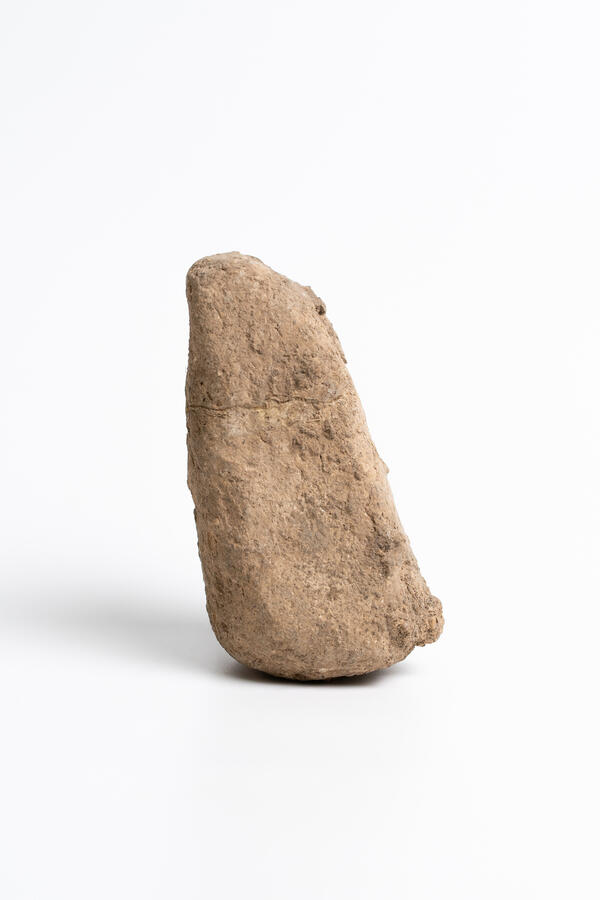
The pyramidal loom weight from the museum collection was found during excavations at the Bolshoi Kastel Estate by the Tarkhankut expedition. In ancient times, weaving was done at home, mostly by women, both free and enslaved. By weaving fabrics, such women met the needs of their families. The Greek loom was quite primitive. Its design can be traced based on the drawings on Greek vases.
The loom had a vertical structure. The threads hanging from a bar were tied to small weights. No mechanical devices were used to work with the threads. Most fabrics were made of wool which was produced in large quantities in the Northern Black Sea region due to the developed cattle breeding. The tools of the weavers from the Northern Pontic region have also been preserved. These include spindle whorls, on which twisted thread was wound, and the weights that held the threads in place. Many of the weights have branding, in the form of imprints of gems, keys, or special stamps. Some consider these to be the marks of the potters who made the weights. However, it is more likely that these are the marks of the customers who owned the looms.
Loom weights are found in large numbers, indicating the widespread presence of weaving. In some cases, for example, in Tanais, groups of weights were found together with the remains of burned looms. Tanais was an ancient emporium founded by Greeks from the Bosporan Kingdom.
It is likely that looms were present in every
household and fabric production was primarily a domestic activity. In some
cases, loom weights were also found in temples. They were associated with
offerings to Demeter, the goddess of agriculture and fertility. Tools for
weaving and spinning found in temples are interpreted as female offerings, as weaving
and needlework were considered to be traditional women’s crafts in ancient
times.