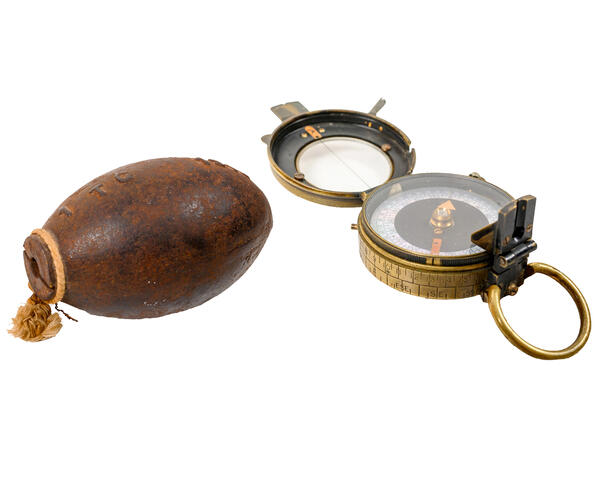
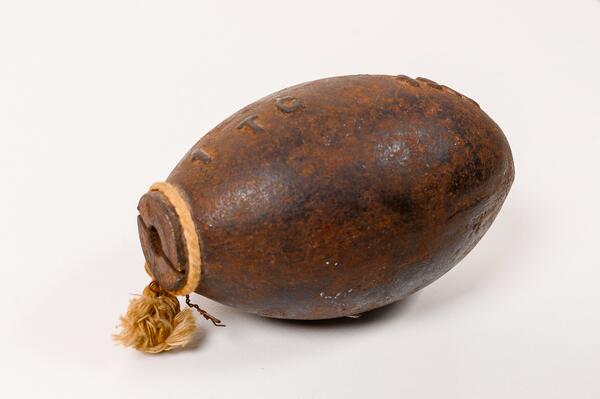
Hand grenade No. 16 was produced in the UK during the First World War. It served as an alternative for the No. 15 ball grenade which was less reliable and convenient. The ammunition had the simplest design possible: the demand for grenades was growing rapidly at that time, so, if the design had been too sophisticated, it would have slowed down the production.
The No. 16 was oval, which made it easier to handle than the round model No. 15. The smooth metal body had a firing charge that exploded when triggered by a spark.
The fuse of the grenade No. 16 consisted of a safety cap, a friction wire, a body, a delay mechanism, a detonator, and a paper charge holder. The cap was connected to the friction wire: when it was pulled out, a power delay fuse was ignited, giving a soldier a 6-7 second delay to take cover before the explosion. Sometimes, a small piece of a Bickford fuse was used as a delay mechanism, which was inserted into the hole in the upper part of the grenade and ignited. It was more water-resistant than a standard fuse and therefore more reliable. A paper charge holder prevented a spark from getting to a detonator ahead of time so that the device would not explode in a soldier’s hands.
Russia and Great Britain were allies during the First World War. Therefore, some of the British ammunition, including grenades, were supplied to the Russian army. However, these grenades were withdrawn from service in 1915, as they were considered too sensitive to humidity, unreliable, and rather ineffective. They were replaced by another model developed by the British marine engineer William Mills. The Mills bomb had a grooved surface, which allowed to increase the power and range of the spray, and hence the effectiveness.
Grenades No. 16 became the prototype for the Soviet hand grenade “limonka” — the F-1 model. This ammunition was also sometimes called “lemons” for their distinct oblong shape. There was another grenade, developed by Captain Lemon of the British Army, that had the same nickname.
The No. 16 was oval, which made it easier to handle than the round model No. 15. The smooth metal body had a firing charge that exploded when triggered by a spark.
The fuse of the grenade No. 16 consisted of a safety cap, a friction wire, a body, a delay mechanism, a detonator, and a paper charge holder. The cap was connected to the friction wire: when it was pulled out, a power delay fuse was ignited, giving a soldier a 6-7 second delay to take cover before the explosion. Sometimes, a small piece of a Bickford fuse was used as a delay mechanism, which was inserted into the hole in the upper part of the grenade and ignited. It was more water-resistant than a standard fuse and therefore more reliable. A paper charge holder prevented a spark from getting to a detonator ahead of time so that the device would not explode in a soldier’s hands.
Russia and Great Britain were allies during the First World War. Therefore, some of the British ammunition, including grenades, were supplied to the Russian army. However, these grenades were withdrawn from service in 1915, as they were considered too sensitive to humidity, unreliable, and rather ineffective. They were replaced by another model developed by the British marine engineer William Mills. The Mills bomb had a grooved surface, which allowed to increase the power and range of the spray, and hence the effectiveness.
Grenades No. 16 became the prototype for the Soviet hand grenade “limonka” — the F-1 model. This ammunition was also sometimes called “lemons” for their distinct oblong shape. There was another grenade, developed by Captain Lemon of the British Army, that had the same nickname.