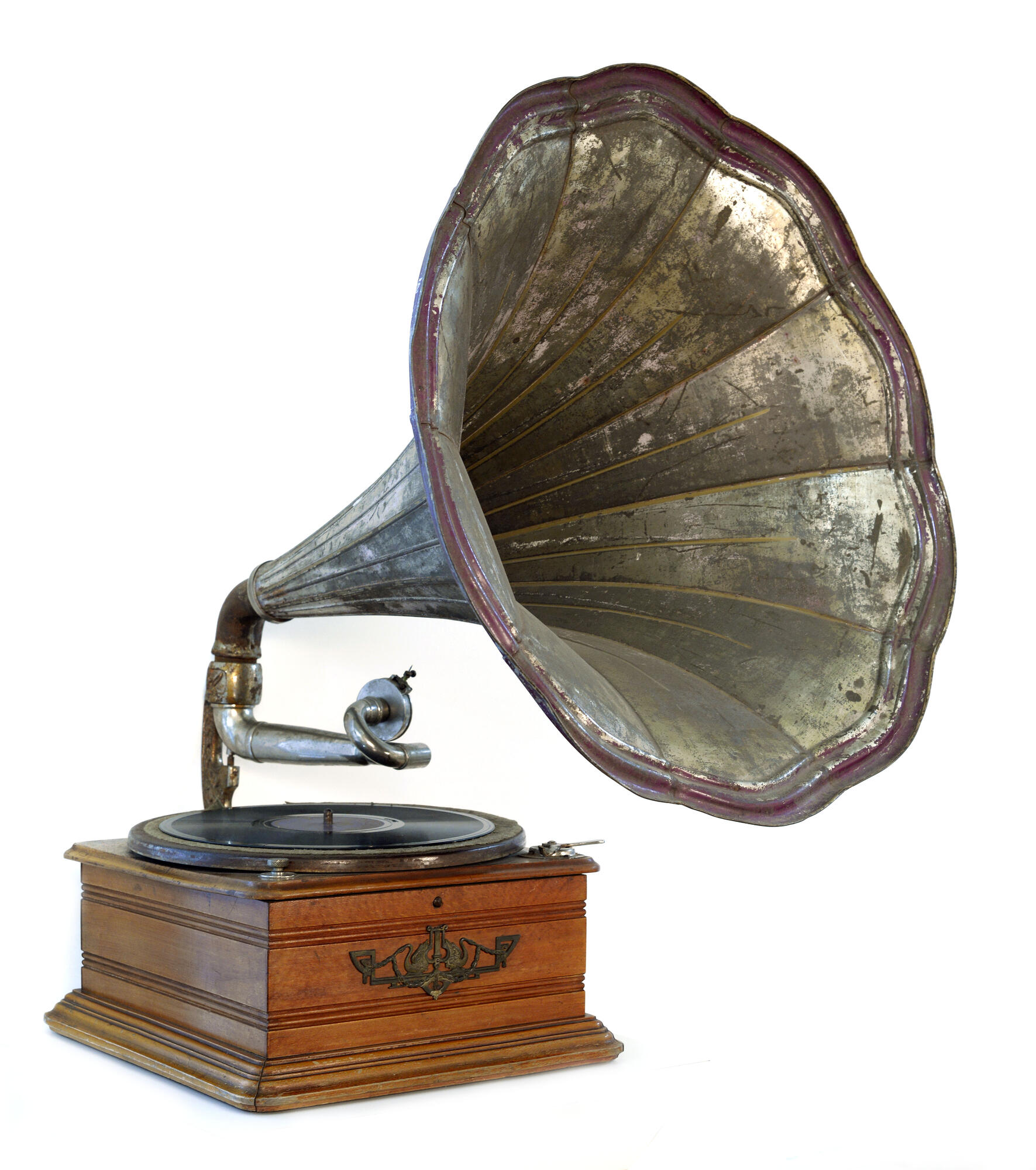


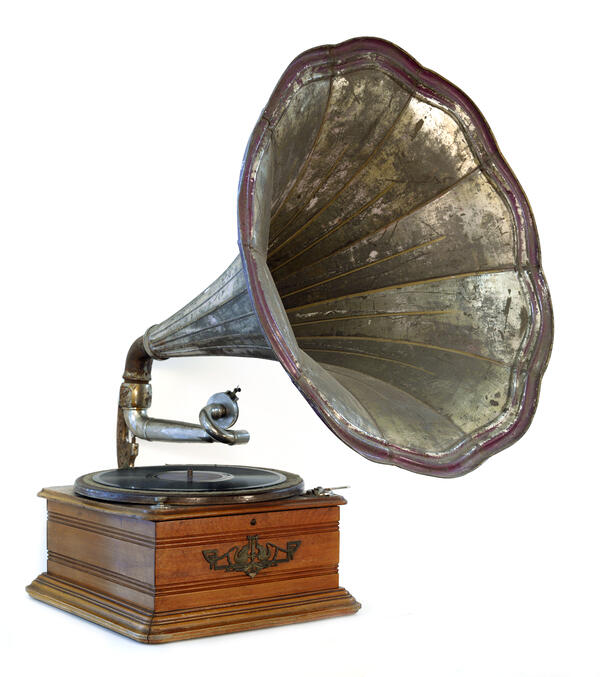
The museum’s exhibition contains a gramophone produced in Russia in the early 20th century. It belonged to Epitimia Fokina, a native of Oryol. The gramophone consists of a wooden case with bronze plates and a tin pipe.
In 1877, inventors Charles Cros and Thomas Edison independently of each other designed the first phonographs — an instrument for recording and reproducing sound. Another inventor, Emile Berliner, found out about Cros’ work and decided to try using discs instead of cylinders for recording and reproducing. He named his invention the gramophone and patented it on September 26, 1887.
The world’s first gramophone record was made of zinc. Later these records were made of ebonite, and then shellac was used for production. During the sound recording, a cutter attached to a vibrating and sound-receiving membrane, makes a spiral-shaped trace on the lacquer disc. This trace is transferred to the record. The gramophone needle moves in a spiral when it rotates, the membrane vibrates and this is how sound is produced.
The main advantage of the gramophone over the phonograph was transverse recording, which significantly reduced sound distortion. In addition to it, the first gramophones already sounded 16 times louder than the phonograph. The gramophone records were much easier to replicate than cylinders. In 1895, Berliner’s Gramophone Company was founded, which was the first company to produce them.
During the period from 1904 until 1906, the gramophone was improved. It became possible to play music quite clearly — both vocal parts and instrumental ones. In the United States and in Europe, including Russia, entrepreneurs opened their own enterprises producing gramophones and developing new similar devices.
In 1907, the French company “Pathé” introduced the first pathéphone (a portable gramophone). In 1925, Berliner Company, together with the Radio Corporation of America (RCA), created the first mass-produced electrophone (a musical instrument that produces sound using electronic circuitry).
The production of records with a variety of music became an industry of its own. In 1927, the world’s first sound film “The Jazz Singer” was released, the soundtrack of which was played with the help of a gramophone record. This technology was used in cinematography for several years before the spread of sound recording. Since the mid-1950s, gramophones and pathéphones have given way entirely to electrophones.
In 1877, inventors Charles Cros and Thomas Edison independently of each other designed the first phonographs — an instrument for recording and reproducing sound. Another inventor, Emile Berliner, found out about Cros’ work and decided to try using discs instead of cylinders for recording and reproducing. He named his invention the gramophone and patented it on September 26, 1887.
The world’s first gramophone record was made of zinc. Later these records were made of ebonite, and then shellac was used for production. During the sound recording, a cutter attached to a vibrating and sound-receiving membrane, makes a spiral-shaped trace on the lacquer disc. This trace is transferred to the record. The gramophone needle moves in a spiral when it rotates, the membrane vibrates and this is how sound is produced.
The main advantage of the gramophone over the phonograph was transverse recording, which significantly reduced sound distortion. In addition to it, the first gramophones already sounded 16 times louder than the phonograph. The gramophone records were much easier to replicate than cylinders. In 1895, Berliner’s Gramophone Company was founded, which was the first company to produce them.
During the period from 1904 until 1906, the gramophone was improved. It became possible to play music quite clearly — both vocal parts and instrumental ones. In the United States and in Europe, including Russia, entrepreneurs opened their own enterprises producing gramophones and developing new similar devices.
In 1907, the French company “Pathé” introduced the first pathéphone (a portable gramophone). In 1925, Berliner Company, together with the Radio Corporation of America (RCA), created the first mass-produced electrophone (a musical instrument that produces sound using electronic circuitry).
The production of records with a variety of music became an industry of its own. In 1927, the world’s first sound film “The Jazz Singer” was released, the soundtrack of which was played with the help of a gramophone record. This technology was used in cinematography for several years before the spread of sound recording. Since the mid-1950s, gramophones and pathéphones have given way entirely to electrophones.