

The rocks of the Polar Urals form the northern section of the Ural Mountains. They are located in the western part of the Yamalo-Nenets Autonomous Okrug, standing high and jutting out into the waters of the Arctic Ocean. These eternal polar cliffs are home to the natural riches of this northern region.
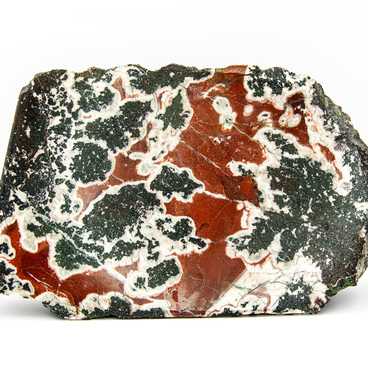
Gondite is a metamorphic (transformed) rock that serves as an ornamental raw material. Its name comes from the word “gondi” which was used to refer to ancient Indian tribes. In the Polar Urals, gondites were first discovered and described in 1987. These stones were found by the geologist Boris Marinovich in the West Kharamatolou block. The gondites of the Polar Urals are distinguished by their unique ornamentation, pattern, and coloring. Thanks to these qualities, they are as valuable as famous Ural gems, including jasper and rhodonite. In the Central and Southern Urals, gondites are not as beautiful and are not characterized by a variety of colors. Apart from gondite, the ornamental stones found in the Polar Urals include serpentinite, jasper, jasperoids, rhodingite, chrome-diopside, bronzitite, greenstone, eclogite, yenzorite, basalt, tuff, and tuffite.
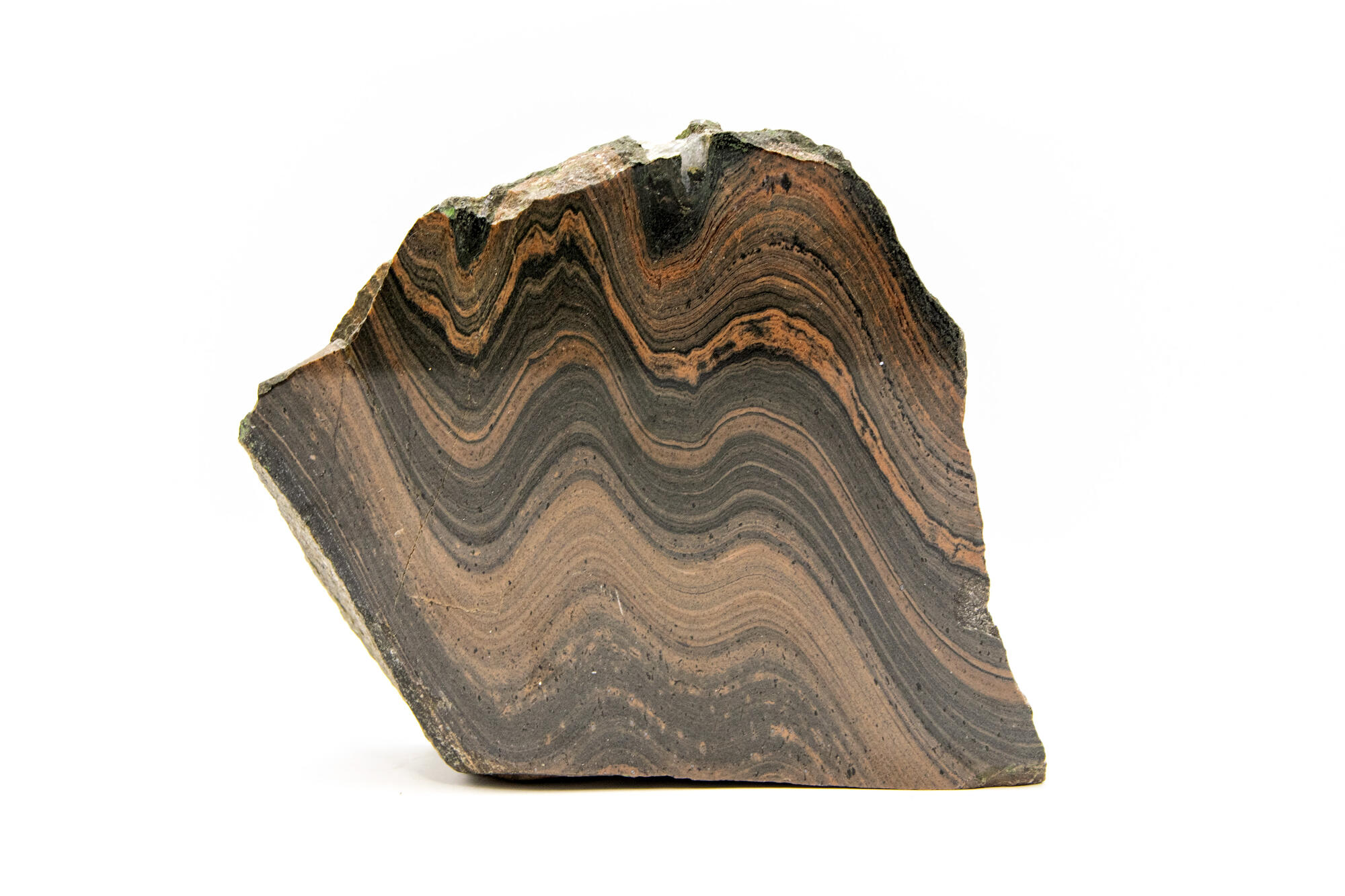
Yamal gondites are characterized by finely banded, speckled, and puckered structures with unique patterns. The color palette of gondites includes brown, dark brown, and black. The rocks have a fine-grained or medium-grained structure. The rock forming minerals are quartz and garnet, while accessory minerals include chlorite, epidote, amphibole, apatite, biotite, and ore minerals. Garnet is represented by a rare variety known as spessartine. Sometimes, the body of gondite features pinkish-brown speckles and large inclusions, for example, of the rare manganese mineral, rhodochrosite. In its color and mineral composition, this rock is most similar to the well-known Ural gem, rhodonite. Gondite is an exotic stone that resembles a fossilized tree in its structure. The finely banded, puckered gondite with its unique patterns has been found only on the banks of the Izykiryu River, a tributary of the Kharamatolou River.
The rock is amenable to
polishing and looks very impressive when used for making large products. This
sample was selected by experts of the Polar-Ural Mining and
Geological Expedition at the end of the 20th century. The rock is
sawn and polished.