#1

Head of a Bear, Bowed lute, Zither
#2
#3

#4
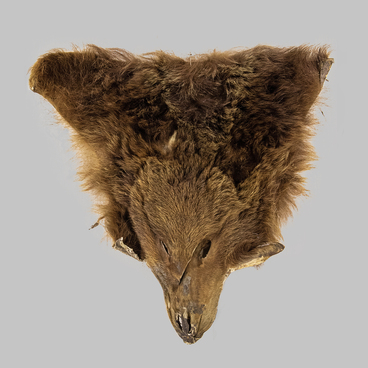
The exhibition showcased the head of a sacred bear that was killed, and which the Khanty and Mansi used to celebrate the so-called bear celebration. This is part of the bear cult: the celebration is held in honor of the animal that reigns in the Russian forests, or after a successful hunt for one. In the past, when it was not allowed to kill bears, bear celebration were held every winter for seven years in a row, followed by a seven-year break. The celebration began in December, at the winter solstice, and ended in March, at the vernal equinox.
During the celebration, the bear was represented by its skin, which was usually kept in a sacred barn. The first part of the celebration included songs and legends about the bear, and dances done by ancestors of the families or different lineages. Special ‘bear’ songs were performed. This was followed by ‘invocational songs’ and ‘bird dances’, during which both common deities and the ancestors of genealogical groups were invoked, as well as dances with sabers or swords. This part of the celebration was sacred.
During the celebration, the bear was represented by its skin, which was usually kept in a sacred barn. The first part of the celebration included songs and legends about the bear, and dances done by ancestors of the families or different lineages. Special ‘bear’ songs were performed. This was followed by ‘invocational songs’ and ‘bird dances’, during which both common deities and the ancestors of genealogical groups were invoked, as well as dances with sabers or swords. This part of the celebration was sacred.
The performers of dances, songs, and comic scenes - interludes - were men in disguise, including in women’s roles. On the last night of the bear celebration, they put on sacred performances, and portrayed the main spirits - the Big Spirit, Kaltasch ekwa, Otyr, and Mir susne khum, and performed dances dedicated to them. Dances and songs were performed to the accompaniment of a five-stringed musical instrument called a sankvyltap. The culmination of the bear celebration was considered to be a performance with dolls. These could be wooden figures controlled by the hands of a musician playing the sankvyltap. The puppet show carried a tremendous, inviolable significance, and ended with the death of the doll, which was perceived as an atoning sacrifice for killing the bear. During the last century, the Khanty and Mansi held a shortened version of this celebration, which was put on occasionally. It lasted five nights if a male bear was killed while hunting, and four nights if it was a female.
The celebration was held in the hunter’s house, in front the bear skin, with its head laid in the traditional ‘sacrificial’ position. The bear’s head was covered with a headscarf, with mugs made from birch bark or coins placed over the eyes, and the paws were decorated with rings and ribbons. In front of the bear, they put food, wine, and figurines fashioned from dough depicting deer. Then they performed “bear songs”, dances, and put on scenes satirically depicting boasters, cowards, thieves, and lazy, sloven people. An important place was occupied by the rites of renunciation, when the hunters, turning to the bear, said that they were not to blame for its death. Those celebrating covered their faces with birch bark masks. The bear meat was eaten on the last night using hands or special chopsticks (no metal objects were used). Evading culpability for eating the meat, the hunters cawed like crows, and purified themselves with water and fire.
#5
Date: late 19th century
Technique: taxidermy sculpture
Dimensions: 62×56 cm
Collection: Ethnography of Siberian Tatars and the Peoples in the Russian Far North
Copyright: Tyumen Province State Autonomous Cultural Institution “Tyumen Museum and Educational Association”, Structural Division “Tobolsk Historical and Architectural Museum Reserve”
Technique: taxidermy sculpture
Dimensions: 62×56 cm
Collection: Ethnography of Siberian Tatars and the Peoples in the Russian Far North
Copyright: Tyumen Province State Autonomous Cultural Institution “Tyumen Museum and Educational Association”, Structural Division “Tobolsk Historical and Architectural Museum Reserve”
#7
Bowed lute, a musical instrument
#6
#8
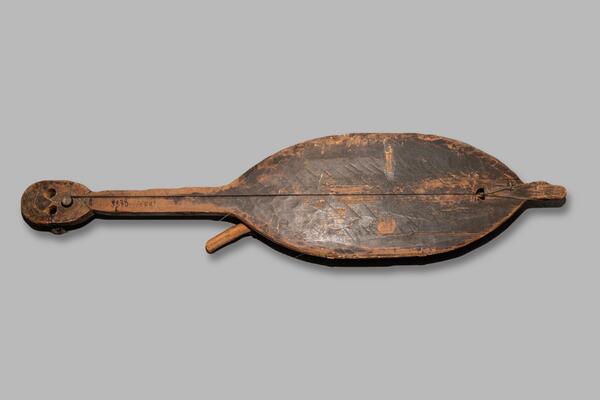
In 1915, the funds of the Provincial Museum received a bowed lute of the Northern Mansi from the Toboldinskiye Yurty of the Tobolsk province. Its national Mansi name is ‘nairne-yv’. Such a lute is not at all like the medieval one, which had four or five pairs of strings and was assembled from separate ribs of solid wood.
The Northern West Siberian lute is a scaphoid-shaped stringed musical instrument. The Tobolsk Museum exhibit is made by hand. The master hollowed out the case from a single piece of wood. The lute consists of a hollow body, a straight flattened neck, and a soundboard cut to the shape of the body. The master made the nose part elongated and completed it with a triangular protrusion. The instrument has only one, rarely two strings, which were made from horse hair or of sinews of an elk. The string was stretched using a peg in the form of a small rod.
The bow was a slightly curved stick in the shape of a bow with a tuft of twisted horsehair attached to the edges. One end of the bow expanded to form a handle. In order not to lose the bow, the master made a special through hole in the bottom of the lute for its storage.
Usually, the name of the instrument ‘nairne-yv’ is translated as ‘female tree’. This is due to the high-pitched sound that resembles a female voice. By playing the instrument, the musician really extracted sounds that resemble crying and convey all the shades of the human voice. When playing, the instrument was placed on one knee. Sometimes it was tied to the leg with a thread passed through a special hole in the body. The musician held the string with one hand and moved the bow with the other. Another technique of playing suggested that the musician would swing the lute towards the bow. Rosin, the pine resin used to rub the bow, was always close by on the back of the lute case.
Usually, the lute was used for chamber performance or played on it at festive ceremonies. One- or two-stringed bowed box-shaped lutes were called ‘nairne-yv’ by the North Mansi, and ‘nairne-har’ by the South Mansi. The Northern Khanty called the two-stringed bowed lute ‘ningyiv’, which also meant ‘female tree’, similarly to the Mansi ‘nairne-yv’.
The Northern West Siberian lute is a scaphoid-shaped stringed musical instrument. The Tobolsk Museum exhibit is made by hand. The master hollowed out the case from a single piece of wood. The lute consists of a hollow body, a straight flattened neck, and a soundboard cut to the shape of the body. The master made the nose part elongated and completed it with a triangular protrusion. The instrument has only one, rarely two strings, which were made from horse hair or of sinews of an elk. The string was stretched using a peg in the form of a small rod.
The bow was a slightly curved stick in the shape of a bow with a tuft of twisted horsehair attached to the edges. One end of the bow expanded to form a handle. In order not to lose the bow, the master made a special through hole in the bottom of the lute for its storage.
Usually, the name of the instrument ‘nairne-yv’ is translated as ‘female tree’. This is due to the high-pitched sound that resembles a female voice. By playing the instrument, the musician really extracted sounds that resemble crying and convey all the shades of the human voice. When playing, the instrument was placed on one knee. Sometimes it was tied to the leg with a thread passed through a special hole in the body. The musician held the string with one hand and moved the bow with the other. Another technique of playing suggested that the musician would swing the lute towards the bow. Rosin, the pine resin used to rub the bow, was always close by on the back of the lute case.
Usually, the lute was used for chamber performance or played on it at festive ceremonies. One- or two-stringed bowed box-shaped lutes were called ‘nairne-yv’ by the North Mansi, and ‘nairne-har’ by the South Mansi. The Northern Khanty called the two-stringed bowed lute ‘ningyiv’, which also meant ‘female tree’, similarly to the Mansi ‘nairne-yv’.
#9
Date: late 19th century
Technique: wood, carving, sawing, hollowing, gluing wood, drilling
Place: Toboldinskiye Yurty, Russia
Dimensions: 57.5×14 cm
Collection: Ethnography of Siberian Tatars and the Peoples in the Russian Far North
Copyright: Tyumen Province State Autonomous Cultural Institution ‘Tyumen Museum and Educational Association’, Structural Division ‘Tobolsk Historical and Architectural Museum Reserve’
Goskatalog Number: 4109786
Technique: wood, carving, sawing, hollowing, gluing wood, drilling
Place: Toboldinskiye Yurty, Russia
Dimensions: 57.5×14 cm
Collection: Ethnography of Siberian Tatars and the Peoples in the Russian Far North
Copyright: Tyumen Province State Autonomous Cultural Institution ‘Tyumen Museum and Educational Association’, Structural Division ‘Tobolsk Historical and Architectural Museum Reserve’
Goskatalog Number: 4109786
#11
Zither, a plucked musical instrument
#10
#13
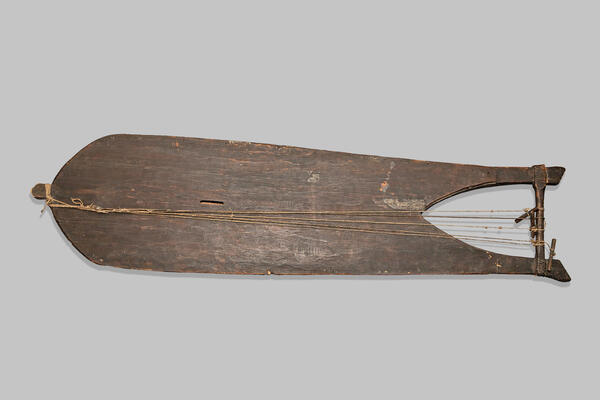
The national art of Khanty and Mansi, their rituals and holidays are inextricably linked with music. The earliest extant descriptions of music-making by the Khants and Mansi are fragmentary. They are contained in Russian chronicles of the 11th - 14th centuries. At the same time, representatives of these peoples have not lost their skills of playing their musical instruments. One of them, a five-string plucked zither with a resonator box, is exhibited at the Tobolsk Provincial Museum.
The museum’s zither is made by hand. The master hollowed out the body from a single piece of wood, gave it a classic navicular shape, and painted it in a dark color. The soundboard was cut from a thin plate, and it completely repeats the shape of the zither body. Closer to the sharp end of the case, the master made an elongated resonating through hole in the soundboard. The instrument has five strings made of animal tendons, which are attached at one end to a crossbar in the aft part of the body and are tuned using pegs in the form of small sticks.
Previously, the zither was an exclusively male instrument. It was accompanied when singing heroic songs about the exploits of legendary heroes. But recently, women have also started playing it more often. The zither was often played at a bear festival when singing solo or dancing. Each representative of the Khanty had at least two personal name songs of their own. A children’s song was given to the child shortly after birth, and an adult song was composed by themselves when they came of age. Some of the them also had a personal named instrumental playing. They were often picked up on five-stringed zithers. These musical amulets accompanied the owner all their lives.
Sometimes the harp was used by the shamans during rites instead of the tambourine. At the same time, shamans never sold the instrument, having believed that by selling it, they would sell their soul. Before moving the zither to another place, it was covered with a handkerchief and carried out of the house ‘head’ forward as a sign of special respect and reverence.
When playing, the zither was placed horizontally on the lap by turning it to one side. The musician’s hands rested lightly on the edge of the instrument. They played the instrument with two hands. One was used for pinching the strings, and the other for muffling them. Sometimes both hands of the musician participated in conducting the melody.
The museum’s zither is made by hand. The master hollowed out the body from a single piece of wood, gave it a classic navicular shape, and painted it in a dark color. The soundboard was cut from a thin plate, and it completely repeats the shape of the zither body. Closer to the sharp end of the case, the master made an elongated resonating through hole in the soundboard. The instrument has five strings made of animal tendons, which are attached at one end to a crossbar in the aft part of the body and are tuned using pegs in the form of small sticks.
Previously, the zither was an exclusively male instrument. It was accompanied when singing heroic songs about the exploits of legendary heroes. But recently, women have also started playing it more often. The zither was often played at a bear festival when singing solo or dancing. Each representative of the Khanty had at least two personal name songs of their own. A children’s song was given to the child shortly after birth, and an adult song was composed by themselves when they came of age. Some of the them also had a personal named instrumental playing. They were often picked up on five-stringed zithers. These musical amulets accompanied the owner all their lives.
Sometimes the harp was used by the shamans during rites instead of the tambourine. At the same time, shamans never sold the instrument, having believed that by selling it, they would sell their soul. Before moving the zither to another place, it was covered with a handkerchief and carried out of the house ‘head’ forward as a sign of special respect and reverence.
When playing, the zither was placed horizontally on the lap by turning it to one side. The musician’s hands rested lightly on the edge of the instrument. They played the instrument with two hands. One was used for pinching the strings, and the other for muffling them. Sometimes both hands of the musician participated in conducting the melody.
#12
Date: second half of the 19th - beginning of the 20th century
Technique: wood, carving, sawing, hollowing
Place: Tyumen Region, Russia
Dimensions: 95×24 cm
Collection: Ethnography of Siberian Tatars and the Peoples in the Russian Far North
Copyright: Tyumen Province State Autonomous Cultural Institution “Tyumen Museum and Educational Association”, Structural Division “Tobolsk Historical and Architectural Museum Reserve”
Goskatalog Number: 4109753
Technique: wood, carving, sawing, hollowing
Place: Tyumen Region, Russia
Dimensions: 95×24 cm
Collection: Ethnography of Siberian Tatars and the Peoples in the Russian Far North
Copyright: Tyumen Province State Autonomous Cultural Institution “Tyumen Museum and Educational Association”, Structural Division “Tobolsk Historical and Architectural Museum Reserve”
Goskatalog Number: 4109753
read morehide
00:00
00:00
1x
Head of a Bear, Bowed lute, Zither
Collection
Exhibition
0
 Point your smartphone camera to open in the app
Open in app
Share