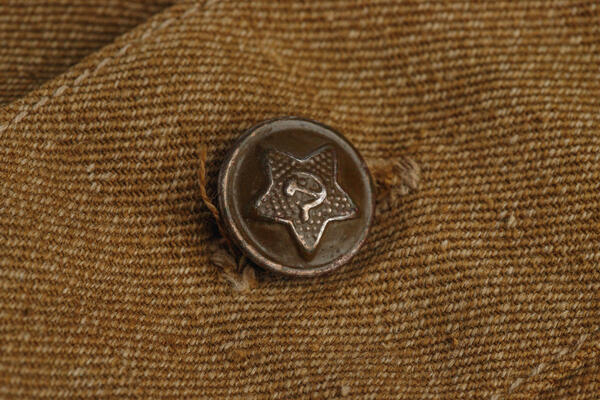
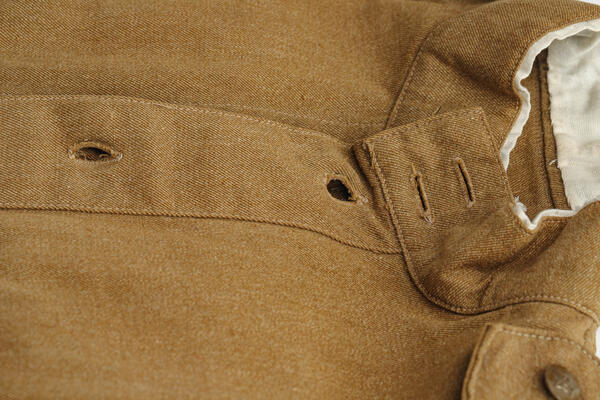
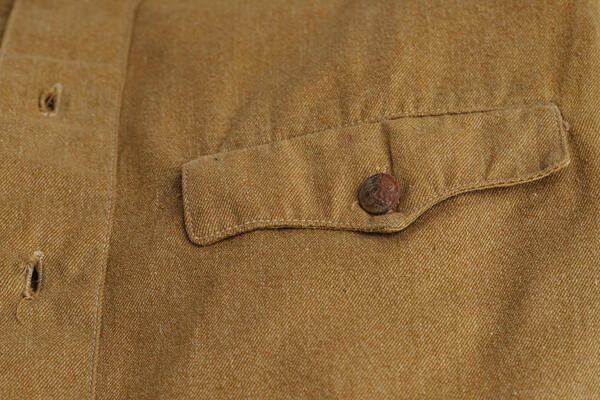
The tunic of a Soviet soldier from the Great Patriotic War is on display in the Museum of Intelligence Officer Nikolai Kuznetsov. This modest yet deeply significant artifact belonged to Fyodor Fyodorovich Shubin, who served as a technician in an aviation regiment.
Before the war, Fyodor Shubin worked at the Talitsa distillery in the Sverdlovsk Region. In 1941, he was drafted into the Red Army and sent to the front to defend his Motherland. He began his service with the 734th Aviation Regiment of the 61st Army on the Bryansk Front, where he worked as a senior aviation mechanic. Later, he was transferred to the 97th Guards Night Bomber Aviation Regiment, where he continued his duties as a mechanic and rose to the rank of Guard Sergeant.
During the war, Fyodor Shubin prepared 642 aircraft for combat missions, including 13 for particularly critical operations, as well as approximately 500 aircraft for special communications purposes. He marched alongside his unit along a heroic path — from the ruins of Stalingrad to the streets of Budapest. For his courage and dedication in the performance of military duty, he was awarded the Order of the Red Star, the Medal “For Military Merit,” and other state honors.
After the war, Fyodor Shubin returned to his hometown of Talitsa and resumed work at the distillery, where he remained for more than forty years, continuing to serve his country in peacetime.
In 1979, Antonina Andreyevna Marfina donated his tunic to the museum’s collection. This simple garment carries the memory of a Soviet soldier’s heroism and the quiet, selfless labor of an aviation mechanic. Its coarse fabric — faded by sun and steeped in the scent of engine oil — bears witness to countless hours spent on airfields amid dust, wind, and the thunder of enemy raids. Every patch, every seam is not merely a mark of time, but proof of perseverance, tireless work, and unwavering faith in victory.
The tunic was a standard element of the Soviet serviceman’s uniform: a shirt-style garment with a front-button closure, short sleeves, and a buttoned placket. Originally developed in the Imperial Russian Army, it was retained by the Red Army and became an enduring symbol of the everyday life of soldiers during the Great Patriotic War.