Font
Color
Graphics
Изображение точки

To see AR mode in action:

1. Install ARTEFACT app for iOS or Android;

2. Find the exhibition «House with the Mezzanine»

3. Push the «Augmented reality» button and point your phone's camera at the exhibit;

Скрыть точки интересаПоказать точки интереса
Показать в высоком качестве

Guillotine

Creation period
the 19th century
Place of сreation
the Russian Empire
Dimensions
25x35 cm
Technique
wood, metal, casting
0
Open in app
#2
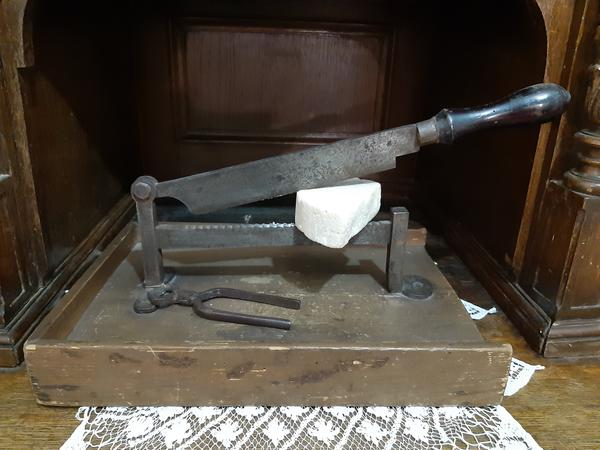
Before the invention of its granulated and refined varieties, sugar was sold in large blocks all over the world. They weighed between one pound and one pood, and crushing such a block required tongs and special guillotines. In the house, where the academician Ivan Petrovich Pavlov grew up, a sugar guillotine was stored in the sideboard, and only the father Pyotr could use it. The children did not have enough strength to crush a sugar block into pieces, but they were allowed to pick up sugar crumbs from a wooden box where a guillotine was fixed.

The poet and satirist Sergey Gorny was 30 years younger than Ivan Pavlov, but his recollections are very similar to the description of life in the Pavlov house,
#7
There was (shamefully hidden into the shade of the sideboard) a strange, guillotine-like device used to crush sugar. Back then refined sugar was still a rare occurrence. It was a novelty. They crushed a large block of sugar — they chopped off pieces of it — sometimes hit the fingers with a cleaver. Anything could happen. Then they picked up the crumbs and used a piece of paper to pour everything into a sugar bowl. The crushed sugar seemed frosty and snowy.
#6
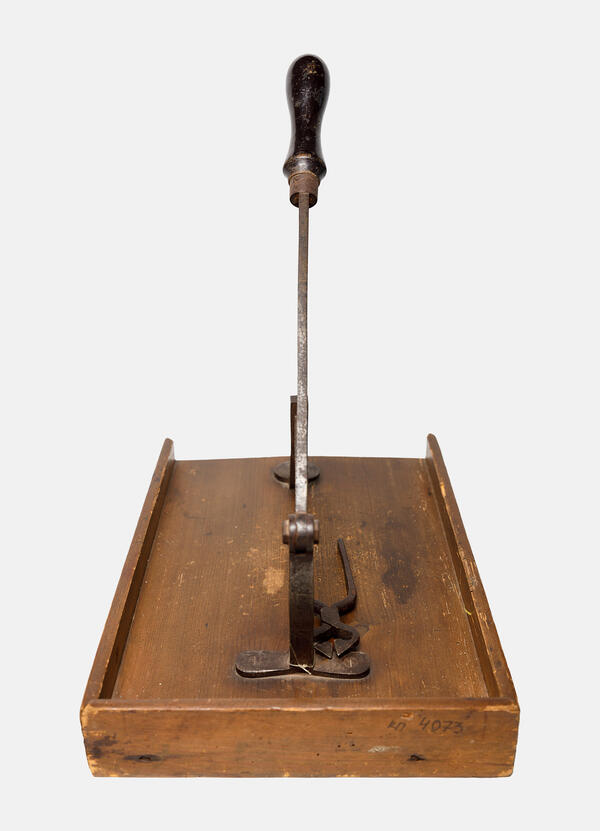
The guillotine for crushing sugar used the same principle as scissors. The two blades were mounted on a wooden base with low ledges that prevented sugar crumbs from falling to the floor. One serrated blade was 22 cm long and remained motionless, while the other, twice as long and with a wooden handle, had a fixed angle and could be moved. Its blade was sharpened on both sides. It was the upper knife that went down and crushed sugar into pieces.

In 19th-century Russia, sugar was a precious commodity, so during the tea ceremony, it was consumed frugally. Russians had many words to describe the various ways of eating sugar: it was taken together with tea, or after it, licked or combined with other foods. Nikolay Leykin, a Saint Petersburg writer and publisher of Anton Chekhov’s short stories, wrote about his childhood years,
#8

I remember that during my first confession the priests asked me, Who are your parents, are you deceiving them, are you secretly stealing sugar from the sugar bowl?

#9
Father Pyotr Pavlov could also ask such a question when his children came to confession.
#10
Guillotine
#4
View in the State Catalogue
read morehide
00:00
00:00
1x

Guillotine

Creation period
the 19th century
Place of сreation
the Russian Empire
Dimensions
25x35 cm
Technique
wood, metal, casting
0
Point your smartphone camera to open in the app
Share
VkontakteOdnoklassnikiTelegram
Share on my website
Copy linkCopied
Copy
Open in app
To see AR mode in action:
  1. Install ARTEFACT app for 
  2. iOS or Android;
  3. Find and download the «Paintings in Details» exhibition
  4. Push the «Augmented reality» button and point your phone's camera at the painting;
  5. Watch what happens on your phone screen whilst you flip through the pictures.
 
We use Cookies
Cookies on the Artefact Website. We use cookies to ensure that we give you the best experience on our website. If you continue without changing your settings, we'll assume that you are happy to receive all cookies on the Artefact website. However, if you would like to, you can change your cookie settings at any time.
Learn more about useHide
Content is available only in Russian

X

Нашли опечатку?...

%title%%type%