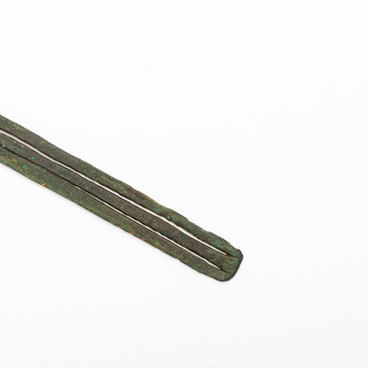
The iron knife was found during archaeological excavations at the Idnakar site in 2000. Since the olden times, a knife has remained one of the basic, universal and indispensable tools.
Early knives were made of stone and appeared in the Paleolithic era.
People used them for hunting, cooking and preparing materials. Later, for greater convenience, knives were given a handle — first from wound fragments of leather and tendons and then from wood and bone.
Knives are the most common finds at the Idnakar site. Local blacksmiths forged them from iron, which was extracted from bog ore. These knives differ in size; the length of blades ranges from 4 to 15 centimeters, but knives with a blade length of about 7 centimeters are more common.
Idnakar was the largest center of metallurgy and blacksmithing in the Prikamye region. Local skilled craftsmen forged agricultural and woodworking tools, household items, weapons, jewelry and talismans.
Local ore — limonite — was found along river banks and in swamps. Bog iron was mined in different ways. In winter, ice and bottom deposits containing the ore were cut out in places where the channels froze to the bottom.
In summer, another method was used: a log frame (like one to surround a well, only larger) was placed on the shore near streams or marsh lakes. A pit was dug in the center of the frame until the layer with ore was reached. As the log frame gradually sank into the ground, new logs were added, and the water filling the pit was periodically removed. It was dangerous to dig a pit without a log frame: at times, the wet soil crumbled so quickly that people working in the pit could rarely be saved.
The resulting ore was prepared for smelting: it was sieved, washed, fired and crushed. After this, it was mixed with charcoal and placed in a blast furnace. A blacksmith used pliers to take out a piece of bloom — soft and malleable iron — and knock out the remaining slag from it. This painstaking work resulted in blooming iron blanks, suitable for forging small knives.
Initially, iron objects discovered during excavations at the Idnakar site were badly damaged by rust, but they were restored to almost mint condition.