Udmurtskaya Pravda had several predecessors. The first of them was Izvestia Izhevskogo Soveta Rabochikh, Soldatskikh I Krestyanskikh Deputatov (‘The News of the Izhevsk Council of Workers’, Soldiers’ and Peasants’ Deputies’) which was first published in September 1917, just before the Great October Revolution. The newspaper continued to be published until the beginning of the anti-revolutionary uprising in Izhevsk in 1918.
The publication of the newspaper resumed in October 1918 at the division headquarters of red commander Vladimir Azin in Sarapul where the Borba (“Struggle”) newspaper was published. A month later, Borba started coming out at the Izhevsk Revolutionary Council under the name Izhevskaya Pravda. The newspaper existed until April 1919 when the city was occupied by Kolchak’s troops. Its publishing resumed with the arrival of the Red Army to Izhevsk.
Since end of July 1919, the newspaper started being published at the Izhevsk Regional Revolutionary Committee, and later, at the Executive Committee of the Workers’ and Peasants’ Party (Bolshevik party). In 1920, its print run was 8.000 copies: the newspaper became a popular title.
In the years 1920–1930, Izhevskaya Pravda became the most popular printed medium in Udmurtia. It covered the socialist competition, the achievements of collectivization and labor feats of the people of Izhevsk. Its daily print run reached 15.000 copies. It had string correspondents in various regions: they sent to the newspaper over 8.000 messages a year, and about half of them were published.
On the 15th of March of 1937, the name of the newspaper was changed to Udmurtskaya Pravda. Now, the newspaper covered the events in the whole Udmurtia. Articles about the life of top-quality workers, artists, participants of the Revolution, and events in towns and villages were published in it.
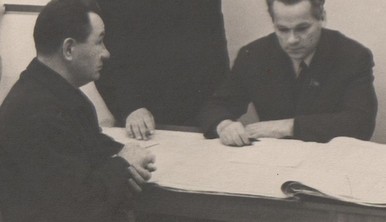
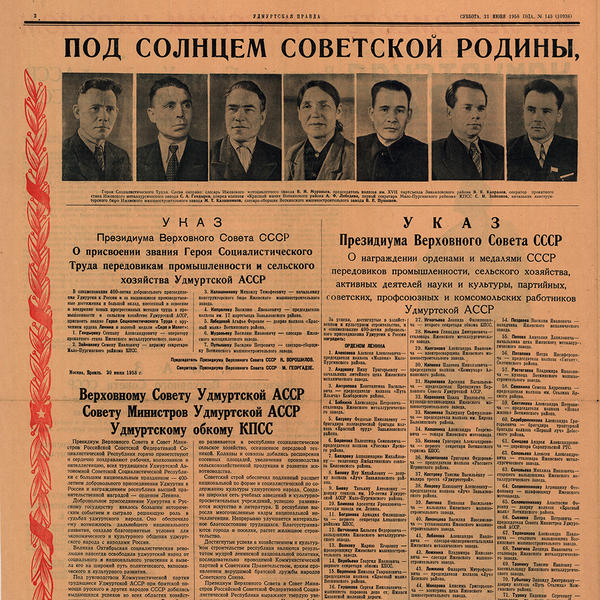
This Saturday edition, N. 145 of 21.06.1958, was dedicated to the honoring of new Heroes of Socialist Labor of Udmurtia. Among them, there was Mikhail Kalashnikov, head of the construction department of the Izhevsk mechanical engineering plant. He received an award for the creation of a light machine gun and modernization of the assault rifle.
The publication of the newspaper resumed in October 1918 at the division headquarters of red commander Vladimir Azin in Sarapul where the Borba (“Struggle”) newspaper was published. A month later, Borba started coming out at the Izhevsk Revolutionary Council under the name Izhevskaya Pravda. The newspaper existed until April 1919 when the city was occupied by Kolchak’s troops. Its publishing resumed with the arrival of the Red Army to Izhevsk.
Since end of July 1919, the newspaper started being published at the Izhevsk Regional Revolutionary Committee, and later, at the Executive Committee of the Workers’ and Peasants’ Party (Bolshevik party). In 1920, its print run was 8.000 copies: the newspaper became a popular title.
In the years 1920–1930, Izhevskaya Pravda became the most popular printed medium in Udmurtia. It covered the socialist competition, the achievements of collectivization and labor feats of the people of Izhevsk. Its daily print run reached 15.000 copies. It had string correspondents in various regions: they sent to the newspaper over 8.000 messages a year, and about half of them were published.
On the 15th of March of 1937, the name of the newspaper was changed to Udmurtskaya Pravda. Now, the newspaper covered the events in the whole Udmurtia. Articles about the life of top-quality workers, artists, participants of the Revolution, and events in towns and villages were published in it.
This Saturday edition, N. 145 of 21.06.1958, was dedicated to the honoring of new Heroes of Socialist Labor of Udmurtia. Among them, there was Mikhail Kalashnikov, head of the construction department of the Izhevsk mechanical engineering plant. He received an award for the creation of a light machine gun and modernization of the assault rifle.
The title of Hero of Socialist Labor was introduced in 1938 for ‘especially outstanding innovative activity’ in the areas of national economy, trade, transport and science. Heroes of Socialist Labor were awarded the Order of Lenin and a certificate from the Presidium of the Supreme Soviet of the USSR. Later, another award appeared, a golden medal named Serp i Molot (‘Sickle and Hammer’). For those who were awarded two Orders of Lenin, bronze busts were installed in their hometowns. Mikhail Kalashnikov was also twice awarded the title of Hero of Socialist Labor.