Font
Color
Graphics
Изображение точки

To see AR mode in action:

1. Install ARTEFACT app for iOS or Android;

2. Find the exhibition «Ugra Heritage»

3. Push the «Augmented reality» button and point your phone's camera at the exhibit;

Скрыть точки интересаПоказать точки интереса
Показать в высоком качестве

Belt set, Bardiche, Bronze snake

Exhibition
0
Open in app
#1
Belt set, Bardiche, Bronze snake
#17
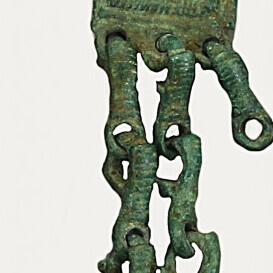
Belt set
#16
The belt is considered to be one of the oldest accessories in history. Nobody certainly knows when this piece of clothing appeared, but researchers note that one can see the horizontal stripes which divided the human figure in the images of the Neolithic period. So they assumed that people could put a belt on already in the New Stone Age.

In the Middle Ages, a belt, in addition to its main function, replaced pockets: they appeared as a piece of clothing, presumably, only in the 15th century. The belt was fastened with a buckle, which was a part of the belt set. People attached a pouch or necessary items such as a drill bit, awl, scabbard, amulets, tinderbox (firesteel) to it. There were both male and female belts. Children up to about six or eight years old were not belted.

Belt was used in many cultures during wedding and funeral ceremonies. Belt sets in the burial graves indicated the social status and property status of the deceased. The belt, richly decorated with overlays, showed the man’s belonging to the warrior class. Belt decorations were made of gold, silver and bronze. Metal was chosen depending on the society status of the owner of the belt.

The set from the archaeological collection of the museum complex was found in 2005 during exploration works on a site of the Middle Ages — the village of Sorovskoye 26 on the Bolshoy Salym River 100 kilometers west of the city of Nefteyugansk. The artifact appeared in the museum funds in 2011.

The set includes six bronze elements, which are made in the technique of casting and forging. Plaques were attached to the belt with the help of pins — special spikes located on the reverse side. Metal objects in the Middle Ages came to the territory of the Nefteyugansk District mainly from those regions where metalworking was one of the main crafts. Only princes and their bodyguards could have such expensive items. Therefore, it can be assumed that a wealthy man from military class is buried in the grave discovered in 2005.
#5
Полное наименование: Belt set
Дата создания: the 12th — 17th century
Техника: forging, casting
Коллекция: History and Art Museum Complex
Правообладатель изображений: History and Art Museum Complex
Размеры: 3.1×4.5×1 cm
Место создания: Volga Bulgaria
#15
Bardiche
#14
The exploration of Siberia lasted more than a century and was accompanied by numerous clashes with the local population. Russian troops were armed with several types of weapons. One of them was bardiche — a cold cutting pole weapon. A bardiche was similar to an ax with a blade in the form of an elongated crescent. Most often it was used in the 16th–17th centuries. Similar weapons were found in the Middle Ages in many Western European countries and countries of the East. When the bardiche appeared on the territory of Russia, scientists have not been able to reliably establish it until now. According to one of the versions, it happened in the first half of the 15th century.

Until the middle of the 17th century, a bardiche was made in suburban (city) and village smithies, not always from high-quality raw materials. This weapon was not expensive, so that every warrior could buy it. Masters made so many bardiches that they did not brand them, unlike individual swords.

The form of a bardiche was changing with time, but in 1656, a special decree was issued about introducing the unified standard. This allowed unifying the appearance of the weapon.

Western Siberia had no production of its own, so weapons with long shafts were supplied from the European part of Russia. Deliveries were irregular, and some garrisons lacked bardiches. In March 1675, there was a tsar decree forbidding local servicemen to sell bardiches to “any foreigners”. This measure helped tsar commanders to provide their troops with weapons.

The bardiche from the archeological collection of the History and Art Museum Complex has an unusual story. According to a legend, the Khanty attached a bardiche, lost by the Russian troops, to an oblas — a dugout canoe, and performed a ritual procession before fishing. It was believed that this ceremony opened the passage for fish from the Bolshoi Salym River to Syrkovy Sor Lake. Later, the tool was placed in the sacred barn of Sotym-te-ike and hold sacred as a weapon of the legendary bogatyr. The bardiche of the 17th century is the only Russian object displayed at the exhibition “Ugra Heritage”.
#9
Полное наименование: Bardiche
Дата создания: the 17th century
Техника: forging
Размеры: 56.7×13.6 cm; lower end of the blade — 9.5 cm
Коллекция: History and Art Museum Complex
Правообладатель изображений: History and Art Museum Complex
#12
Bronze snake
#13
The collection of the Nefteyugansk History and Art Museum Complex displays a bronze snake figurine. It was found during the excavations of the archaeological site — ancient settlement Sorovskoye 10 near Bolshoye Sorovskoye lake. This figure was given to the Museum of the Ob River in 2012. Nowadays, it is there on display. Researchers suggest that this zoomorph is approximately 1000 years old.

Sculptures of animals with relief ornaments are generally called “zoomorphic”. Scientists suggest that people began to make zoomorphic figures as soon as they mastered casting from bronze or iron. The first known finds date back to the 5th millennium BC. Idolized animals, predators, birds, and fantastic creatures, such as griffins were depicted most often. Zoomorphic style differed from simple images of animals — the subject had to conform with the decorative art instructions: the characters were placed symmetrically, the ornament had a certain rhythm, and the images of animals had conditionality.

Archaeologists most often find figures of bears, moose, or birds among all sculptures. Images of reptiles are rare.

Researchers believe that the images of medieval artistic metal plastics are connected with world order ideas of those years. For example, a bird — one of the most common characters — was perceived as an intermediary between the human world and the spirit world, a herald of the gods and a messenger of people. Reptiles symbolized the road to other worlds.

The snake from the Nefteyugansk collection was created in the 9th century AD. Medieval masters depicted it in a dynamic pose: a snake seems to be crawling. This effect is achieved due to a slightly curved body. The snake’s body is flat, and 14 oval reliefs are visible on its back. Medieval cast figures with a skeletal structure are often found on the territory of Western Siberia. Perhaps, the master has indicated the snake’s spine with patterned elements. The animal’s head is made more realistically: it is three-dimensional with detailed eyes, nostrils, and mouth. The realism and naturalness of the snake’s shape show the author’s skill.
#10
Полное наименование: Bronze snake
Дата создания: the 9th century
Техника: casting
Место создания: the Kama region
Размеры: 11×1×0.5 cm
Коллекция: History and Art Museum Complex
Правообладатель изображений: History and Art Museum Complex
#11
read morehide
00:00
00:00
1x

Belt set, Bardiche, Bronze snake

Exhibition
0
Point your smartphone camera to open in the app
Share
VkontakteOdnoklassnikiTelegram
Share on my website
Copy linkCopied
Copy
Open in app
To see AR mode in action:
  1. Install ARTEFACT app for 
  2. iOS or Android;
  3. Find and download the «Paintings in Details» exhibition
  4. Push the «Augmented reality» button and point your phone's camera at the painting;
  5. Watch what happens on your phone screen whilst you flip through the pictures.
 
We use Cookies
Cookies on the Artefact Website. We use cookies to ensure that we give you the best experience on our website. If you continue without changing your settings, we'll assume that you are happy to receive all cookies on the Artefact website. However, if you would like to, you can change your cookie settings at any time.
Learn more about useHide
Content is available only in Russian

X

Нашли опечатку?...

%title%%type%