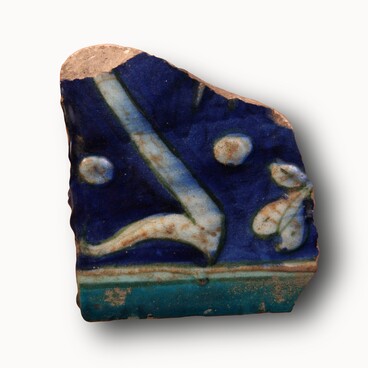
The Golden Hord, also known as Ulus Jochi, had its own school of architectural décor. It absorbed the traditions of several countries of the Middle East and Central Asia. In the 14th century, local craftsmen mastered perfectly the art of architectural decoration. One of the forms of décor in the Golden Horde architecture was ganch carving, which decorated the walls of the buildings.
Ganch — the alabaster of special composition — was used to produce carved and stamped tiles of greyish color. It was obtained by firing the raw material, which contained gypsum and clay. Ganch tiles had carved and openwork designs and decorated mostly the interior walls of buildings, which distinguished them from glazed ceramics that were used for exterior walls.
Such forms of architectural décor as ganch carving and plaster painting were much rarer in the Golden Horde settlements compared to other decorative features. Ganch was used for friezes and partitions.
Architectural decoration was enriched by terracotta elements with stamped ornaments, carved plaster window lattices and inlays on some parts of buildings. Floral, geometric, epigraphic and zoomorphic ornamentation patterns were the most common for ganch carvings.
Ganch carved tiles featured openwork ornamentation in the form of circles and curvilinear figures. The motif of regular geometric lattices, which was widespread in the medieval Muslim world, was often used too.
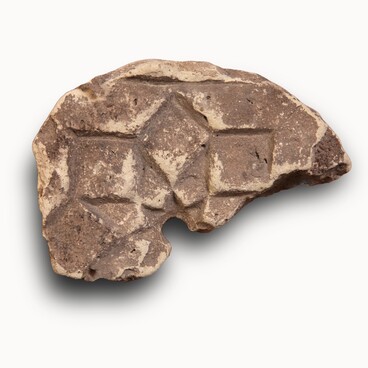
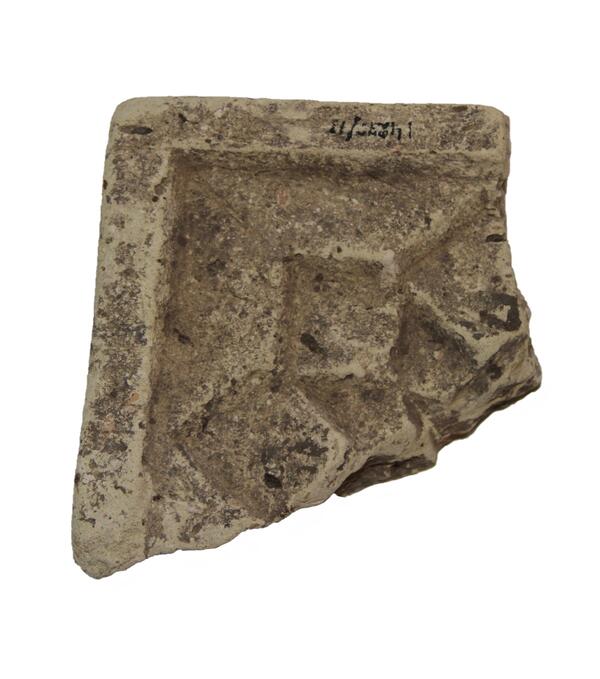
Archaeologists have also found ganch carved tiles with simple rhombic grid patterns. Ganch carving in the Golden Horde architecture was inherently more restrained compared to the multi-colored mosaics, majolica and glazed ceramics. Eventually, craftsmen in the Golden Horde started to paint ganch carvings in different colors and even to coat them with gold.
The exhibit from the collection of the Volgograd Regional Museum of Local History is a ganch tile with a geometric pattern. Experts have established that it was handmade between the 13th and 14th centuries.
Ganch — the alabaster of special composition — was used to produce carved and stamped tiles of greyish color. It was obtained by firing the raw material, which contained gypsum and clay. Ganch tiles had carved and openwork designs and decorated mostly the interior walls of buildings, which distinguished them from glazed ceramics that were used for exterior walls.
Such forms of architectural décor as ganch carving and plaster painting were much rarer in the Golden Horde settlements compared to other decorative features. Ganch was used for friezes and partitions.
Architectural decoration was enriched by terracotta elements with stamped ornaments, carved plaster window lattices and inlays on some parts of buildings. Floral, geometric, epigraphic and zoomorphic ornamentation patterns were the most common for ganch carvings.
Ganch carved tiles featured openwork ornamentation in the form of circles and curvilinear figures. The motif of regular geometric lattices, which was widespread in the medieval Muslim world, was often used too.
Archaeologists have also found ganch carved tiles with simple rhombic grid patterns. Ganch carving in the Golden Horde architecture was inherently more restrained compared to the multi-colored mosaics, majolica and glazed ceramics. Eventually, craftsmen in the Golden Horde started to paint ganch carvings in different colors and even to coat them with gold.
The exhibit from the collection of the Volgograd Regional Museum of Local History is a ganch tile with a geometric pattern. Experts have established that it was handmade between the 13th and 14th centuries.