#1
Fortune-telling kit
#2
#15
#3
The majority of residents of the Yenisei province were orthodox. However, the people preserved traditional rituals rooted in the pagan past. One of these traditions was fortune-telling. People wanted to know their future, so, despite the negative attitude of the church to such rites, the clergy failed to eradicate the tradition of learning the future with the help of mystical powers.
Young girls usually read the fortune for their betrothed. This had to be done on certain days, and one had to strictly follow the established rules. For example, fortune-telling often took place during the Yuletide period, which began on Christmas Eve, that is, on December 24, according to the old style, and lasted until Epiphany — on January 6. Besides, our ancestors told fortune on Butter Week, on Whit Monday, on St. John Baptist’s day. One of the main topics of fortune-telling for girls was marriage.
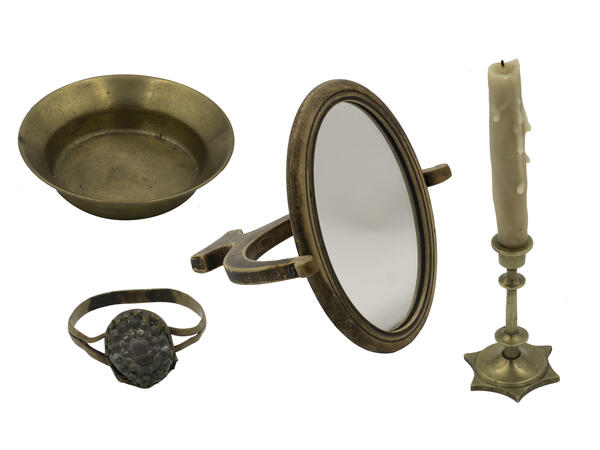
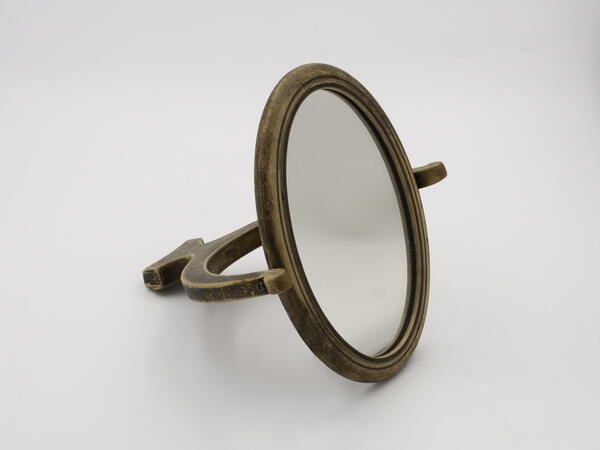
Various objects and devices, such as a mirror, were used for divination. In addition to the mirror, the fortune-telling kit presented in the museum has candlesticks, a plate, and a ring. With the help of these objects, it was possible to tell fortune in different ways. In the mirror, the girl tried to see the image of the future groom. Staying alone in the evening, after bathhouse, she would light candles on the sides of the mirror and sit down opposite it.
Sometimes two mirrors were used in this divination: the girl put them opposite each other and sat between them. Trying not to blink, she peered into the mirror, saying: ‘The betrothed and beloved, come to look in the mirror, show yourself, and look at me.’ Or even shorter: ‘Appear to me, my betrothed and beloved! ’ It was believed that at the moment when the silhouette of the betrothed appeared in the mirror, it was necessary to shout: ‘Keep away from me! ’.
If a girl wanted to find out the name of her betrothed, then a new object appeared during the fortune-telling. She would sit in front of the mirror and put a cup of water in front of her. Scraps of paper with men’s names were put around the circle of the cup. A thread was tied to the ring. Holding the thread by one end, the girl lowered the ring into the cup and slowly moved it over the names, waiting for the pendulum to start swinging or spinning.
In addition to the mirror, other fortune-telling objects were also used: spinning wheels and spindles, handkerchiefs, various kinds of flowers, and herbs that were woven into a crown. Many of the divinations have survived to this day. Modern girls resort to fortune-telling to find out their fate or the name of the future significant one. However, today divination no longer has that halo of mystery and mysticism, as before. It has become part of a custom, and sometimes a funny ritual or a pleasant pastime.
Young girls usually read the fortune for their betrothed. This had to be done on certain days, and one had to strictly follow the established rules. For example, fortune-telling often took place during the Yuletide period, which began on Christmas Eve, that is, on December 24, according to the old style, and lasted until Epiphany — on January 6. Besides, our ancestors told fortune on Butter Week, on Whit Monday, on St. John Baptist’s day. One of the main topics of fortune-telling for girls was marriage.
Various objects and devices, such as a mirror, were used for divination. In addition to the mirror, the fortune-telling kit presented in the museum has candlesticks, a plate, and a ring. With the help of these objects, it was possible to tell fortune in different ways. In the mirror, the girl tried to see the image of the future groom. Staying alone in the evening, after bathhouse, she would light candles on the sides of the mirror and sit down opposite it.
Sometimes two mirrors were used in this divination: the girl put them opposite each other and sat between them. Trying not to blink, she peered into the mirror, saying: ‘The betrothed and beloved, come to look in the mirror, show yourself, and look at me.’ Or even shorter: ‘Appear to me, my betrothed and beloved! ’ It was believed that at the moment when the silhouette of the betrothed appeared in the mirror, it was necessary to shout: ‘Keep away from me! ’.
If a girl wanted to find out the name of her betrothed, then a new object appeared during the fortune-telling. She would sit in front of the mirror and put a cup of water in front of her. Scraps of paper with men’s names were put around the circle of the cup. A thread was tied to the ring. Holding the thread by one end, the girl lowered the ring into the cup and slowly moved it over the names, waiting for the pendulum to start swinging or spinning.
In addition to the mirror, other fortune-telling objects were also used: spinning wheels and spindles, handkerchiefs, various kinds of flowers, and herbs that were woven into a crown. Many of the divinations have survived to this day. Modern girls resort to fortune-telling to find out their fate or the name of the future significant one. However, today divination no longer has that halo of mystery and mysticism, as before. It has become part of a custom, and sometimes a funny ritual or a pleasant pastime.
#4
Full name: Fortune-telling kit: a mirror on a mount
Date: the end of the 19th century
Technique: home-made
Place: Krasnoyarsk
Copyright: Krasnoyarsk Regional Museum of Local History
Dimensions: 30×15,7
Goskatalog Number: 10772374
#5
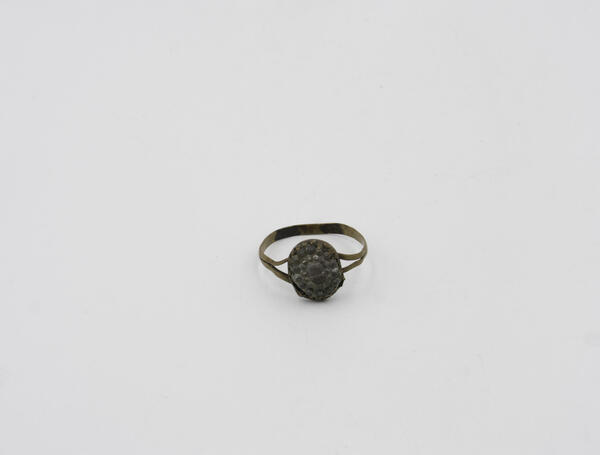
Fortune-telling kit: a woman’s ring
#16
#6
Our ancestors believed that in the period from Christmas to Epiphany (Yuletide), all predictions came true. It was a time of fortune-telling and mysterious rituals, during which people, without fear, called on evil spirits to find out their future, tell fortunes for the groom or find answers to questions that bothered them. Yuletide is the period when, according to legend, the souls of the dead returned to earth, hence the assumption that all divination would come true. According to the researchers, since ancient times, the Yuletide time in Russian culture had been perceived as good, cheerful, interesting, but at the same time — dangerous and hostile. According to custom, it was believed, evil spirits were active on these days.
It is important to note that when starting a fortune-telling ritual, participants often freed themselves from all sorts of amulets and even cursed themselves to increase the effect. In addition to Christmas and Epiphany, divination rites were sought to be held on St. George’s Day, Easter, Trinity, and St. John the Baptist’s day. The most popular rituals were fortune-telling for a future husband. It was believed, that before starting the ceremony, the girl had to take off her cross, bracelets, and belts, untie all the knots on her clothes, and let her hair down. An exception was made only for the ring, which was an important part of many rituals. For example, with a thread and a ring, the sex of the unborn child was learned: for this purpose, the ring was suspended on a thread and slowly lowered between the thumb and index finger. If the ring started spinning — a girl would be born. And if it swung like a pendulum from side to side — a boy.
People also believed that if one poured grain into a deep plate and put a ring there, one could find out how soon a girl would get married. To do this, unmarried women would sit in a circle and take turns picking up grains in their hand: the one who got the ring was destined to get married in the following year.
The wedding ring has always been endowed with a special magical power. It was believed that the accuracy of the prediction largely depended on what kind of ring was used. Usually, a very smooth ring was used for the rites. If an unmarried girl was telling fortunes, she asked for an engagement ring from a close relative. Married women used theirs.
The simplest and most popular way to find out the future with the help of an engagement ring was a “pendulum”. A thread or hair of the fortune-teller was tied to the ring, then the “pendulum” was fixed in the center and everybody looked in which direction it would rotate. For this, for example, one could write the names of the betrothed on paper and see which of them the “pendulum”would react to.
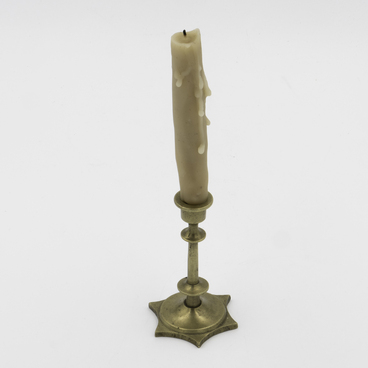
In addition to the ring, the fortune-telling kit on display in the museum collection there are candlesticks, a plate, and a mirror. With the help of these objects, a girl could tell fortune for the looks of the future groom or ask other questions that were important to her.
It is important to note that when starting a fortune-telling ritual, participants often freed themselves from all sorts of amulets and even cursed themselves to increase the effect. In addition to Christmas and Epiphany, divination rites were sought to be held on St. George’s Day, Easter, Trinity, and St. John the Baptist’s day. The most popular rituals were fortune-telling for a future husband. It was believed, that before starting the ceremony, the girl had to take off her cross, bracelets, and belts, untie all the knots on her clothes, and let her hair down. An exception was made only for the ring, which was an important part of many rituals. For example, with a thread and a ring, the sex of the unborn child was learned: for this purpose, the ring was suspended on a thread and slowly lowered between the thumb and index finger. If the ring started spinning — a girl would be born. And if it swung like a pendulum from side to side — a boy.
People also believed that if one poured grain into a deep plate and put a ring there, one could find out how soon a girl would get married. To do this, unmarried women would sit in a circle and take turns picking up grains in their hand: the one who got the ring was destined to get married in the following year.
The wedding ring has always been endowed with a special magical power. It was believed that the accuracy of the prediction largely depended on what kind of ring was used. Usually, a very smooth ring was used for the rites. If an unmarried girl was telling fortunes, she asked for an engagement ring from a close relative. Married women used theirs.
The simplest and most popular way to find out the future with the help of an engagement ring was a “pendulum”. A thread or hair of the fortune-teller was tied to the ring, then the “pendulum” was fixed in the center and everybody looked in which direction it would rotate. For this, for example, one could write the names of the betrothed on paper and see which of them the “pendulum”would react to.
In addition to the ring, the fortune-telling kit on display in the museum collection there are candlesticks, a plate, and a mirror. With the help of these objects, a girl could tell fortune for the looks of the future groom or ask other questions that were important to her.
#7
Full name: Fortune-telling kit: a woman’s ring
Date: the end of the 19th century
Technique: metal, glass
Place: Russian Empire
Copyright: Krasnoyarsk Regional Museum of Local History
Dimensions: Diameter — 2,2 cm
Goskatalog Number: 13214864
Date: the end of the 19th century
Technique: metal, glass
Place: Russian Empire
Copyright: Krasnoyarsk Regional Museum of Local History
Dimensions: Diameter — 2,2 cm
Goskatalog Number: 13214864
#8
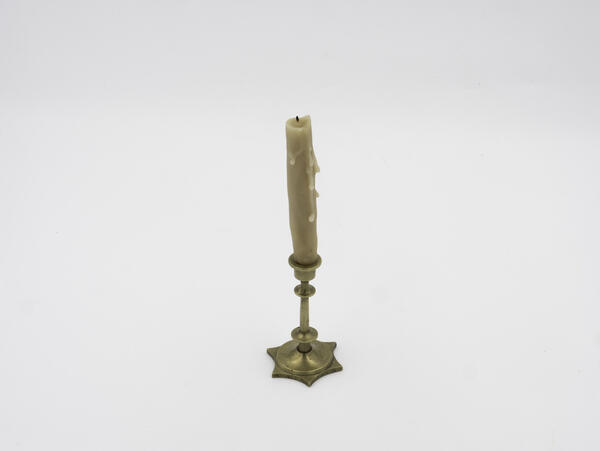
Fortune-telling kit: a candlestick
#17
#9
At Christmastide, during the period from Christmas to Epiphany, it was customary to tell fortunes with the help of various objects — jewelry, clothing parts, mirrors, towels, tablecloths, and candles. They served as a magical intermediary between a person and the other world. Traditionally, fortune-telling was included in the list of magical actions of pagan worship, which was condemned or prohibited by the official church and secular authorities.
Most often, unmarried girls were engaged in divination at Christmastide. They told fortunes for the future betrothed, about getting married soon, about a happy married life. The fortune-telling kit presented in the museum collection has candlesticks, a plate, a mirror, and a ring. Using these objects, one could tell fortunes in different ways, but lit candles were always an important part of the ritual. Even in modern times, when electricity has become available to people, the tradition of telling fortunes exclusively by candlelight has been preserved.
One of the most popular ways to find out the future was to light a candle, which was passed around among friends. Whoever had it extinguished in her hands would be the first to get married. Also, girls told fortunes with two mirrors and candles between the mirrors: while the candles were burning, girls tried to see the image of their betrothed in the mirror. An interesting fact was that women started the rituals with their heads uncovered, without a headscarf, since in this case, the veil was a guarding obstacle that prevented communication with spirits. In fact, divination with mirrors or water replacing the mirror surface required great courage. The fortune-tellers appeared in front of the mirror in an undershirt without a cross. The mystical fear of this rite was explained by the fact that the mirror surface could take the soul of the fortune-teller forever, and the mirror frame or the well beam was associated with the door to the other world.
Often, candles were considered a magical object that could tell a lot to the fortune-teller. For example, in order to check whether the young people were compatible, they lit two candles and looked at the flame. If both candles burned evenly, without crackling and soot, it meant that relations in the family would be calm and stable. If one of the candles began to crackle or smoke — it was a sign that one of the partners would soon have a change of heart towards the other. In general, as the researchers point out, the use of candles, logs, fire, and a stove as a guardian of fire in divination is also explained by their semantic load: fire symbolizes the sun’s energy and indicates the desired goal — enrichment, fertility, and prosperity.
Another well-known method of fortune-telling with a candle also required the use of a plate with water. The candle was lit and one waited for the flame to melt the wax at the base of the wick. After that one took the candle in the left hand and tilted it over the water, observing what shapes the wax left on its surface.
In addition to candles, other divination objects were used: spinning wheels and spindles, handkerchiefs, various kinds of flowers, and herbs that were woven into a crown. Many of the divinations have survived to this day and become part of a fun ritual that modern girls resort to for entertainment.
Most often, unmarried girls were engaged in divination at Christmastide. They told fortunes for the future betrothed, about getting married soon, about a happy married life. The fortune-telling kit presented in the museum collection has candlesticks, a plate, a mirror, and a ring. Using these objects, one could tell fortunes in different ways, but lit candles were always an important part of the ritual. Even in modern times, when electricity has become available to people, the tradition of telling fortunes exclusively by candlelight has been preserved.
One of the most popular ways to find out the future was to light a candle, which was passed around among friends. Whoever had it extinguished in her hands would be the first to get married. Also, girls told fortunes with two mirrors and candles between the mirrors: while the candles were burning, girls tried to see the image of their betrothed in the mirror. An interesting fact was that women started the rituals with their heads uncovered, without a headscarf, since in this case, the veil was a guarding obstacle that prevented communication with spirits. In fact, divination with mirrors or water replacing the mirror surface required great courage. The fortune-tellers appeared in front of the mirror in an undershirt without a cross. The mystical fear of this rite was explained by the fact that the mirror surface could take the soul of the fortune-teller forever, and the mirror frame or the well beam was associated with the door to the other world.
Often, candles were considered a magical object that could tell a lot to the fortune-teller. For example, in order to check whether the young people were compatible, they lit two candles and looked at the flame. If both candles burned evenly, without crackling and soot, it meant that relations in the family would be calm and stable. If one of the candles began to crackle or smoke — it was a sign that one of the partners would soon have a change of heart towards the other. In general, as the researchers point out, the use of candles, logs, fire, and a stove as a guardian of fire in divination is also explained by their semantic load: fire symbolizes the sun’s energy and indicates the desired goal — enrichment, fertility, and prosperity.
Another well-known method of fortune-telling with a candle also required the use of a plate with water. The candle was lit and one waited for the flame to melt the wax at the base of the wick. After that one took the candle in the left hand and tilted it over the water, observing what shapes the wax left on its surface.
In addition to candles, other divination objects were used: spinning wheels and spindles, handkerchiefs, various kinds of flowers, and herbs that were woven into a crown. Many of the divinations have survived to this day and become part of a fun ritual that modern girls resort to for entertainment.
#10
Full name: Fortune-telling kit: a candlestick
Date: the end of the 19th century
Technique: bronze
Place: Russian Empire, Moscow
Copyright: Krasnoyarsk Regional Museum of Local History
Dimensions: 7×4 cm
Goskatalog Number: 17473844
Date: the end of the 19th century
Technique: bronze
Place: Russian Empire, Moscow
Copyright: Krasnoyarsk Regional Museum of Local History
Dimensions: 7×4 cm
Goskatalog Number: 17473844
#11
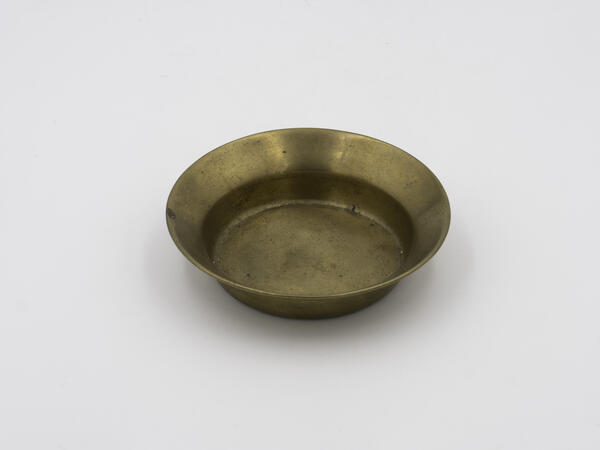
Fortune-telling kit: a plate
#18
#12
Fortune-telling on a saucer is an ancient folk ritual. Any small plate, like the one that is presented in the museum collection, was used for it. People have always wanted to know their future, tell fortunes for their betrothed or success in business — that’s why many rites and rituals have survived to this day. As a rule, divination was carried out during the Yuletide period, which began on Christmas Eve — December 24, under the Julian calendar, and continued until Epiphany — January 6, under the Julian calendar.
The saucer acted as one of the main objects during divination. Usually, a small flat plate without a pattern was used. These objects served as a magical intermediary between a person and the other world. One of the most famous ways of divination with a saucer was lot drawing: people put rings, earrings, buttons into a plate, and then covered them with a handkerchief and sang short songs, in which the fate of the one whose object the presenter would pull out, was indicated.
Often the saucer was used together with candles, and one would look at patterns the wax left on the water. Such divination on wax is considered one of the most ancient. For the ceremony, water was poured into a deep plate, and an engagement ring was placed on the bottom. The wax was heated, and one would say again and again: ‘Burn, burn, candle, melt, melt, wax, tell me the name of my betrothed.’ Then one would pour out the melted wax into the water in the center of the ring and carefully examine the shape of the frozen wax figure.
In addition to the saucer, the fortune-telling kit presented in the museum collection also has candlesticks, a mirror, and a ring. With the help of these objects, one could see the image of the future betrothed. Late into the small hours, after washing in the baths, the girl lit candles and sat down in front of the mirror. She needed to put a cup or saucer with water in front of her. Scraps of paper with men’s names were put around the circle of the cup or saucer. A thread was tied to the ring. Holding the thread by one end, the girl lowered the ring into the water and slowly moved it over the names, waiting for the pendulum to start swinging or spinning.
Modern girls also sometimes resort to divination, but it is rarely perceived as something mystical.
The saucer acted as one of the main objects during divination. Usually, a small flat plate without a pattern was used. These objects served as a magical intermediary between a person and the other world. One of the most famous ways of divination with a saucer was lot drawing: people put rings, earrings, buttons into a plate, and then covered them with a handkerchief and sang short songs, in which the fate of the one whose object the presenter would pull out, was indicated.
Often the saucer was used together with candles, and one would look at patterns the wax left on the water. Such divination on wax is considered one of the most ancient. For the ceremony, water was poured into a deep plate, and an engagement ring was placed on the bottom. The wax was heated, and one would say again and again: ‘Burn, burn, candle, melt, melt, wax, tell me the name of my betrothed.’ Then one would pour out the melted wax into the water in the center of the ring and carefully examine the shape of the frozen wax figure.
In addition to the saucer, the fortune-telling kit presented in the museum collection also has candlesticks, a mirror, and a ring. With the help of these objects, one could see the image of the future betrothed. Late into the small hours, after washing in the baths, the girl lit candles and sat down in front of the mirror. She needed to put a cup or saucer with water in front of her. Scraps of paper with men’s names were put around the circle of the cup or saucer. A thread was tied to the ring. Holding the thread by one end, the girl lowered the ring into the water and slowly moved it over the names, waiting for the pendulum to start swinging or spinning.
Modern girls also sometimes resort to divination, but it is rarely perceived as something mystical.
#13
Full name: Fortune-telling kit: a plate
Date: the end of the 19th century
Technique: dishing
Place: Krasnoyarsk
Copyright: Krasnoyarsk Regional Museum of Local History
Dimensions: 9,5×2 cm
Goskatalog Number: 17474235
Date: the end of the 19th century
Technique: dishing
Place: Krasnoyarsk
Copyright: Krasnoyarsk Regional Museum of Local History
Dimensions: 9,5×2 cm
Goskatalog Number: 17474235
#14
Ministry of Culture of the Russian Federation
read morehide
00:00
00:00
1x
Fortune-telling kit
0
 Point your smartphone camera to open in the app
Open in app
Share