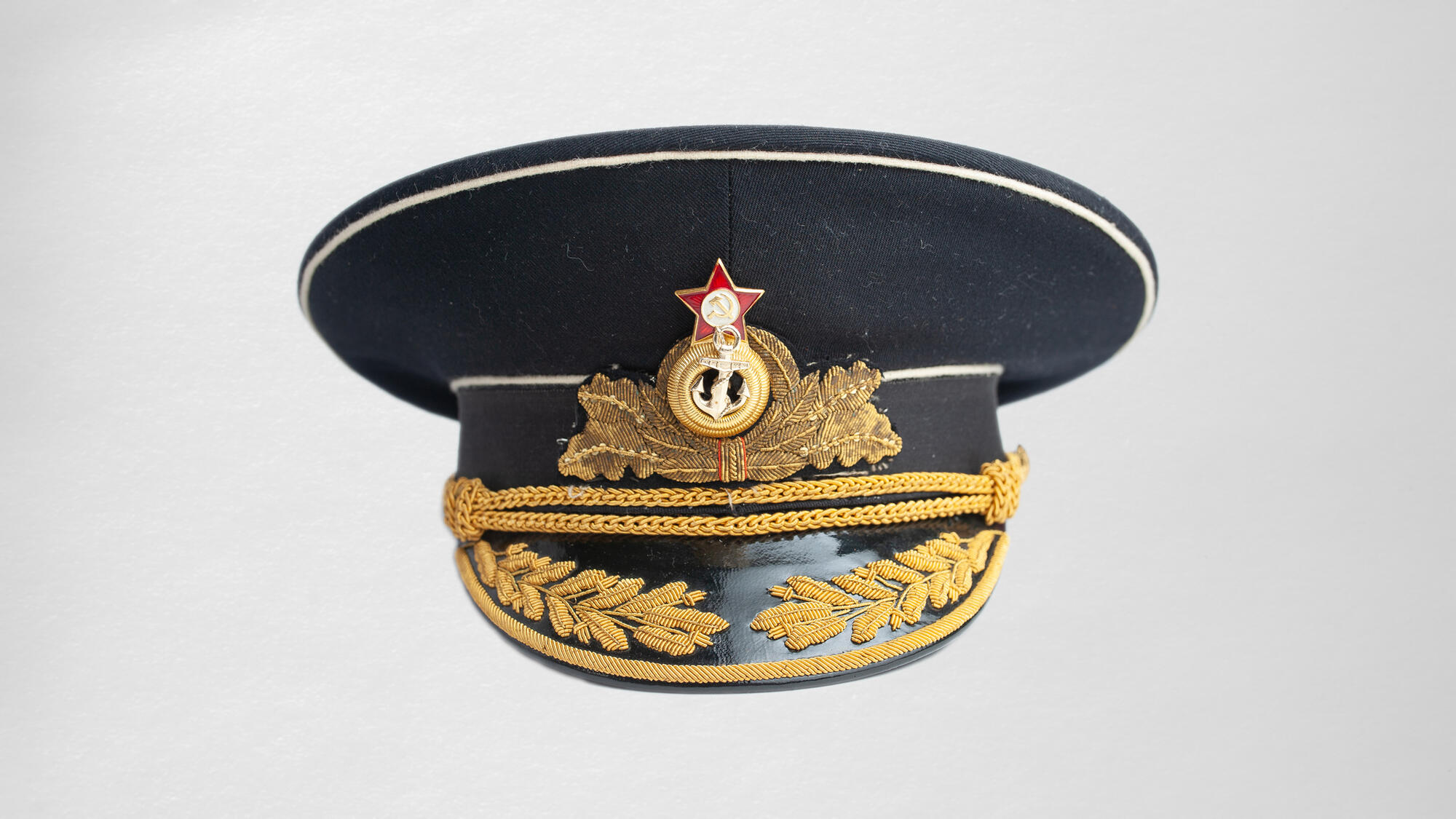


The black forage cap with a lacquered visor belonged to Rear Admiral Georgy Yarygin. The exhibit was donated to the museum by his widow Eugenia in 2004. The exhibition also displays the field tunic of Yarygin.
The forage cap was part of the military uniform in all armies of the Soviet and Russian armies, including the navy. Its centerpiece was a cockade, a gold emblem with a red star and a sea anchor. It was present on all hats regardless of rank. There were buttons on the sides with braided cords attached to them. The visor is crowned by two branches embroidered in gold.
In order to make the headwear hold its shape and not to crumple, a steel hoop or special rollers were put inside it. Cardboard gaskets were also added to the top and sides.
In the Navy, the hats had special summer replaceable covers, as the black headgear could get very hot in the heat.
Georgy Yarygin, a resident of Anzhero-Sudzhensk, spent more than 40 years in the Navy and rose to the rank of rear admiral — he was on a rearguard ship in the rear and commanded combat vessels from there. In the USSR Navy, this rank was established on May 7, 1940, and it corresponded to the rank of major general in the land forces and aviation.
Yarygin served both at sea and on land during the Great Patriotic War: first he served as an assistant chief of staff for reconnaissance, and then he was transferred to the Navy. There, Georgy Yarygin was an assistant commander of a minesweeper, a special purpose ship that detected and detonated mines.
For his military merits Yarygin was awarded two Orders of the Red Banner, the Order of the Great Patriotic War, 1st and 2nd classes, as well as two Orders of the Red Star.
After the war, Yarygin remained in service: from 1968 to 1973, he worked in the Pacific Fleet as the head of the Orgmobupravlenie — department, which was engaged in the organization of military training and recruitment.
In 1987, Georgy Yarygin retired in the rank of rear admiral. He died in 1998 in Moscow and was buried at the Troekurov Cemetery.
The forage cap was part of the military uniform in all armies of the Soviet and Russian armies, including the navy. Its centerpiece was a cockade, a gold emblem with a red star and a sea anchor. It was present on all hats regardless of rank. There were buttons on the sides with braided cords attached to them. The visor is crowned by two branches embroidered in gold.
In order to make the headwear hold its shape and not to crumple, a steel hoop or special rollers were put inside it. Cardboard gaskets were also added to the top and sides.
In the Navy, the hats had special summer replaceable covers, as the black headgear could get very hot in the heat.
Georgy Yarygin, a resident of Anzhero-Sudzhensk, spent more than 40 years in the Navy and rose to the rank of rear admiral — he was on a rearguard ship in the rear and commanded combat vessels from there. In the USSR Navy, this rank was established on May 7, 1940, and it corresponded to the rank of major general in the land forces and aviation.
Yarygin served both at sea and on land during the Great Patriotic War: first he served as an assistant chief of staff for reconnaissance, and then he was transferred to the Navy. There, Georgy Yarygin was an assistant commander of a minesweeper, a special purpose ship that detected and detonated mines.
For his military merits Yarygin was awarded two Orders of the Red Banner, the Order of the Great Patriotic War, 1st and 2nd classes, as well as two Orders of the Red Star.
After the war, Yarygin remained in service: from 1968 to 1973, he worked in the Pacific Fleet as the head of the Orgmobupravlenie — department, which was engaged in the organization of military training and recruitment.
In 1987, Georgy Yarygin retired in the rank of rear admiral. He died in 1998 in Moscow and was buried at the Troekurov Cemetery.