Font
Color
Graphics
Изображение точки

To see AR mode in action:

1. Install ARTEFACT app for iOS or Android;

2. Find the exhibition «At the Wellspring of Bashkir Oil»

3. Push the «Augmented reality» button and point your phone's camera at the exhibit;

Скрыть точки интересаПоказать точки интереса
Показать в высоком качестве
#1
Jointer plane
#2
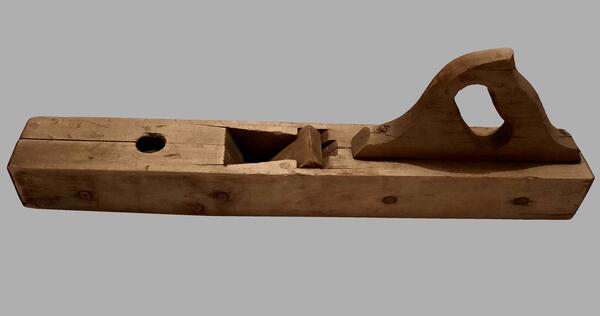
The material most commonly used in the construction of oil facilities in the IshimbAy region during the 1930s was wood. For this reason, local carpenters, joiners, and construction workers could often be seen armed with jointer planes like the one stored in the collection of the IshimbAy Museum of History and Local Lore.

The jointer plane is a hand-held carpentry tool designed for fine shaving, as well as for flattening large surfaces and jointing separate pieces. It is used once the wood has been treated with a jack plane and a hand plane. In its design, the tool looks like a longer type of a hand plane that has been fitted with a double blade.

The jointer plane is intended for achieving a high-quality surface finish when working long pieces: for example, when straightening the edges of boards before gluing them together. Smaller surfaces are usually worked with the shorter and narrower semi-jointer plane. The front of the jointer plane’s body has a lever cap that loosens the blade when hit with a wooden mallet. Additionally, the body of the jointer plane is fitted with a handle that sits behind the blade.

When a jointer plane is used on an initially uneven surface, the shavings come out as small pieces; however, with subsequent passes, they become continuous, indicating that the surface is getting smoother. The jointer is considerably longer than the other types of planes—the jack plane and the hand plane—and its blade is positioned at a 45-degree angle. Some jointer planes also come fitted with a chipbreaker, which is a component that breaks apart wood shavings and removes them from the work surface.

The jointer plane goes back centuries. Archaeologists date the oldest known tool of a similar type, a hand plane, to the 4th or 3rd century BC, and based on the other archaeological finds, at least some components used in wood planing had come into use even earlier. The design of the hand plane has remained unchanged; however, a wide variety of its types have since been designed, including the draw shave, the compass plane, the bead plane, the jointer plane, the finishing plane, the jack plane, the shoulder plane, the rebate plane, the router plane, and a lot more.
#3
Дата создания: 20th century
Автор: unknown
Техника: wood, metal, assembly
Размеры: 16.5 cm x 6.5 cm x 50 cm
Коллекция: Miscellaneous
Правообладатель изображений: Ishimbay Museum of History and Local Lore
#5
#4

Mudbrick

#6
The first geologists searching for oil in the vicinity of the present-day city of IshimbAy as far back as 1929 were quartered mainly in peasant huts. In addition to the usual tents, the first dugouts, barracks, and mudbrick houses could also be seen popping up next to derricks after the launch of exploratory drilling works. Such housing was built in an unregulated fashion and with the use of primitive techniques since it was unknown at the time whether the site would turn out to be suitable for oil production.

After the first oil gusher erupted from a well near the village of IshimbAevo in May 1932 and the future prospects of oil production became clear, thousands of workers flocked to these parts. The first 20 houses were built for them in the summer of that same year. However, there was still a dire shortage of housing, as the population of IshimbAevo rose from 147 in 1931 to as many as 7,000 in 1936. In 1937, Ishimbay had an average of just 2.5 square meters of living space per person. By early 1940, there were over 23,000 people living in the city of IshimbAevo. At the time, the city had 40,000 square meters of housing, but only four wooden houses were two-story high.

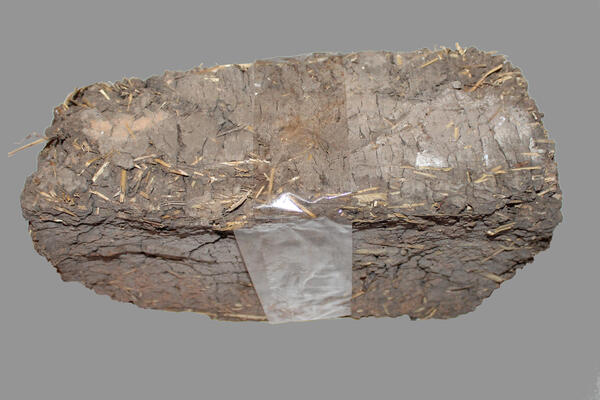
Some areas of IshimbAy still have mudbrick buildings that have been preserved to this day. In the 1930s, many inhabitants of the Ishimbay region even believed mudbrick to be the most practical building material. Mudbricks are made of clay and straw with the addition of water; however, there are no exact proportions or a complete list of components since the composition of this man-made stone can vary drastically depending on the characteristics required of it.

The main ingredient of any mudbrick is clay, with preference being given to types with medium plasticity. The initial viscosity of the substance can vary, which is why, if necessary, a certain amount of water is added to make the material easier to mix. It is also common to add fillers to hold the dried clay together, increase its durability, and slightly improve its heat conductivity. Historically, fibrous plants and even manure could serve as such component, but today it is more common to use finely chopped straw or chaff, the waste product of threshing. Components like these were certainly used in the past, whereas today mudbricks can contain a variety of additives that significantly improve some of their properties.
#7
Дата создания: 1930s
Автор: unknown
Техника: clay, straw
Размеры: 10 cm x 15 cm
Коллекция: Miscellaneous
Правообладатель изображений: Ishimbay Museum of History and Local Lore
#8
#9

Hand plane

#11
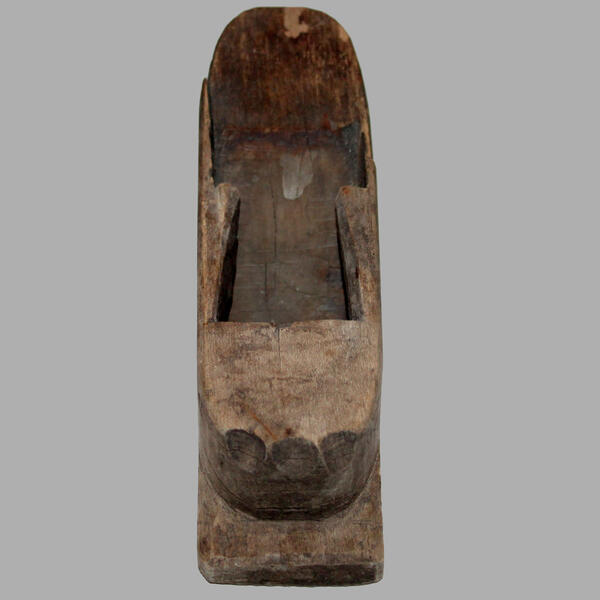
Planes were essential in the construction of oil field facilities in the village of IshimbAevo in the 1930s, and are still a highly widespread woodworking tool to this day. Collection of the IshimbAy Museum of History and Local Lore contains an example of a simple wooden single-blade hand plane like the ones used by Ishimbay construction workers and carpenters.

Planes are used for flattening wood surfaces after sawing or after treating them with the jack plane, a tool for the initial rough dressing of boards. The cutting edge of the plane blade is straight and slightly rounded at the corners in order to prevent it from leaving marks when planing wood surfaces. However, the absence of the special component known as the chipbreaker or the cap iron in a plane can sometimes result in the jagging, tearing, or chipping of the worked surface. The blade extends about 1 mm beyond the base of the plane.

The plane still remains one of the most popular tools among both professional and amateur woodworkers. It comes in a great variety of types. Some of them are no longer in use today, but it is still quite interesting to know how the planes used by the craftsmen of old looked and what possibilities they could offer. In the late 19th century, carpenters distinguished four types of planes based on their country of origin: these included English, German, French, and American planes. The most widespread type in Russia was the German plane. Even the Russian word for ‘the plane, ’ ‘rubanok, ’ as well as the names of all other tools of this kind (including ‘the jointer plane, ’ or ‘fuganok’; ‘the shoulder plane’, or ‘zenzubel’; ‘the rebate plane’, or ‘falzgebel’; and many others) come from German.

German and French planes did not differ much from the models commonly found in Russia. The English plane had a wider and shorter body with rounded sides for lighter weight and easier grip. The opening in the bottom part of the tool’s body was moved forward and positioned at an angle, greatly facilitating its use. American planes often had cast iron bodies with a carefully polished front side. The main advantage of metal planes was their highly practical and convenient way of securing the blade with screws and springs, rather than a wedge, an additional piece that had to be hammered into the plane with a mallet.

However, American planes had their drawbacks: cast iron tools were heavy to move, and the friction of cast iron on wood was greater than that of wood on wood. To overcome this disadvantage, manufacturers reduced the area of the friction surface and the tool’s weight. This was achieved by replacing cast-iron bodies with wooden ones, leaving only small metal inserts for securing the blade.
#10
Дата создания: 20th century
Автор: unknown
Техника: industrial production
Размеры: 5.3 cm x 6 cm
Коллекция: Miscellaneous
Правообладатель изображений: Ishimbay Museum of History and Local Lore
#12
#13

Drawknife

#15
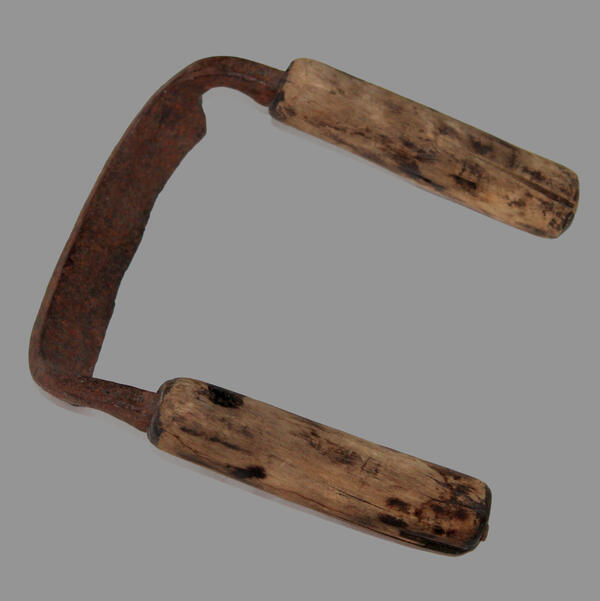
In the 1930s, during active construction in the oil village of IshimbAevo, workers often used drawknives. The drawknife is an ancient carpentry tool that consists of a straight or curved blade with handles at each end, and is designed for debarking logs, as well as for their initial rough dressing. There are two main types of drawknives – the curved and the straight blades, – while the collection of the IshimbAy Museum contains an example of the in-between variant: the semi-curved drawknife.

The drawknife was often used for debarking logs when felling trees: it allowed to peel bark at the edge of the bast without damaging the wood itself, while at the same time smoothing out the log’s surface, as well as shaving off any irregularities and small knots. Wood becomes light in color when treated with a drawknife, and all traces of bark are completely removed from its surface. That is why, for example, the walls of a log house that have been treated with a drawknife do not require any additional sheathing or finishing, and display the wood’s natural beauty.

During debarking, the removal of bark, the drawknife is drawn from the wider part of the tree trunk, the butt end, towards the top, so as not to leave any irregularities or jagging on the wood’s surface. When using an axe for debarking, the carpenter is very likely to chip or notch the wood. Not only does it ruin the wood’s appearance, but also increases the chance of its infection and, consequently, the deterioration of its properties. Conversely, logs with a solid, dense, and smooth surface can last remarkably long.

Drawknives were also used for removing wavy irregularities left on hewn surfaces after they had been treated with an axe, as well as for bringing the smoothness of wood surfaces to perfection. With its help, carpenters planed walls, roofing boards, doors, shutters, as well as door and window frames. Such structural elements were only planed in small quantities to be used for interiors of homes or churches, as drawknives are very difficult to work with, significantly more difficult than hand planes.

Straight surfaces were treated with straight drawknifes, while curved blades was used for round corners. Door and window frames, doors, boards and other similar structural elements were planed along the grain, while walls were planed at an angle of about 60 degrees relative to the log’s surface. Since the logs used for walls had sloping grain, they were planed in two directions, with one half of the log being planed in one direction, and the other half in another. Once it was planed with a drawknife, the surface required no additional treatment.
#14
Дата создания: 20th century
Автор: Unknown
Техника: Craft production
Размеры: 18 cm x 17 cm
Коллекция: Miscellaneous
Правообладатель изображений: Ishimbay Museum of History and Local Lore
#16
#17

Bead plane

#19
Beading is a woodworking technique that enables making ornamental cuts and creating various decorative elements. For example, it is used to make door panels—the decorative recesses that are often rectangular and look much better than a simple bevel.

The tool that is designed to work the wood in this way is accordingly named the bead plane. In a factory environment, all beading work is often carried out by huge machines that are operated manually or via computers; at home, on the other hand, beading is done with a completely different tool, which looks like and is a type of a hand plane.

The bead plane possesses a number of characteristics that distinguish it from the ordinary hand plane. First of all, it has a different shape. Its base, the sole, is ornately shaped: for example, the sole of the plane kept in the collection of the IshimbAy Museum of History and Local Lore has a clearly visible depression shaped like a strip. The purpose of the sole’s complex shape is to transfer this pattern to the worked piece. Secondly, the bead plane is fitted with sharp movable blades that are positioned along the tool’s sole at an angle that allows it to carefully remove layers of material in accordance with the set matrix. With the help of the bead plane, a flat board can be decorated with a wide variety of ornate elements, including ordinary grooves, as well as protrusions and depressions of different sizes, curves, and notches. When using the bead plane, it is essential to apply a consistent force to the workpiece and follow a clear path.

Beading is mostly used when working with wood, as this technique involves the removal of different layers of material one at a time to shape a decorative piece. There is a wide variety of decorative elements that can be applied to door designs with the use of beading, including panels, hinges, and architraves. Beading helps create smooth curves, wavy patterns along the end cut of the wood, and a variety of intricate depressions—the woodworking opportunities offered by this tool are only limited by the imagination of its user. Armed with it, you can create a unique piece that will be an integral part of any interior.
#18
Дата создания: 20th century
Автор: Unknown
Техника: Industrial production
Размеры: 7.5 cm x 26.5 cm
Коллекция: Miscellaneous
Правообладатель изображений: Ishimbay Museum of History and Local Lore
read morehide
00:00
00:00
1x
Point your smartphone camera to open in the app
Share
VkontakteOdnoklassnikiTelegram
Share on my website
Copy linkCopied
Copy
Open in app
To see AR mode in action:
  1. Install ARTEFACT app for 
  2. iOS or Android;
  3. Find and download the «Paintings in Details» exhibition
  4. Push the «Augmented reality» button and point your phone's camera at the painting;
  5. Watch what happens on your phone screen whilst you flip through the pictures.
 
We use Cookies
Cookies on the Artefact Website. We use cookies to ensure that we give you the best experience on our website. If you continue without changing your settings, we'll assume that you are happy to receive all cookies on the Artefact website. However, if you would like to, you can change your cookie settings at any time.
Learn more about cookie useHide
Content is available only in Russian

X

Нашли опечатку?...

%title%%type%