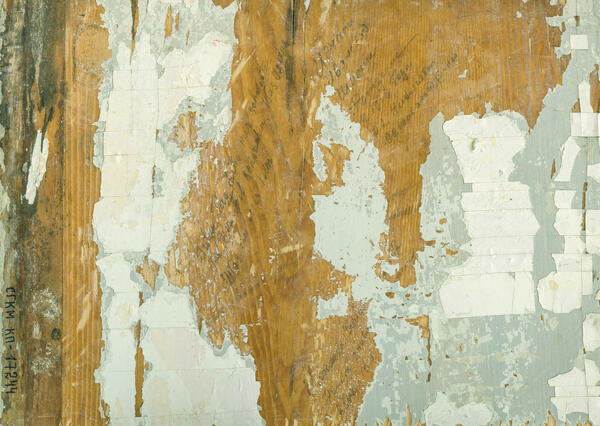
The archives of the Severodvinsk Museum contain a fragment of the door to the bathroom of a residential apartment on Lenin Avenue. On it you can see the inscriptions of the prisoners of the Yagrinsk forced labor camp of the late 1940s.
In the summer of 2002, one of the residents of Severodvinsk began repairing his bathroom. They decided to cut the old doors for firewood and take them to their country house. But when the work began, a piece of paint chipped off, and under it the owners saw handwritten letters. With the help of a chisel, it was possible to remove the paint from a larger area and with it a fragment of an inscription in German was exposed. A fragment of the wooden door was handed over to the museum, and the staff began to study the history of German inscriptions. Unfortunately, the full text of the inscription, except for the words ‘Liebe sister’ (‘Dear sister’), will never be restored — it was burned in the stove at the Severodvinsk dacha.
The house where the door was installed was built in 1949. From 1944 to 1948, a prisoner of war camp was allocated in the structure of Yagrinlag — prisoners of Germans, Romanians, Hungarians worked on the construction of the city. Traces of prisoners’ stay are regularly found during the repair of houses and apartments of the old housing stock in Severodvinsk. They took part in the development of the city in the area bounded by the streets of Pervomaiskaya — Profsoyuznaya — Severnaya (Tortsev) — Arkticheskaya (Lenin Avenue). Also, the prisoners of war began to build the Rodina cinema, reconstructed the Gorky club on Severnaya Street.
At first, the prisoners worked only on construction sites, and only under escort, but with the end of the war, they could be seen more and more often on the streets of the city without any protection. German prisoners of war worked as chauffeurs and made decorations in the theater. With their characteristic thoroughness and accuracy, the Germans worked on the improvement of Severodvinsk: they installed a picket fence, made flower beds, and laid out lawns.
The museum archives contain fragments of logs and floor slabs with pencil records of convicts under Article 58 (state crimes and counter-revolutionary activities). Such items make up an entire museum collection.
In the summer of 2002, one of the residents of Severodvinsk began repairing his bathroom. They decided to cut the old doors for firewood and take them to their country house. But when the work began, a piece of paint chipped off, and under it the owners saw handwritten letters. With the help of a chisel, it was possible to remove the paint from a larger area and with it a fragment of an inscription in German was exposed. A fragment of the wooden door was handed over to the museum, and the staff began to study the history of German inscriptions. Unfortunately, the full text of the inscription, except for the words ‘Liebe sister’ (‘Dear sister’), will never be restored — it was burned in the stove at the Severodvinsk dacha.
The house where the door was installed was built in 1949. From 1944 to 1948, a prisoner of war camp was allocated in the structure of Yagrinlag — prisoners of Germans, Romanians, Hungarians worked on the construction of the city. Traces of prisoners’ stay are regularly found during the repair of houses and apartments of the old housing stock in Severodvinsk. They took part in the development of the city in the area bounded by the streets of Pervomaiskaya — Profsoyuznaya — Severnaya (Tortsev) — Arkticheskaya (Lenin Avenue). Also, the prisoners of war began to build the Rodina cinema, reconstructed the Gorky club on Severnaya Street.
At first, the prisoners worked only on construction sites, and only under escort, but with the end of the war, they could be seen more and more often on the streets of the city without any protection. German prisoners of war worked as chauffeurs and made decorations in the theater. With their characteristic thoroughness and accuracy, the Germans worked on the improvement of Severodvinsk: they installed a picket fence, made flower beds, and laid out lawns.
The museum archives contain fragments of logs and floor slabs with pencil records of convicts under Article 58 (state crimes and counter-revolutionary activities). Such items make up an entire museum collection.