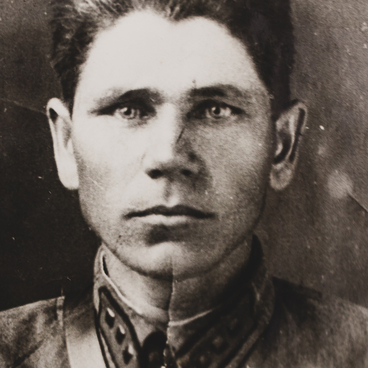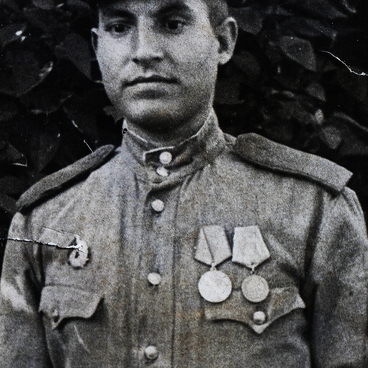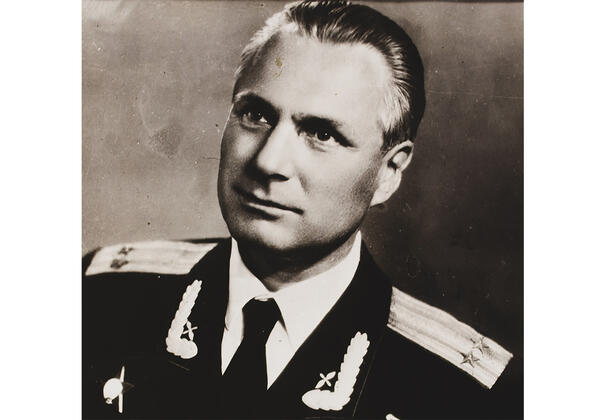
The photo shows retired Colonel, Hero of the Soviet Union, Leonid Tuigunov. During his service, he received more than 20 state awards. Among them he had two Orders of Lenin, two Orders of the Red Banner, two Orders of the Red Star, the Order of Alexander Nevsky, the Order of the Patriotic War of the first degree, the Order of the Hungarian National Republic of the fifth degree and a medal ‘For Battle Merit’.
Tuigunov was born on October 5, 1919, in Krasnoyarsk. He was orphaned at an early age: his father, Naum Ilyich, was a water-pumper, a senior worker on barges at the Yenisei Steamship Company. He died in 1920 during the liquidation of the Kolchak gangs. His mother, Maria Nesterovna Tuigunova, worked as a laundress in a military unit. In the 1930s, his family moved to Anzhero-Sudzhensk.
In 1939, Tuigunov graduated with honors from secondary school No. 17 in Anzhero-Sudzhensk and entered the Chelyabinsk aviation-military school. Alongside with his studies, he mastered pilot training programs at Kiselevsk and Prokopyevsk flying clubs. In 1940, Tuigunov graduated from high school and enlisted in the 203d Far-Range Bomber Aviation Regiment of the 1st Leningrad Military District.
From the first day of the war, the pilot performed combat missions at the Leningrad, Kalinin, and Western fronts: he attacked enemy airfields and places of troops accumulation, from the air he inspected railway stations, at which enemy soldiers unloaded their equipment.
In 1944, Tuigunov participated in the liberation of Leningrad and destroyed military-industrial facilities of Helsinki, Turku and Vyborg. After that, he was sent to Europe, where from the air he supported the troops of the 3rd and 4th Ukrainian Fronts when liberating Lviv, Galati, Constants, Satu Mare and Budapest. At the end of the war, the pilot took part in Berlin operation — he fought at the capital of Germany and its suburbs.
After the war, the retired colonel lived in Svetlogorsk, the Kirovograd region and worked as an engineer of the power engineering service of the coal mining production association ‘Alexandriaugol’. He died on September 11, 2001, and was buried in the military cemetery in Alexandria according to his will.
Tuigunov was born on October 5, 1919, in Krasnoyarsk. He was orphaned at an early age: his father, Naum Ilyich, was a water-pumper, a senior worker on barges at the Yenisei Steamship Company. He died in 1920 during the liquidation of the Kolchak gangs. His mother, Maria Nesterovna Tuigunova, worked as a laundress in a military unit. In the 1930s, his family moved to Anzhero-Sudzhensk.
In 1939, Tuigunov graduated with honors from secondary school No. 17 in Anzhero-Sudzhensk and entered the Chelyabinsk aviation-military school. Alongside with his studies, he mastered pilot training programs at Kiselevsk and Prokopyevsk flying clubs. In 1940, Tuigunov graduated from high school and enlisted in the 203d Far-Range Bomber Aviation Regiment of the 1st Leningrad Military District.
From the first day of the war, the pilot performed combat missions at the Leningrad, Kalinin, and Western fronts: he attacked enemy airfields and places of troops accumulation, from the air he inspected railway stations, at which enemy soldiers unloaded their equipment.
In 1944, Tuigunov participated in the liberation of Leningrad and destroyed military-industrial facilities of Helsinki, Turku and Vyborg. After that, he was sent to Europe, where from the air he supported the troops of the 3rd and 4th Ukrainian Fronts when liberating Lviv, Galati, Constants, Satu Mare and Budapest. At the end of the war, the pilot took part in Berlin operation — he fought at the capital of Germany and its suburbs.
After the war, the retired colonel lived in Svetlogorsk, the Kirovograd region and worked as an engineer of the power engineering service of the coal mining production association ‘Alexandriaugol’. He died on September 11, 2001, and was buried in the military cemetery in Alexandria according to his will.