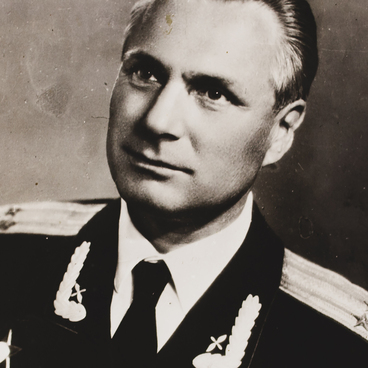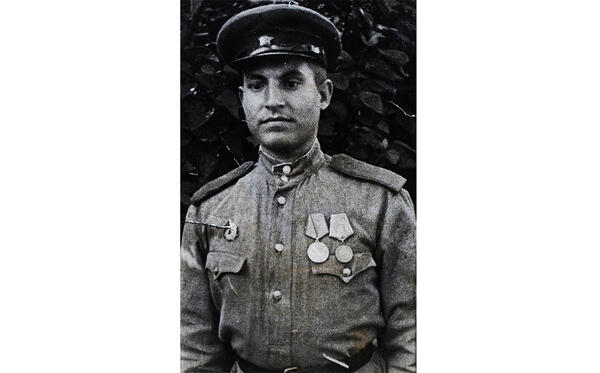
The picture shows Nikolay Smolkin, machine gunner and mechanic of the mine.
Smolkin was born in 1924, in Voskresenka village of the Izhmorskiy district of the Kemerovo region. He was going to work at the mine, but did not even have time to start studying at the mining college: in August 1942, he was drafted into the army.
At first, Nikolay Smolkin was sent to Leninsk-Kuznetsky, where he served as a cadet in a machine-gun school. Then, in January 1943, he went to the front as part of the 307th Guards Rifle Regiment Machine-Gun Platoon.
The first battle in which Smolkin participated was the forcing the Dnieper south of the town of Kremenchug. The platoon had the task to take the height behind the village of Kutsevolovka, where the enemy machine gunners were firing from.
For this battle Nikolay Smolkin received the medal ‘For Valor’. In the reward list the events were described in detail: ‘The commander of the 45 mm gun of the 2nd Battalion, Sergeant Smolkin Nikolay Andreevich, when forcing the Dnieper River in 1943, destroyed a German tank with a machine gun, covering the crossing of our infantry across the Dnieper River, suppressed two enemy fire points, providing a bridgehead on the right bank of the Dnieper.’ When Smolkin was crawling out of a trench, he was wounded and spent a month in a hospital afterwards.
After the hospital, Smolkin fought in the 572nd Rifle Regiment as an anti-tank rifleman and was wounded twice. Then, he was sent to the 502nd Rifle Regiment as a gun commander on the Leningrad Front. There, after another wound, in the hospital he again received the medal ‘For Valor’.
After the war, Smolkin returned home. He studied at the Mining Technical College and interned at the mine as an electric fitter at the mining site. In 1949, he defended his diploma and became a mechanic of the 2nd section of the mine №5/7.
In 1951–1954, Nikolay Smolkin was abroad, on a business trip he studied at the higher engineering courses. In 1959, he was appointed chief mechanic of the mine ‘Fizkulturnik’, in 1970, he was transferred to the mine number 3 (‘Sibirskaya’). In 1974, Smolkin officially retired, but continued to work for another 20 years. His total length of service was 54 years.
Smolkin was born in 1924, in Voskresenka village of the Izhmorskiy district of the Kemerovo region. He was going to work at the mine, but did not even have time to start studying at the mining college: in August 1942, he was drafted into the army.
At first, Nikolay Smolkin was sent to Leninsk-Kuznetsky, where he served as a cadet in a machine-gun school. Then, in January 1943, he went to the front as part of the 307th Guards Rifle Regiment Machine-Gun Platoon.
The first battle in which Smolkin participated was the forcing the Dnieper south of the town of Kremenchug. The platoon had the task to take the height behind the village of Kutsevolovka, where the enemy machine gunners were firing from.
For this battle Nikolay Smolkin received the medal ‘For Valor’. In the reward list the events were described in detail: ‘The commander of the 45 mm gun of the 2nd Battalion, Sergeant Smolkin Nikolay Andreevich, when forcing the Dnieper River in 1943, destroyed a German tank with a machine gun, covering the crossing of our infantry across the Dnieper River, suppressed two enemy fire points, providing a bridgehead on the right bank of the Dnieper.’ When Smolkin was crawling out of a trench, he was wounded and spent a month in a hospital afterwards.
After the hospital, Smolkin fought in the 572nd Rifle Regiment as an anti-tank rifleman and was wounded twice. Then, he was sent to the 502nd Rifle Regiment as a gun commander on the Leningrad Front. There, after another wound, in the hospital he again received the medal ‘For Valor’.
After the war, Smolkin returned home. He studied at the Mining Technical College and interned at the mine as an electric fitter at the mining site. In 1949, he defended his diploma and became a mechanic of the 2nd section of the mine №5/7.
In 1951–1954, Nikolay Smolkin was abroad, on a business trip he studied at the higher engineering courses. In 1959, he was appointed chief mechanic of the mine ‘Fizkulturnik’, in 1970, he was transferred to the mine number 3 (‘Sibirskaya’). In 1974, Smolkin officially retired, but continued to work for another 20 years. His total length of service was 54 years.