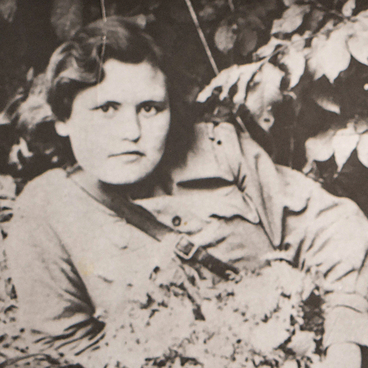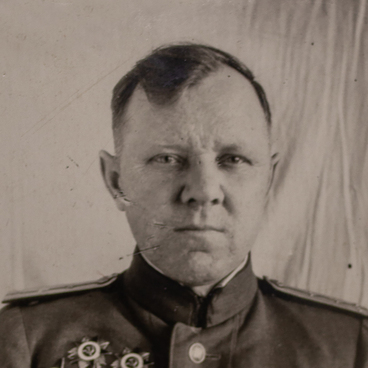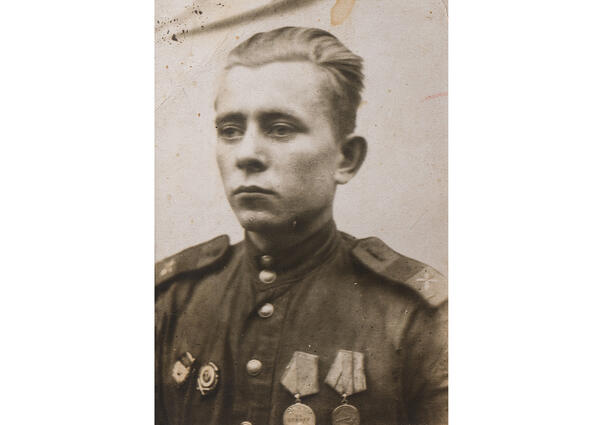
The exhibition displays a photo of Grigory Kolobov — a participant in the Great Patriotic War. He received four state awards for his military merits.
Kolobov was born on May 3, 1922, in the village of Tisul, the Kemerovo Region. Immediately after the beginning of the war, he was called up for military service. The young soldier first underwent military training in Tomsk. Then, he was assigned to the 284th Infantry Division with the rank of private artilleryman and sent to Elets and Livny, and after — to Stalingrad, Odessa, Dnepr, and Germany.
By the decree of January 20, 1943, Grigory Kolobov was awarded a medal ‘For Valor’ for courage, initiative, and bravery on the battlefront. In 1942, the wounded artilleryman crossed the Volga during the battle and delivered an urgent report to the other side. A few days later, he distinguished himself again: when shrapnel from an air bomb wounded a soldier charging a gun, Kolobov replaced him. The award document stated: ‘…Performed two duties, and the gun operated uninterruptedly’.
In 1945, he took part in the battles for the bridgehead on the river Oder in Germany. Kolobov was the first soldier to cross the river with the gun equipment to the other side. When it was damaged, he took his carbine and led the detachment to the attack. For his determination and courage, Kolobov was awarded the Order of the Great Patriotic War, 2nd degree, and two medals: ‘For the Capture of Berlin’ and ‘For Victory over Germany’.
Order of the Great Patriotic War, 2nd degree was awarded to the soldiers who made a significant contribution to the success of military operations. During the war, the Order was awarded to 951,652 people. The medal ‘For the Capture of Berlin’ was one of the seven awards for the capture of foreign cities. It was awarded to about 1,100,000 people in Soviet times.
Kolobov got the rank of major and was demobilized in 1945. After the war, he returned to Anzhero-Sudzhensk and got married; his family had two children. At first, Grigory Kolobov worked as a carpenter in the housing department, and in 1963, he became an apprentice underground fixer at Mine No. 2. After that, he finished a three-month course on repair and restoration of mine workings and worked as a mine worker of the 5th category, and in 1972 he retired.
Kolobov was born on May 3, 1922, in the village of Tisul, the Kemerovo Region. Immediately after the beginning of the war, he was called up for military service. The young soldier first underwent military training in Tomsk. Then, he was assigned to the 284th Infantry Division with the rank of private artilleryman and sent to Elets and Livny, and after — to Stalingrad, Odessa, Dnepr, and Germany.
By the decree of January 20, 1943, Grigory Kolobov was awarded a medal ‘For Valor’ for courage, initiative, and bravery on the battlefront. In 1942, the wounded artilleryman crossed the Volga during the battle and delivered an urgent report to the other side. A few days later, he distinguished himself again: when shrapnel from an air bomb wounded a soldier charging a gun, Kolobov replaced him. The award document stated: ‘…Performed two duties, and the gun operated uninterruptedly’.
In 1945, he took part in the battles for the bridgehead on the river Oder in Germany. Kolobov was the first soldier to cross the river with the gun equipment to the other side. When it was damaged, he took his carbine and led the detachment to the attack. For his determination and courage, Kolobov was awarded the Order of the Great Patriotic War, 2nd degree, and two medals: ‘For the Capture of Berlin’ and ‘For Victory over Germany’.
Order of the Great Patriotic War, 2nd degree was awarded to the soldiers who made a significant contribution to the success of military operations. During the war, the Order was awarded to 951,652 people. The medal ‘For the Capture of Berlin’ was one of the seven awards for the capture of foreign cities. It was awarded to about 1,100,000 people in Soviet times.
Kolobov got the rank of major and was demobilized in 1945. After the war, he returned to Anzhero-Sudzhensk and got married; his family had two children. At first, Grigory Kolobov worked as a carpenter in the housing department, and in 1963, he became an apprentice underground fixer at Mine No. 2. After that, he finished a three-month course on repair and restoration of mine workings and worked as a mine worker of the 5th category, and in 1972 he retired.