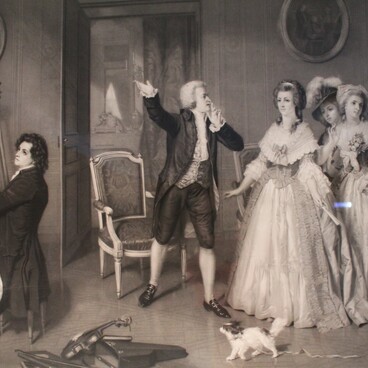
Up until the 1920s, all photographs were traditionally attached to a thick cardboard base known as the mat. These templates had to be specially designed and printed and were usually ordered in the European part of Russia or abroad. They protected the picture and enhanced its visual appearance. Owners of photo parlors sought various ways to decorate their mats and add the studio details, including its name, address, and awards. Thanks to these details, it is possible to determine the authorship of any photograph even today.


Photograph
Creation period
1914
Place of сreation
Perm
Dimensions
10,7x16,2 cm
Technique
Photographic printing, relief printing
Collection
Exhibition
0
Open in app#1
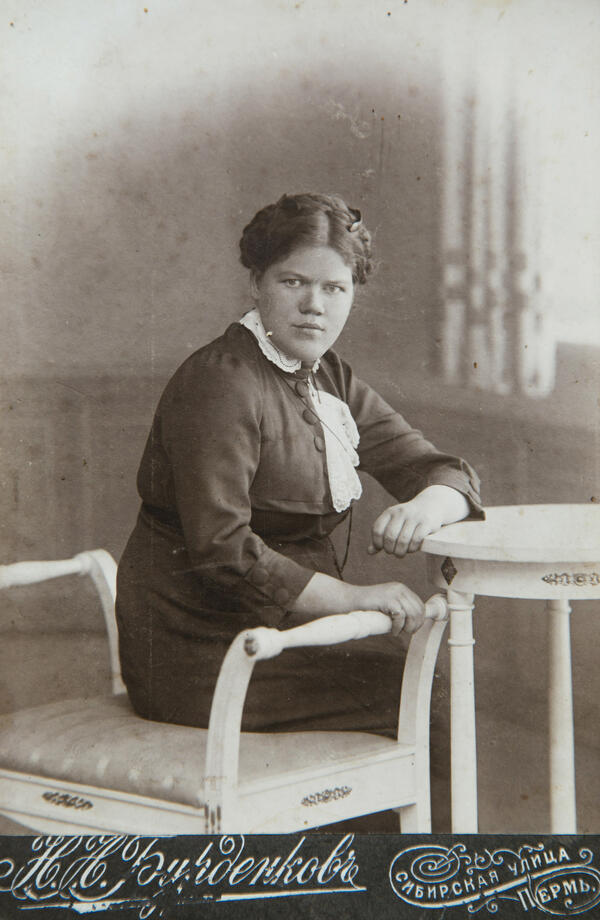
Portrait photograph
#3
#4
Based on the information written on the mat, we can conclude that the photo from our collection was taken in the studio of N. A. Burdenkov, which was based in Maslennikov’s house on Sibirskaya Street in Perm. The photo parlor was located in that building from 1913 to 1926. If we take a look at the reverse side of the picture, we can find out that the mat’s production process involved the work of Iosif Pokorny’s lithography workshop in Moscow. Iosif Pokorny was one of the largest manufacturers of cameras and photo supplies in Tsarist-era Russia. He owned warehouses and factories in Moscow, Libava, Odesa, Kyiv, and Rostov-on-Don. In the late 19th century, he established a Moscow-based factory that produced photographic templates, which, apparently, is where the mat was printed.
#5
The front side of mats often indicated the size of the picture. At the time, photographs came in many sizes, which were intended for different purposes. The smallest photo size was known as mignon (36 mm x 70 mm), and was followed by carte de visite, souvenir, stereoscopic, cabinet, promenade, impériale, and panel photos, with the latter being the largest at 160 mm x 300 mm. Carte de visite photographs were the most popular, as they could offer a convenient size coupled with low cost. Pictures of this size were printed by the dozen, after which they could be gifted to someone else, or even used as identification. Cabinet photographs had dimensions of 100 mm x 137 mm and were called this way because they featured not only the face of a person but also the interior of the photo parlor. Pictures like these were usually kept in photo albums, framed on tables and shelves, or adorned mantels.
#6
Tomsk History Museum
read morehide
00:00
00:00
1x
Photograph
Creation period
1914
Place of сreation
Perm
Dimensions
10,7x16,2 cm
Technique
Photographic printing, relief printing
Collection
Exhibition
0
 Point your smartphone camera to open in the app
Open in app
Share