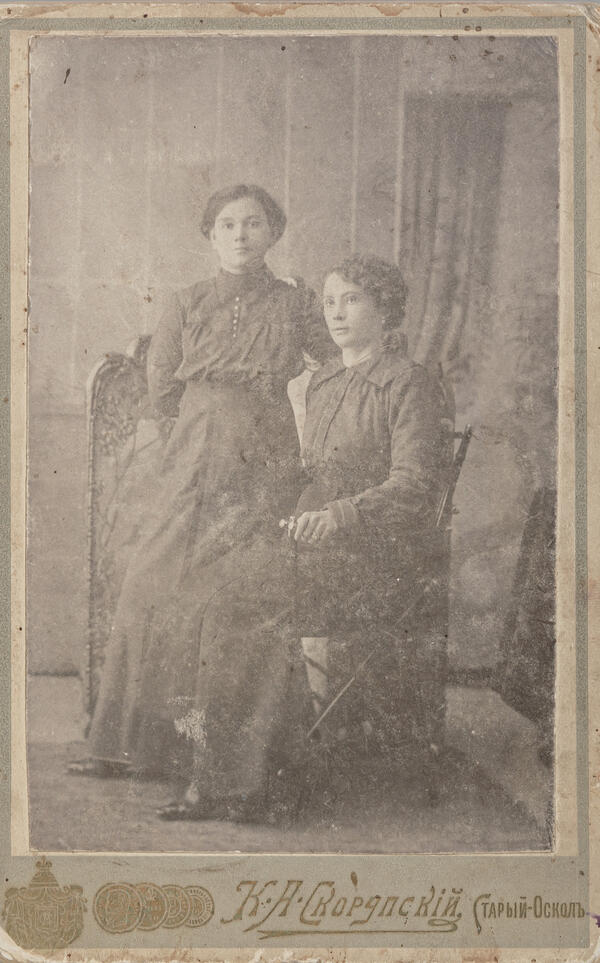
Cabinet cards served as cartes de visite for the owner of the photo studio. They came into use in 1849.
Initially they were sheets of white or light colored cardboard without any images. They were cropped right in the workshop so that the margins of the cardboard protruded slightly beyond the borders of the photo card. That was done for a very practical purpose: the photographs were printed on thin albumin paper and the cardboard backing-frame ensured their preservation and more impressive appearance. To protect photos from dust and sun rays the cards were often provided with a sheet of transparent paper called “etiquette” or “apron” in Russian. It was glued to the top edge of the cardboard from the back side and flipped over to the front side. Sometimes the “etiquette” was decorated with advertising text.
Over time, both the demand for cabinet cards and the requirements for their appearance increased considerably.
The blank cards were lithographed with all the necessary information: the photographer’s name, the name of the studio, its address, awards and insignia. They often featured an easel, brushes and palette — these artist’s attributes emphasized the photographer’s association with the world of high art. The valid graduates of serious art schools first put the title “artist” on their cards, and then the specialization “photographer”.
By the 1880s, factories in Moscow, Vienna, Odessa and Warsaw had been successfully operating. “Shirl and Scamoni” in St Petersburg produced up to one and a half million cartes de visite a year, not counting “cabinet”, “boudoir” and “stereoscopic” cards (about a million annually).
The cards were essential for photographic artists, not only for elegant packaging of their orders, but also for participation in various events — photographic, polytechnic and even manufactory exhibitions — where it was important to show the product in its best possible light.
Initially they were sheets of white or light colored cardboard without any images. They were cropped right in the workshop so that the margins of the cardboard protruded slightly beyond the borders of the photo card. That was done for a very practical purpose: the photographs were printed on thin albumin paper and the cardboard backing-frame ensured their preservation and more impressive appearance. To protect photos from dust and sun rays the cards were often provided with a sheet of transparent paper called “etiquette” or “apron” in Russian. It was glued to the top edge of the cardboard from the back side and flipped over to the front side. Sometimes the “etiquette” was decorated with advertising text.
Over time, both the demand for cabinet cards and the requirements for their appearance increased considerably.
The blank cards were lithographed with all the necessary information: the photographer’s name, the name of the studio, its address, awards and insignia. They often featured an easel, brushes and palette — these artist’s attributes emphasized the photographer’s association with the world of high art. The valid graduates of serious art schools first put the title “artist” on their cards, and then the specialization “photographer”.
Workshops and later factories specializing in producing blanks for cabinet cards appeared.
In the 1860s creating texts for them became almost the main job of lithographers. In 1872 a factory opened in St Petersburg which produced both Bristol cardboard and cards with the stamps of photographic studios. Photographers could choose a design from among the available samples or provide the printer with a sketch of their own.
In the 1860s creating texts for them became almost the main job of lithographers. In 1872 a factory opened in St Petersburg which produced both Bristol cardboard and cards with the stamps of photographic studios. Photographers could choose a design from among the available samples or provide the printer with a sketch of their own.
By the 1880s, factories in Moscow, Vienna, Odessa and Warsaw had been successfully operating. “Shirl and Scamoni” in St Petersburg produced up to one and a half million cartes de visite a year, not counting “cabinet”, “boudoir” and “stereoscopic” cards (about a million annually).
The cards were essential for photographic artists, not only for elegant packaging of their orders, but also for participation in various events — photographic, polytechnic and even manufactory exhibitions — where it was important to show the product in its best possible light.