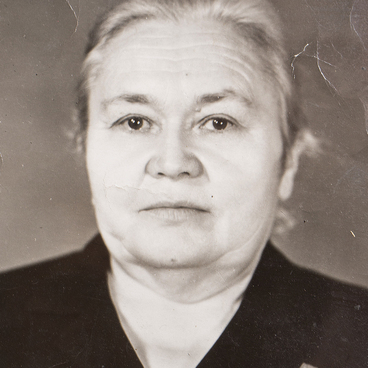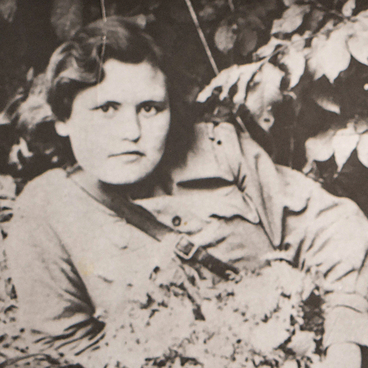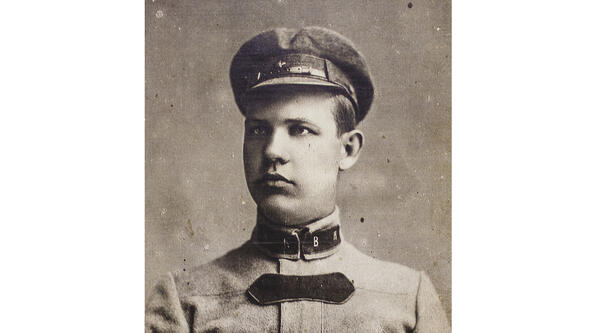
The photograph depicts Nikolay Leshchev, the father of Joseph Leshchev, a hero of the Great Patriotic War and head of the North Caucasus engineering troops.
Nikolay Leshchev was born in the city of Mariinsk of the former Tomsk governorate. He served in the Far Eastern Navy army on the cruiser ‘Zabiyaka’, and when he returned home, he married Olga Makarova. The young family moved to the Mikhelson mines, to the future city of Anzhero-Sudzhensk.
Leshchev worked as a machine operator on the hoisting machine at Mine No. 5-7 and then moved to Mine No. 1. In 1915, he died of acute pneumonia, which he received after an accident at work: the water pipes burst. Eight children lost their father: the elder was 14 years old, and the younger daughter was 3 months old. Olga Makarova had a hard time with her large family, she never received a pension, but she managed to raise her children.
Nikolay Leshchev’s son Joseph was a Komsomol member, and participated in the Civil War. He graduated from the Red Army Military Engineering Academy. V. V. Kuibyshev and from the first days of the war was in the 9th Army of the Southern Front.
In September 1941, Joseph Leshchev was appointed senior assistant and then head of the operational department of the staff of the 8th Sapper Army. He was in charge of building defensive structures near Rostov. Then Leshchev headed the 9th Sapper Brigade and participated in all combat operations of the Black Sea group of troops near Tuapse and Novorossiysk. With two battalions he defended Minor Land, a defense that lasted 225 days.
The Battle of Stalingrad, the battle for Krasnodar and the demining of the Kuban were after that. In 1943, Leshchev was appointed chief of the 15th Assault Engineer-Sapper Brigade and redeployed to Moscow. He fought at the North-Western Front, near the town of Staraya Russa. As a part of the 22nd army with the brigade he passed from Narva to Pushkin mountains, and then as a part of the 10th guards army he liberated Latvia. Near the village of Mazili, his battalion engaged in a battle with a retreating SS group of 400 men. They ended up capturing almost half of the enemy — 170 German soldiers.
In 1954, Joseph Leshchev retired to the reserve with the rank of colonel. For his frontline services he received the Order of Lenin, the Order of the Red Star, the Order of the Great Patriotic War, 2nd degree, and two Orders of the Red Banner.
Nikolay Leshchev was born in the city of Mariinsk of the former Tomsk governorate. He served in the Far Eastern Navy army on the cruiser ‘Zabiyaka’, and when he returned home, he married Olga Makarova. The young family moved to the Mikhelson mines, to the future city of Anzhero-Sudzhensk.
Leshchev worked as a machine operator on the hoisting machine at Mine No. 5-7 and then moved to Mine No. 1. In 1915, he died of acute pneumonia, which he received after an accident at work: the water pipes burst. Eight children lost their father: the elder was 14 years old, and the younger daughter was 3 months old. Olga Makarova had a hard time with her large family, she never received a pension, but she managed to raise her children.
Nikolay Leshchev’s son Joseph was a Komsomol member, and participated in the Civil War. He graduated from the Red Army Military Engineering Academy. V. V. Kuibyshev and from the first days of the war was in the 9th Army of the Southern Front.
In September 1941, Joseph Leshchev was appointed senior assistant and then head of the operational department of the staff of the 8th Sapper Army. He was in charge of building defensive structures near Rostov. Then Leshchev headed the 9th Sapper Brigade and participated in all combat operations of the Black Sea group of troops near Tuapse and Novorossiysk. With two battalions he defended Minor Land, a defense that lasted 225 days.
The Battle of Stalingrad, the battle for Krasnodar and the demining of the Kuban were after that. In 1943, Leshchev was appointed chief of the 15th Assault Engineer-Sapper Brigade and redeployed to Moscow. He fought at the North-Western Front, near the town of Staraya Russa. As a part of the 22nd army with the brigade he passed from Narva to Pushkin mountains, and then as a part of the 10th guards army he liberated Latvia. Near the village of Mazili, his battalion engaged in a battle with a retreating SS group of 400 men. They ended up capturing almost half of the enemy — 170 German soldiers.
In 1954, Joseph Leshchev retired to the reserve with the rank of colonel. For his frontline services he received the Order of Lenin, the Order of the Red Star, the Order of the Great Patriotic War, 2nd degree, and two Orders of the Red Banner.