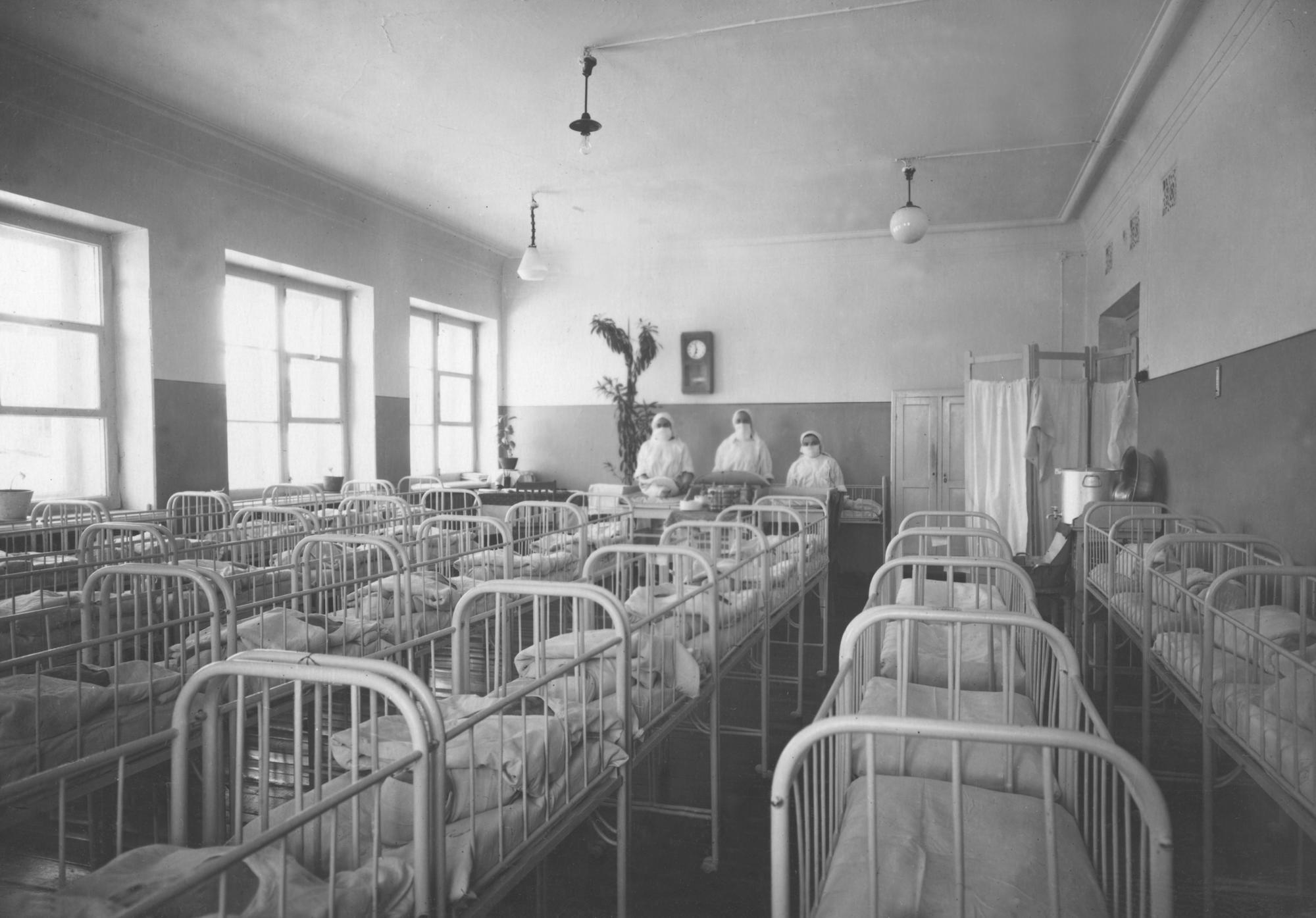


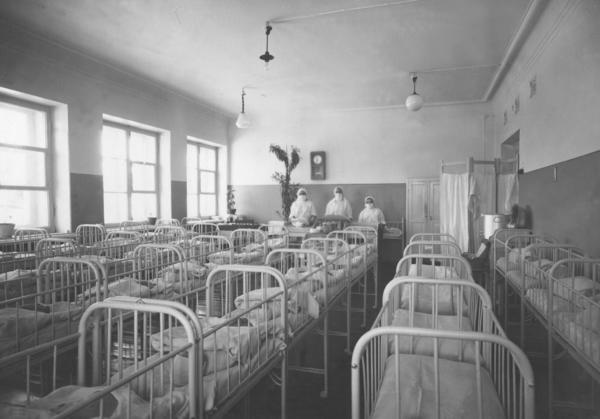
An old photo of the children’s ward of the maternity hospital shows the room in which you are right now. The appearance of the hall has changed, but most importantly, its purpose has changed: before it was a ward for children, now it is a museum space.
From 1944 to 1964, a maternity hospital was located in this building, at 10 Pionerskaya Street. Its appearance is associated with the decree of the State Defense Committee ‘On measures to improve the urban economy of the cities of Arkhangelsk and Molotovsk.’ As part of this decree, funds were allocated for the improvement of cities. In Molotovsk (as Severodvinsk was then called), part of the funds were used to organize a new maternity hospital. For twenty years, about 40 thousand children were born within these walls. This is a significant part of the city’s residents who played an important role in the formation of modern Severodvinsk.
The 1940s–1960s saw one of the peaks in the birth rate in the city. 10 babies could be born in one day. Children were in common wards - now these are large exhibition halls of the museum. The maternity hospital staff were under enormous pressure. According to the recollections of a veteran of the medical service Serafima Sergeeva, the work was built according to a three-tier system: three hours for a round, three hours for an appointment at an antenatal clinic, in addition, all employees of the maternity hospital were on duty. The duty took place at home: this meant that the doctor had to be at home all the time, and from there he was called to the hospital. The chief physician of the maternity hospital throughout this period was the Honored Doctor of the RSFSR Anna Belyavskaya, who lived here on the ground floor.
On the first floor in the left wing of the building there were doctors’ offices, in the right wing and on the second floor there were wards for women in childbirth, prenatal, and children’s wards. The kitchen was located on the ground floor and from there the food was delivered via a small elevator. Unfortunately, it has not survived in the modern building, and the chambers themselves were also reconstructed. This building is a landmark for many townspeople; now grown-up children bring their own children and grandchildren to the Museum of Local Lore, the former home of their birth.
From 1944 to 1964, a maternity hospital was located in this building, at 10 Pionerskaya Street. Its appearance is associated with the decree of the State Defense Committee ‘On measures to improve the urban economy of the cities of Arkhangelsk and Molotovsk.’ As part of this decree, funds were allocated for the improvement of cities. In Molotovsk (as Severodvinsk was then called), part of the funds were used to organize a new maternity hospital. For twenty years, about 40 thousand children were born within these walls. This is a significant part of the city’s residents who played an important role in the formation of modern Severodvinsk.
The 1940s–1960s saw one of the peaks in the birth rate in the city. 10 babies could be born in one day. Children were in common wards - now these are large exhibition halls of the museum. The maternity hospital staff were under enormous pressure. According to the recollections of a veteran of the medical service Serafima Sergeeva, the work was built according to a three-tier system: three hours for a round, three hours for an appointment at an antenatal clinic, in addition, all employees of the maternity hospital were on duty. The duty took place at home: this meant that the doctor had to be at home all the time, and from there he was called to the hospital. The chief physician of the maternity hospital throughout this period was the Honored Doctor of the RSFSR Anna Belyavskaya, who lived here on the ground floor.
On the first floor in the left wing of the building there were doctors’ offices, in the right wing and on the second floor there were wards for women in childbirth, prenatal, and children’s wards. The kitchen was located on the ground floor and from there the food was delivered via a small elevator. Unfortunately, it has not survived in the modern building, and the chambers themselves were also reconstructed. This building is a landmark for many townspeople; now grown-up children bring their own children and grandchildren to the Museum of Local Lore, the former home of their birth.