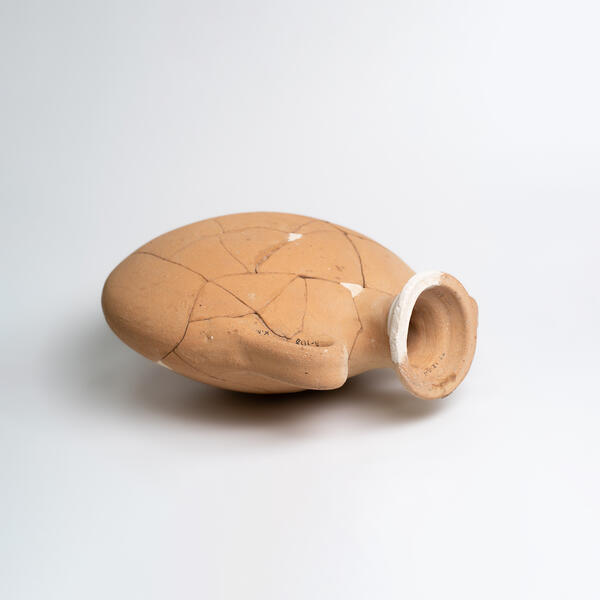
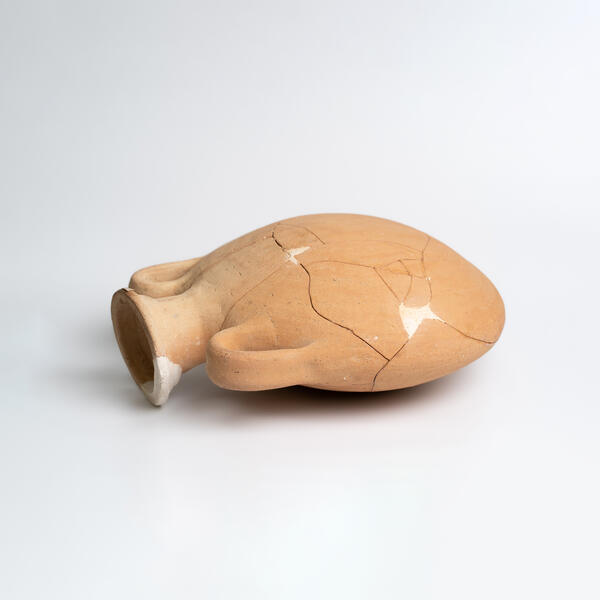
The displayed flask was found in the settlement of Panskoye, which belonged to one of the Olbian settlements in the Northwestern Crimea. In 1959, the Tarkhankut expedition was organized by the Leningrad Branch of the Institute of Archaeology at the Academy of Sciences. It conducted research in the Panskoye settlement under the guidance of the archaeologist Alexander Shcheglov.
The flask is a rare example of a small-sized ceramic container. This is a closed vessel with a wide, rounded, and flattened body. It is equipped with two handles attached to the shoulders and the neck. Such flasks were used by warriors and travelers as they were convenient for carrying liquids. Given its relatively large size and weight, it is likely that this flask was transported in a cart. It was likely manufactured in Chersonesus.
During the Hellenistic period, the ceramic production in Chersonesus was very diverse. A wide variety of pottery was produced in workshops, including amphorae, as well as vessels for cooking and serving food. Such vessels were discovered during excavations in Chersonesus and its chora (agricultural lands). The probable center of flask production was the Tauric Chersonese.
Such flasks were described by the researcher Viktoria Kotenko in her work “Ceramic Flasks from Masliny Settlement in Northwest Taurica”. Masliny settlement was located close to the Panskoye settlement. How did the Chersonese products reach the territory of Olbia? The archaeologist Miron Zolotarev studied groups of Chersonese ceramic stamps found in Olbia and concluded that there were close economic links between the Tauric Chersonese and Olbia between the last quarter of the 4th century BCE and the first quarter of the 2nd century BCE.
The trade activity of the Chersonese state was not limited to supplying products to Olbia in amphorae. Kitchenware, tableware, and other ceramic items were also brought there for sale. This type of vessel has been known since ancient times. These flasks were functional. They were made of leather, clay, and metal, as well as natural “vessels” — pumpkins. This probably explains their characteristic shape. After removing the pulp from the pumpkin, the natural “bottle” was dried, becoming solid and suitable for carrying liquids. The same shape was later used in pottery.