#1
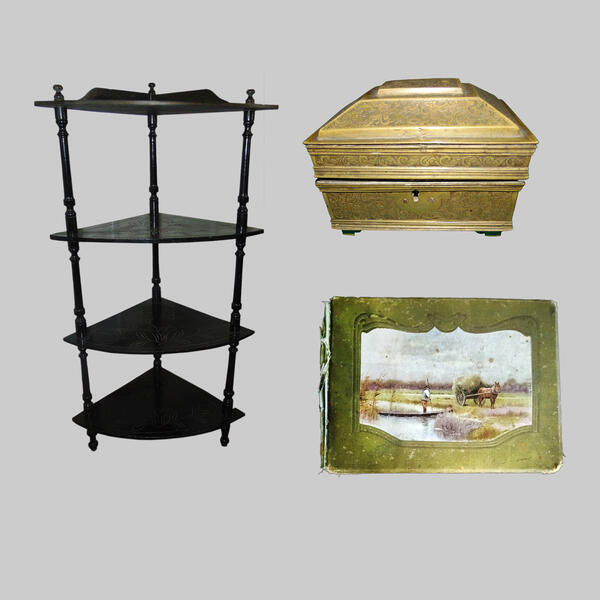
Bookcase, Jewelry box, Photo album
#2
#3
#4
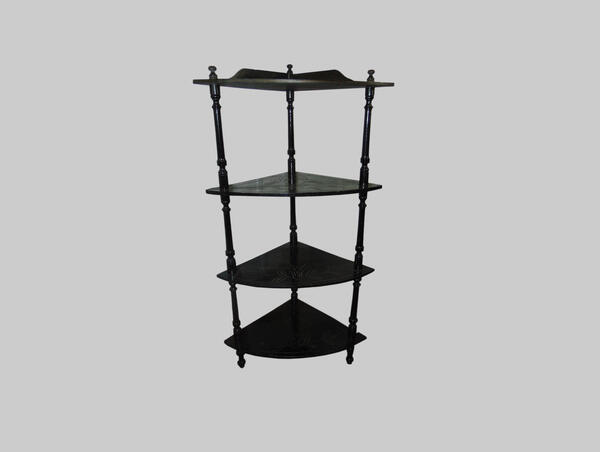
In the early 20th century, Russian noblemen’s houses, among the other furniture, always had a bookcase, usually in the form of a standing or a hanging rack, with shelves open from all sides and supported by openwork stands. This fashion for bookcases also touched the house of the Aksakov family. It stood in their living room to store magazines, documents, home accessories and decorative items.
At that time, a bookcase’s value was considered not only by its functionality, but also by its aesthetic quality. It is no coincidence that the ‘Large sitting room’ presents an exquisite black corner bookcase, manufactured in a factory of the great German-Austrian master cabinetmaker Michael Thonet. Among his many technological innovations was a method of manufacturing furniture by bonding strips of veneer in wooden molds. This method was also applied in creating the bookcase. It is also worth noting that it has a spectacular glossy surface thanks to the abundant coating with a special dark varnish.
The Russian name for this kind of bookcases — Etazherka — is derived from the French word ‘étagère’. According to a belief, the first open bookcases appeared back in the Renaissance period in the 14th century. They were mostly found among wealthy Europeans who needed furniture to store various interior items. Since the 18th century in France, mass production of bookcases has developed. Furniture masters would most often have orders for small custom structures, well suited for placing flowers, books or attributes of luxury. At the same time, varieties of floor bookcases with closed shelves started to emerge.
In the early 20th century, bookcases became so popular that they could even be found on ships. At that time, there were many new designs, including ones made of metal and complex combinations of materials. Nowadays bookcases are used virtually everywhere, starting with bathrooms and living rooms to offices and large factory workshops. More specific designs are also built, for example, for cooling units or industrial warehouses.
At that time, a bookcase’s value was considered not only by its functionality, but also by its aesthetic quality. It is no coincidence that the ‘Large sitting room’ presents an exquisite black corner bookcase, manufactured in a factory of the great German-Austrian master cabinetmaker Michael Thonet. Among his many technological innovations was a method of manufacturing furniture by bonding strips of veneer in wooden molds. This method was also applied in creating the bookcase. It is also worth noting that it has a spectacular glossy surface thanks to the abundant coating with a special dark varnish.
The Russian name for this kind of bookcases — Etazherka — is derived from the French word ‘étagère’. According to a belief, the first open bookcases appeared back in the Renaissance period in the 14th century. They were mostly found among wealthy Europeans who needed furniture to store various interior items. Since the 18th century in France, mass production of bookcases has developed. Furniture masters would most often have orders for small custom structures, well suited for placing flowers, books or attributes of luxury. At the same time, varieties of floor bookcases with closed shelves started to emerge.
In the early 20th century, bookcases became so popular that they could even be found on ships. At that time, there were many new designs, including ones made of metal and complex combinations of materials. Nowadays bookcases are used virtually everywhere, starting with bathrooms and living rooms to offices and large factory workshops. More specific designs are also built, for example, for cooling units or industrial warehouses.
#5
Author: Michael Thonet
Date: early 20th century
Technique: wood, carpentry
Dimensions: 118×42 cm
Copyright: Museum of the Aksakov family
Collection: Furniture
Goskatalog Number: 16752950
Date: early 20th century
Technique: wood, carpentry
Dimensions: 118×42 cm
Copyright: Museum of the Aksakov family
Collection: Furniture
Goskatalog Number: 16752950
#6
Jewelry box
#7
#8
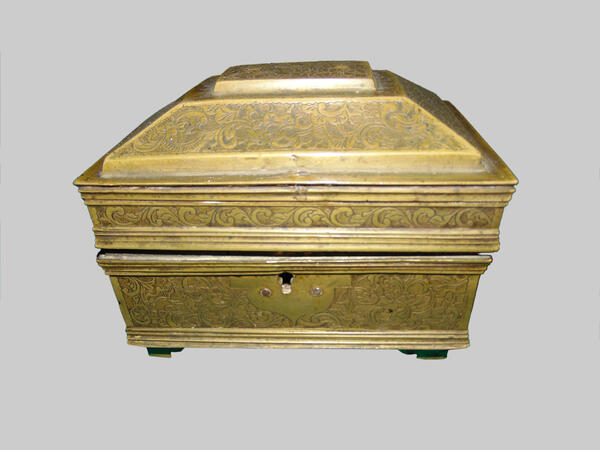
In the ‘Large sitting room’ of the Aksakov family Museum on the corner-shaped bookcase in the style of Thonet stands a rather unremarkable item – a very heavy jewelry box, dating back to the early 20th century. It is made of metal imitating bronze, has a rectangular shape and is decorated with patterns engraved on the entire surface of the casket. This box has a lock, but the key to it was not preserved. Since it had a lock and stood on the bookcase next to the desk, we can assume that once it stored business papers or valuable letters.
The lid of this casket is mounted on special hinges. There is a barely noticeable slit in it: it is possible that someone subsequently used this box as a coin box. On the inside of the lid, the slit is covered with leather, thus making it almost invisible. Also there are pen marks visible on the lid handle, which, however, is currently missing. There is no fabric trim inside the box, and it is unknown whether or not it was supposed to be there.
Most frequently, caskets are used to store small but valuable items, such as money, important documents, items made of rare metals or precious stones. The caskets date back to ancient times and probably originate from chests that served as storage for clothes. In 1598 the word for jewelry box, ‘Shkatula’, was first mentioned in Russian language, and in 1610 - its modern form ‘Shkatulka’. According to Max Fasmer’s Etymological Dictionary of Russian Language, in the word “Shkatulka” was created by merging Polish, Italian and Central Latin words.
As a rule, caskets have a lock. In the 16th-17th centuries, sophisticated caskets with hiding places in the lid or under a false bottom were used for greater safety. In the 19th century caskets “with a secret” started appearing, which could only be opened through some unobvious action or a very complex series of manipulations. Since ancient times, some caskets became magnificent examples of decorative and applied art: for example, in the Louvre there is a richly decorated golden jewelry box, which belonged to the French King Louis IX in the 13th century.
The lid of this casket is mounted on special hinges. There is a barely noticeable slit in it: it is possible that someone subsequently used this box as a coin box. On the inside of the lid, the slit is covered with leather, thus making it almost invisible. Also there are pen marks visible on the lid handle, which, however, is currently missing. There is no fabric trim inside the box, and it is unknown whether or not it was supposed to be there.
Most frequently, caskets are used to store small but valuable items, such as money, important documents, items made of rare metals or precious stones. The caskets date back to ancient times and probably originate from chests that served as storage for clothes. In 1598 the word for jewelry box, ‘Shkatula’, was first mentioned in Russian language, and in 1610 - its modern form ‘Shkatulka’. According to Max Fasmer’s Etymological Dictionary of Russian Language, in the word “Shkatulka” was created by merging Polish, Italian and Central Latin words.
As a rule, caskets have a lock. In the 16th-17th centuries, sophisticated caskets with hiding places in the lid or under a false bottom were used for greater safety. In the 19th century caskets “with a secret” started appearing, which could only be opened through some unobvious action or a very complex series of manipulations. Since ancient times, some caskets became magnificent examples of decorative and applied art: for example, in the Louvre there is a richly decorated golden jewelry box, which belonged to the French King Louis IX in the 13th century.
#9
Date: early 20th century
Technique: metal, copper alloy, casting, engraving
Dimensions: 13×16×11 cm
Copyright: Museum of the Aksakov family
Goskatalog Number: 13446009
Technique: metal, copper alloy, casting, engraving
Dimensions: 13×16×11 cm
Copyright: Museum of the Aksakov family
Goskatalog Number: 13446009
#10
Photo album
#11
#12
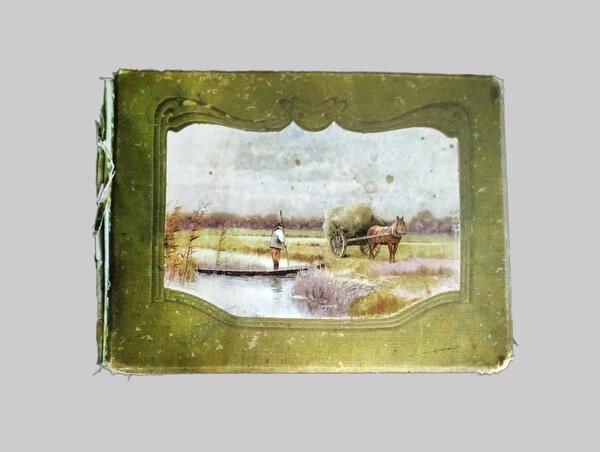
In the early twentieth century, photo albums were often used as interior decoration in noble households. The Aksakov family was no exception. They kept this photo album in one of the living rooms of their houses. It is firmly bound in a hardcover, with a total of 24 sheets, each of which has a photo slit. The size of the slits is different so that it is possible to place images of different sizes in the album. On the cover of it there is an image of a village scene. In the foreground to the right of the center you can see a horse-drawn carriage with hay, and to the left a peasant on a boat pulls up to the shore. The sky in the picture on the album cover is gloomy, promising an imminent rain.
This photo album is of a smaller size, its width being only 11.5 cm. Such photo albums in the late 19th and early 20th centuries were often left in the rooms where guests were accommodated so that they could occupy themselves with something. That’s why in the sitting room of the Aksakovs family museum the photo album is displayed on an elegant wooden bookcase in Thonet style: a visitor there could take the album and look through it while waiting for someone. Given the number of outstanding people among the Aksakovs, it’s not surprising that they regularly had guests.
According to one theory, the old noble lineage of the Aksakovs originates from the renowned Varangian, Shimon Afrikanovich, who came to Kiev in the early 10th century. Some sources link it to the foundation of the Kiev Pechersk Lavra, to the construction of which he made generous donations. However, in addition to the Aksakovs, numerous Russian noble families claimed to be descendants of this Varangian.
As early as in the 19th century, Sergei Timofeevich Aksakov — a famous writer, official and public figure, literary and theater critic, memoirist, corresponding member of the Imperial Academy of Sciences, as well as the author of books about fishing and hunting — glorified his family name throughout the Russian Empire. His family included Konstantin, Ivan, Grigory and Vera Aksakovs, who are all well renowned writers, public figures and consistent supporters of Slavophilia: a literary, religious and philosophical movement, its members believed that Russia had typical features that set it apart from Western countries.
This photo album is of a smaller size, its width being only 11.5 cm. Such photo albums in the late 19th and early 20th centuries were often left in the rooms where guests were accommodated so that they could occupy themselves with something. That’s why in the sitting room of the Aksakovs family museum the photo album is displayed on an elegant wooden bookcase in Thonet style: a visitor there could take the album and look through it while waiting for someone. Given the number of outstanding people among the Aksakovs, it’s not surprising that they regularly had guests.
According to one theory, the old noble lineage of the Aksakovs originates from the renowned Varangian, Shimon Afrikanovich, who came to Kiev in the early 10th century. Some sources link it to the foundation of the Kiev Pechersk Lavra, to the construction of which he made generous donations. However, in addition to the Aksakovs, numerous Russian noble families claimed to be descendants of this Varangian.
As early as in the 19th century, Sergei Timofeevich Aksakov — a famous writer, official and public figure, literary and theater critic, memoirist, corresponding member of the Imperial Academy of Sciences, as well as the author of books about fishing and hunting — glorified his family name throughout the Russian Empire. His family included Konstantin, Ivan, Grigory and Vera Aksakovs, who are all well renowned writers, public figures and consistent supporters of Slavophilia: a literary, religious and philosophical movement, its members believed that Russia had typical features that set it apart from Western countries.
#13
Date: early 19th century
Technique: paper
Dimensions: 8.5×11.5 cm
Copyright: Museum of the Aksakov family
Goskatalog Number: 13446010
Technique: paper
Dimensions: 8.5×11.5 cm
Copyright: Museum of the Aksakov family
Goskatalog Number: 13446010
read morehide
00:00
00:00
1x
Bookcase, Jewelry box, Photo album
0
 Point your smartphone camera to open in the app
Open in app
Share