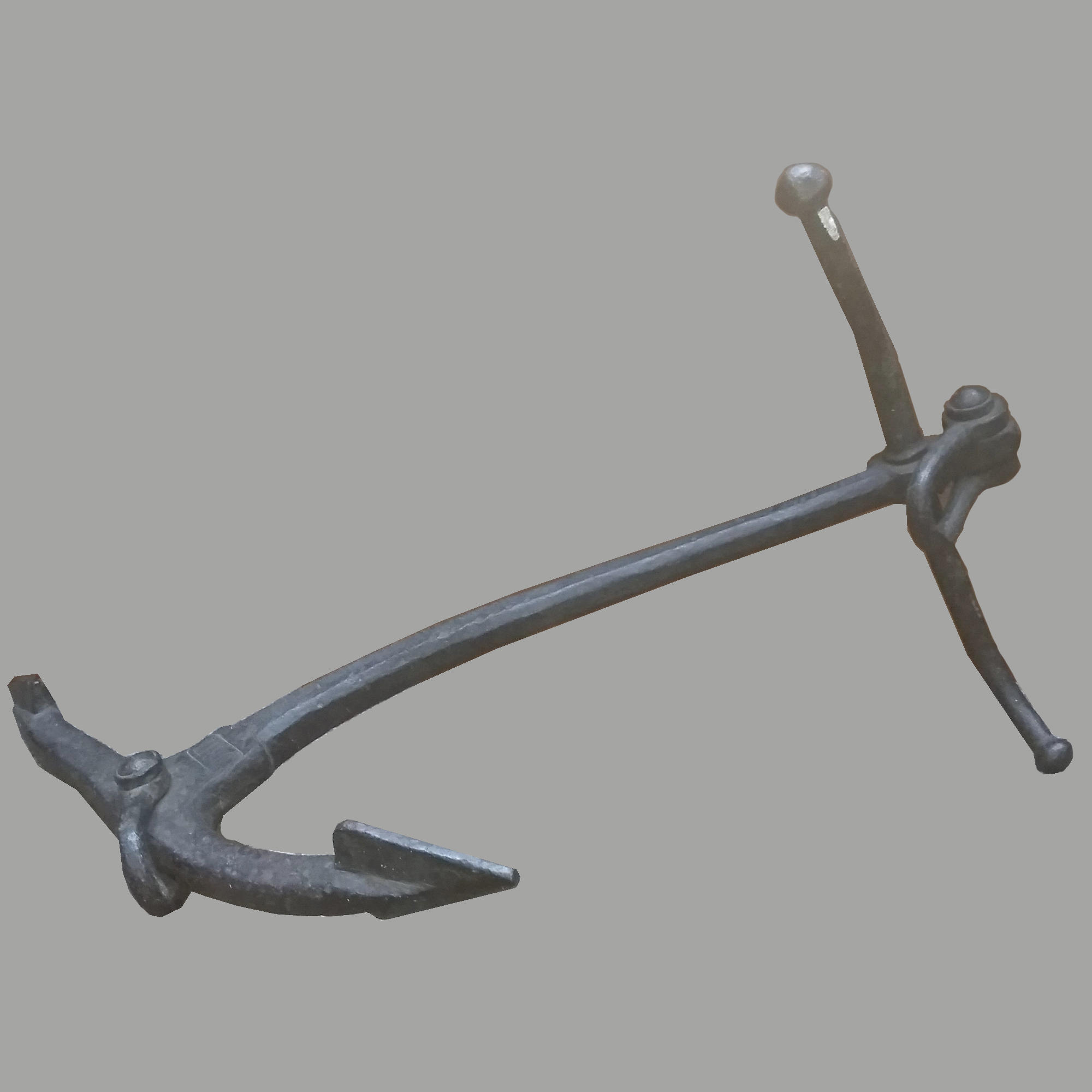



Similar anchors were used on steamboats that started navigating along the Tom River between Tomsk and Kuznetsk at the end of 19th century. The first Kuznetsk port, built at the very beginning of the 20th century, was located on the Ivantsevsky channel (arm of the Tom River) near Naberezhnaya Street, not far from the Cathedral of the Transfiguration of the Saviour. The port was active until the mid-1930s.
On May 25 (old style), 1898, the first steamboat since the town was founded arrived to Kuznetsk. This event has following history. By May 13, the Tom River was completely cleared of ice. Then, state-owned steamboat ‘Tom’ set off from Tomsk on ‘Kuznetsk voyage’ on May 21 at 5 pm, after a ‘sincere wish of good luck’. Assistant to the chief of the Tomsk Railways District, State Councilor Mitrofan Stepanovich Chernyshev was on board of the ship, as leader of the mission and one of the main inspirers of introducing steamship communication along Tom River. The Tom steamboat was a small river ship even at that time. It was a single-deck ship with a draft depth of just over half a meter and a capacity of 30 horsepower, about 36 meters long and 7 meters wide. It was fully made in Russia: its body, engine, and boilers were manufactured relatively recently, in 1895, at the Zhabynsky (Tyumen) Kurbatov and Ignatov mechanical plant (by the way, this plant accounted for almost a third of the total steam fleet navigating along the rivers of the Ob-Irtysh basin by 1917). Making night stops for loading fuel, that is firewood, the ship reached the village of Sheveli by 7 am on May 23, and appeared at Kuznetsk roadstead in the morning of May 25. However, it quietly passed Topolniki without entering Ivantsevo channel (at the time, an arm of Tom River separated Kuznetsk from Topoliny island), proceeded past the sleeping town to the mouth of Kondoma and navigated 15 miles upstream. The crew initially hoped to reach the Telbess mine, but then abandoned this plan because they were afraid of running into underwater trees with protruding roots. After that, the steamboat returned to Kuznetsk at 11 am, making a real sensation, according to one of the witnesses.
Here is how famous writer and Tolstoy scholar Valentin Bulgakov (born in Kuznetsk in 1886) described the arrival of the first ship to Kuznetsk in his memoirs. ‘A giant Aeolian harp, much bigger than one that adorned town governor’s garden, suddenly sounded and filled the whole sky and the whole town with a beautiful, harmonious chord. We stopped, dumbfounded. The wonderful sound lasted for a minute or two, and suddenly fell silent. It was only then that we started looking around, wondering about where it came from. Then we both gasped with awe. A new and by no means lesser miracle appeared before our eyes. There, far on the water, beyond the edge of the flooded Topolnik, from behind tall trees that rose from the water, barely covered with young foliage, a handsome white ship with a red stripe near the bottom smoothly floated out like a wondrous vision, or like a huge fantastic swan.’
On May 25 (old style), 1898, the first steamboat since the town was founded arrived to Kuznetsk. This event has following history. By May 13, the Tom River was completely cleared of ice. Then, state-owned steamboat ‘Tom’ set off from Tomsk on ‘Kuznetsk voyage’ on May 21 at 5 pm, after a ‘sincere wish of good luck’. Assistant to the chief of the Tomsk Railways District, State Councilor Mitrofan Stepanovich Chernyshev was on board of the ship, as leader of the mission and one of the main inspirers of introducing steamship communication along Tom River. The Tom steamboat was a small river ship even at that time. It was a single-deck ship with a draft depth of just over half a meter and a capacity of 30 horsepower, about 36 meters long and 7 meters wide. It was fully made in Russia: its body, engine, and boilers were manufactured relatively recently, in 1895, at the Zhabynsky (Tyumen) Kurbatov and Ignatov mechanical plant (by the way, this plant accounted for almost a third of the total steam fleet navigating along the rivers of the Ob-Irtysh basin by 1917). Making night stops for loading fuel, that is firewood, the ship reached the village of Sheveli by 7 am on May 23, and appeared at Kuznetsk roadstead in the morning of May 25. However, it quietly passed Topolniki without entering Ivantsevo channel (at the time, an arm of Tom River separated Kuznetsk from Topoliny island), proceeded past the sleeping town to the mouth of Kondoma and navigated 15 miles upstream. The crew initially hoped to reach the Telbess mine, but then abandoned this plan because they were afraid of running into underwater trees with protruding roots. After that, the steamboat returned to Kuznetsk at 11 am, making a real sensation, according to one of the witnesses.
Here is how famous writer and Tolstoy scholar Valentin Bulgakov (born in Kuznetsk in 1886) described the arrival of the first ship to Kuznetsk in his memoirs. ‘A giant Aeolian harp, much bigger than one that adorned town governor’s garden, suddenly sounded and filled the whole sky and the whole town with a beautiful, harmonious chord. We stopped, dumbfounded. The wonderful sound lasted for a minute or two, and suddenly fell silent. It was only then that we started looking around, wondering about where it came from. Then we both gasped with awe. A new and by no means lesser miracle appeared before our eyes. There, far on the water, beyond the edge of the flooded Topolnik, from behind tall trees that rose from the water, barely covered with young foliage, a handsome white ship with a red stripe near the bottom smoothly floated out like a wondrous vision, or like a huge fantastic swan.’