Belts with metal fittings were widespread in the Middle Ages in the territory from Central Europe to the Pacific Ocean.
At that time, it was difficult to determine the ethnic affiliation of the owner of the belt, unlike, for example, in the Scythian period, when the presence of a belt with a sword indicated not only Scythian origin, but also tribal affiliation. In the Middle Ages, belts mainly served as a sign of social status.
A belt was an element of clothing, and therefore it should be considered primarily as part of the equipment of a warrior and hunter, farmer or religious servant. At the same time, many of the attributes of a belt were often devoid of any utilitarian function and had aesthetic, magical or other purposes.
This primarily applied to various overlay plaques that covered the surface of the belt either fully or partially, as well as to bells, small bells, lyre-shaped, conical, and other pendants.
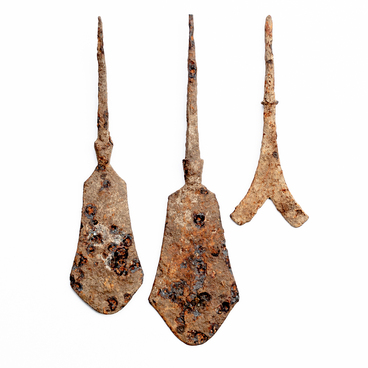
Recently, many complete sets of belt fittings have been discovered during excavations of Jurchen-era burial sites in the Amur region.
The first belt reconstructions were carried out in the early 1970s by the Doctor of Historical Sciences, archaeologist Vitaly Egorovich Medvedev.
Four types of belts were identified, characterized by the absence of any metal fasteners. Subsequent excavations of Jurchen era sites revealed that the lack of fasteners reflected local cultural differences of the Jurchen population rather than being a distinctive feature of all belts of that time. Belts were divided into men’s combat, women’s and children’s belts.
Each category of these clothing items was
characterized by certain attributes and belt sizes. For example, one of the
main features of men’s combat belts was their metal fittings, which was made
exclusively of iron. Moreover, the plaques, buckles, and belt tips were
strongly influenced by the culture of the Turkic-speaking population of Siberia
and Central Asia. Children’s items were distinguished by smaller plaque sizes
and shorter belt lengths.