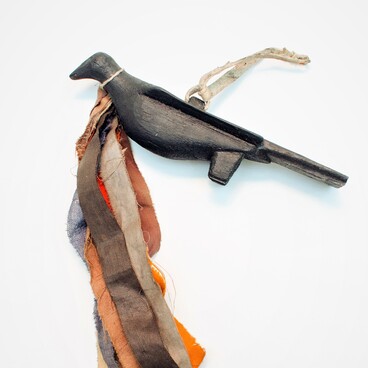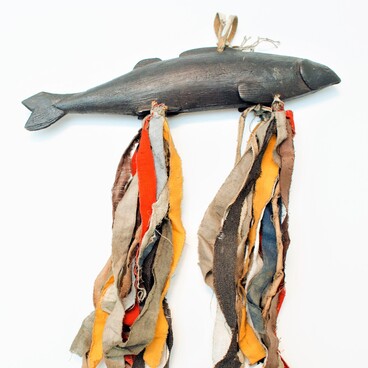
Tuvan shamans referred to their spirit-helpers and receptacle as ‘eeren’. Eerens could serve various purposes.
Some of them cured diseases, others protected shamans from dangers in the world of people and spirits, and others brought good luck and prosperity.
The Minusinsk museum’s collection houses several such shamanic eerens. One of them is Moos eeren — the snake idol. This amulet was believed to have the protective power of the universe. Tuvans identified some animals or birds with their spirits-helpers. Images of snakes were often found on a shaman’s clothes, such as cloaks and jackets, or shamanic attributes. They were believed to protect shamans from evil spirits in the Lower World that belonged to the rampant Erlik-Khan. Moos eeren was among the obligatory spirit-helpers of the Manchurek shamans and served to help them cross the rivers of the Lower World during their shamanistic rituals. The eeren snake refers to the ‘earthly’ spirit-helpers who were summoned to protect shamans and their families with the forces of Mother Earth and the Universe.
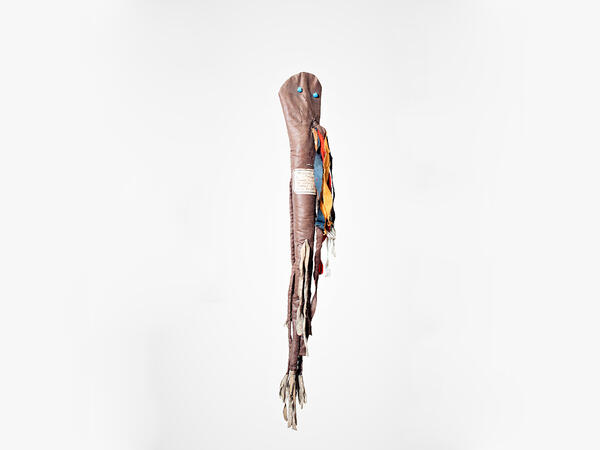
The idol in the form of a snake with an open mouth is made of a felt roller lined with a brown cotton cloth. Its head is hollow, and its mouth is trimmed from the inside with a light-colored monochrome cloth with a narrow red rag roll which is supposed to be a tongue. Two blue beads are attached to the head as eyes. The tail of the snake is bifurcated, with a tassel of seven leather ribbons (salbak) sewn on each end.
There is a bundle of yellow, red, brown, and navy-blue cloth ribbons arranged at the snake’s head. It was believed that a shaman consecrated an eeren by attaching narrow strips of cloth to it. Colored ribbons could also be tied to an idol as a sign of gratitude for the protection it provided.
Every shaman made eerens by himself. Therefore, their appearance might differ. Various additional symbols could be attached to eerens, such as bear claws, ram bones, or pieces of wild animal skins (wolves, bears, badgers). Bells, the sun and the moon figurines, and miniature copies of shamanic attributes — tambourines, whips, and others — were often part of the idols as well.
It was believed that spirit-helpers, which a shaman moved into eerens, stayed with him until death. The more such spirits the shaman had, the more powerful he became.
Some of them cured diseases, others protected shamans from dangers in the world of people and spirits, and others brought good luck and prosperity.
The Minusinsk museum’s collection houses several such shamanic eerens. One of them is Moos eeren — the snake idol. This amulet was believed to have the protective power of the universe. Tuvans identified some animals or birds with their spirits-helpers. Images of snakes were often found on a shaman’s clothes, such as cloaks and jackets, or shamanic attributes. They were believed to protect shamans from evil spirits in the Lower World that belonged to the rampant Erlik-Khan. Moos eeren was among the obligatory spirit-helpers of the Manchurek shamans and served to help them cross the rivers of the Lower World during their shamanistic rituals. The eeren snake refers to the ‘earthly’ spirit-helpers who were summoned to protect shamans and their families with the forces of Mother Earth and the Universe.
The idol in the form of a snake with an open mouth is made of a felt roller lined with a brown cotton cloth. Its head is hollow, and its mouth is trimmed from the inside with a light-colored monochrome cloth with a narrow red rag roll which is supposed to be a tongue. Two blue beads are attached to the head as eyes. The tail of the snake is bifurcated, with a tassel of seven leather ribbons (salbak) sewn on each end.
There is a bundle of yellow, red, brown, and navy-blue cloth ribbons arranged at the snake’s head. It was believed that a shaman consecrated an eeren by attaching narrow strips of cloth to it. Colored ribbons could also be tied to an idol as a sign of gratitude for the protection it provided.
Every shaman made eerens by himself. Therefore, their appearance might differ. Various additional symbols could be attached to eerens, such as bear claws, ram bones, or pieces of wild animal skins (wolves, bears, badgers). Bells, the sun and the moon figurines, and miniature copies of shamanic attributes — tambourines, whips, and others — were often part of the idols as well.
It was believed that spirit-helpers, which a shaman moved into eerens, stayed with him until death. The more such spirits the shaman had, the more powerful he became.