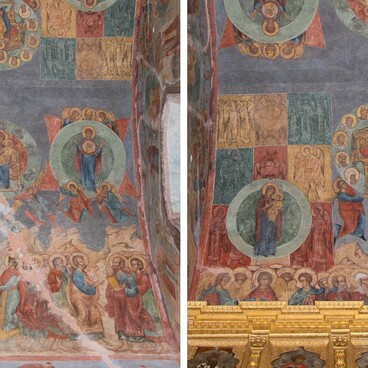
The scene is depicted the famous Troparion, which begins with the following lines: ‘The Only-Begotten Son and Immortal Word of God…’ In the center of the composition is the icon of Immanuel, seated on the seraphim, with a globus cruciger and a scroll in his hands. His rounded glory is supported by angels and God the Father. On the sides of them are the fancifully curved figures of angels with heavenly bodies. On the right hand of Christ there is a depiction of the Mother of God — the House of God’s Wisdom, on the background of the golden chambers. Opposite her is an angel in front of the temple (a symbol of the Church of Christ). At Immanuel’s feet there is a composition ‘Weep Not for Me, Mother’ based on the irmos texts of the Holy Saturday service by Cosmas of Maiuma. Below is a depiction of Christ sitting on the cross in the image of a warrior who is trampling down death. Opposite Him is the personification of death on the apocalyptic beast.
The Troparion ‘The Only-Begotten Son’ is performed at the Divine Liturgy of Saint John Chrysostom and Saint Basil at the end of the 2nd antiphon. The Troparion expresses the Church’s teaching about the stewardship. The poetic metaphors of the hymn were metaphorically embodied in the symbolic-dogmatic composition of the same name, which was established in the Russian art in the middle of the 16th century. It was related to the processes that actively took place in the Cathedral of the Annunciation of the Moscow Kremlin under Metropolitan of Moscow Macarius.
The full name: ‘Only-begotten Son’
Time of creation: 1641
Technique: Fresco, tempera
Location: The eastern slope of the southeastern arch