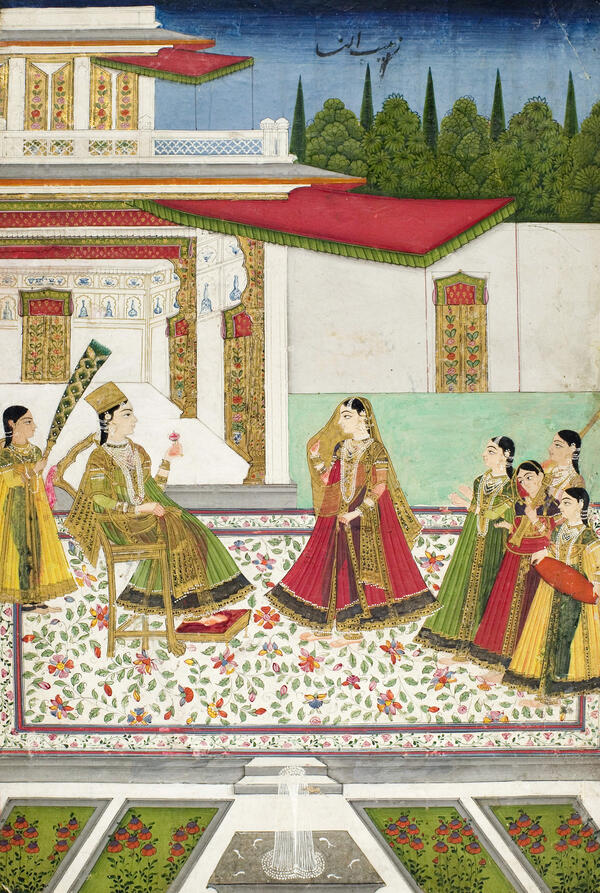
The Samara Regional Art Museum presents an Indian miniature depicting a scene of an evening leisurely activity of the Rajput Princess Zebunnisa. The princess rests on the terrace of the palace surrounded by young girls who dance and play musical instruments.
The color palette of the miniature includes pure blue, purple, pink, emerald and gold. The inscription on top in Persian in Arabic script reads: “Zeb-un-Nissa” — “ornament of womankind”.
Zeb-un-Nisa Begum Sahib was the daughter of the Padishah of the Mughal Empire Aurangzeb (1638–1702). The Princess was famous for her beauty, and was betrothed to her first cousin Prince Sulaiman Shikoh, but never married. She lived a long happy life, was a famous poet, spoke Persian, Arabic and Urdu, studied philosophy, literature, and astronomy. The main theme of her poetic work was the position of the Eastern woman, her inner feelings and spiritual nobility.
The palace scene is set against the background of a garden. Oases and irrigated gardens occupy a very special place in the religion of Muslims. In the Quran, in Surah 76, devout Muslims are promised springs which will be “flowing at their will”, gardens with beautiful trees, which give shade, shrubs and an abundance of fruits, which will be made very easy to reach and have an incomparable taste. Thus, abundance and happiness in eternal life is a reward for a righteous life on earth, which is worth striving for.
The ornamental Islamic gardens, from Morocco to the Mughal Empire in the East, were often called “paradise on earth”, promising harbingers of a future life. Permanent and integral features of these “paradisical gardens” on earth are reservoirs and abundant vegetation, preferably in combination with fruit trees and shrubs that give shade and coolness.
Reservoirs occupied a central place in the garden and gave it formal structure: those could be artfully constructed pools, canals, and fountains, around which flowerbeds and paths were arranged. At the same time, the principle of symmetry was strictly observed in the arrangement of greenery (lawns, flower beds, trees, shrubs), and geometrically correct forms dominated.
The color palette of the miniature includes pure blue, purple, pink, emerald and gold. The inscription on top in Persian in Arabic script reads: “Zeb-un-Nissa” — “ornament of womankind”.
Zeb-un-Nisa Begum Sahib was the daughter of the Padishah of the Mughal Empire Aurangzeb (1638–1702). The Princess was famous for her beauty, and was betrothed to her first cousin Prince Sulaiman Shikoh, but never married. She lived a long happy life, was a famous poet, spoke Persian, Arabic and Urdu, studied philosophy, literature, and astronomy. The main theme of her poetic work was the position of the Eastern woman, her inner feelings and spiritual nobility.
The palace scene is set against the background of a garden. Oases and irrigated gardens occupy a very special place in the religion of Muslims. In the Quran, in Surah 76, devout Muslims are promised springs which will be “flowing at their will”, gardens with beautiful trees, which give shade, shrubs and an abundance of fruits, which will be made very easy to reach and have an incomparable taste. Thus, abundance and happiness in eternal life is a reward for a righteous life on earth, which is worth striving for.
The ornamental Islamic gardens, from Morocco to the Mughal Empire in the East, were often called “paradise on earth”, promising harbingers of a future life. Permanent and integral features of these “paradisical gardens” on earth are reservoirs and abundant vegetation, preferably in combination with fruit trees and shrubs that give shade and coolness.
Reservoirs occupied a central place in the garden and gave it formal structure: those could be artfully constructed pools, canals, and fountains, around which flowerbeds and paths were arranged. At the same time, the principle of symmetry was strictly observed in the arrangement of greenery (lawns, flower beds, trees, shrubs), and geometrically correct forms dominated.