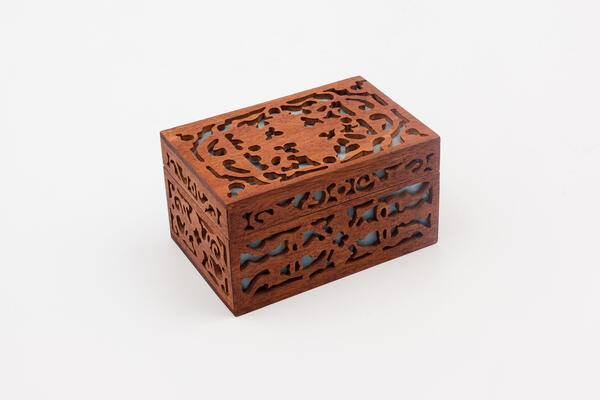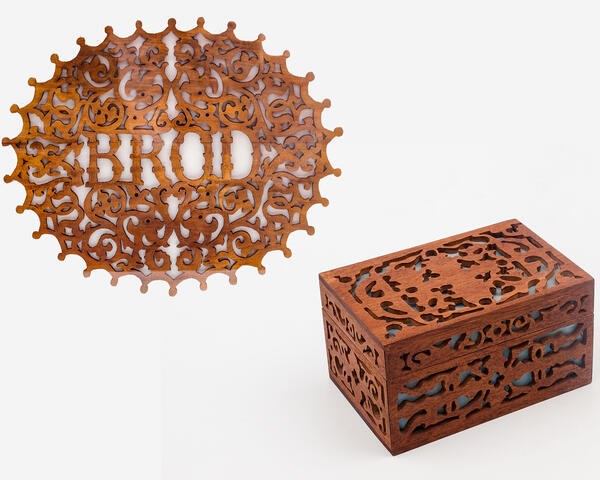
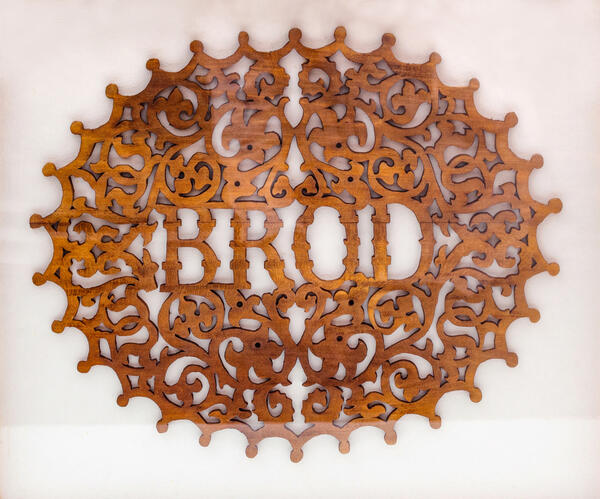
In the Museum House of Vladimir Lenin, in his mother’s room, on the chest of drawers there is an oval-shaped openwork bread board with the inscription BROD. Alexander Ulyanov, Vladimir Lenin’s elder brother, carved it from walnut wood with a hand jigsaw.
Items made of wood are usually not durable. Walnut wood, which the board on display is made of, is a little stronger than other types of wood. Its intricate floral ornamentation and inscription have been preserved to this day, but several small fragments have been lost.
Alexander Ulyanov sawed out a bread board as a gift to his mother in Simbirsk. The exact date of its creation is unknown. The researchers suppose that it happened in 1880-1887. Alexander did not invent the pattern himself: he found a sample in a popular pedagogical magazine ‘Family and School’. The Ulyanovs often subscribed to this magazine, where in the children’s sections, in addition to sketches for handicrafts, they printed contests, rebuses and stories.
The home carpentry workshop of the Ulyanovs household, where the bread board was probably made, was in a wooden structure in the yard, the former carriage barn or stable. The Ulyanovs rented out the stable for the duration of fairs.
Lenin’s elder sister Anna Ulianova-Elizarova recalled: ‘In the carriage shed there were neither horses nor carriages, but there was a carpentry workshop where Alexander and Vladimir Ulianovs carved from “black poplar wood”: boats, toys and other handicrafts, which they gave to their loved ones.’
Maria Ulyanova kept this bread board for many years in memory of her eldest son, who was executed for organizing an assassination attempt on Russian Emperor Alexander III.
In 1886, together with his student Peter Shevyryov, Alexander founded the ‘Terrorist Faction’ of the ‘Narodnaya Volya’ movement and in February 1887 wrote a program for it. That same month, Alexander planned an assassination attempt on the sovereign and procured explosives. But on March 1, 1887, the attack was prevented, and the conspirators were arrested. A month later a trial was held at which Alexander defended himself. On the verdict of the court, five of the organizers of the faction, including Alexander Ulyanov, were hanged in the Schlisselburg fortress, while the rest were given years of hard labor and exile in Siberia.
Items made of wood are usually not durable. Walnut wood, which the board on display is made of, is a little stronger than other types of wood. Its intricate floral ornamentation and inscription have been preserved to this day, but several small fragments have been lost.
Alexander Ulyanov sawed out a bread board as a gift to his mother in Simbirsk. The exact date of its creation is unknown. The researchers suppose that it happened in 1880-1887. Alexander did not invent the pattern himself: he found a sample in a popular pedagogical magazine ‘Family and School’. The Ulyanovs often subscribed to this magazine, where in the children’s sections, in addition to sketches for handicrafts, they printed contests, rebuses and stories.
The home carpentry workshop of the Ulyanovs household, where the bread board was probably made, was in a wooden structure in the yard, the former carriage barn or stable. The Ulyanovs rented out the stable for the duration of fairs.
Lenin’s elder sister Anna Ulianova-Elizarova recalled: ‘In the carriage shed there were neither horses nor carriages, but there was a carpentry workshop where Alexander and Vladimir Ulianovs carved from “black poplar wood”: boats, toys and other handicrafts, which they gave to their loved ones.’
Maria Ulyanova kept this bread board for many years in memory of her eldest son, who was executed for organizing an assassination attempt on Russian Emperor Alexander III.
In 1886, together with his student Peter Shevyryov, Alexander founded the ‘Terrorist Faction’ of the ‘Narodnaya Volya’ movement and in February 1887 wrote a program for it. That same month, Alexander planned an assassination attempt on the sovereign and procured explosives. But on March 1, 1887, the attack was prevented, and the conspirators were arrested. A month later a trial was held at which Alexander defended himself. On the verdict of the court, five of the organizers of the faction, including Alexander Ulyanov, were hanged in the Schlisselburg fortress, while the rest were given years of hard labor and exile in Siberia.