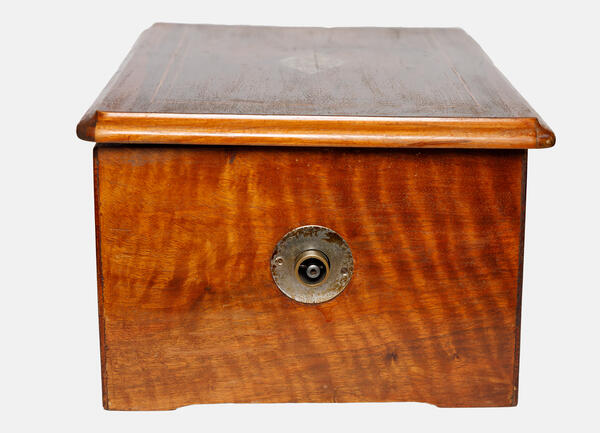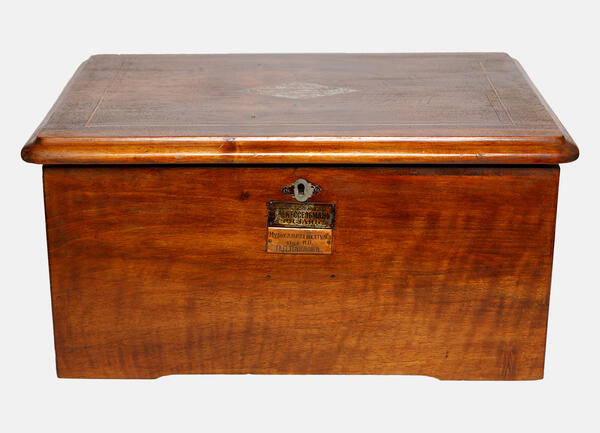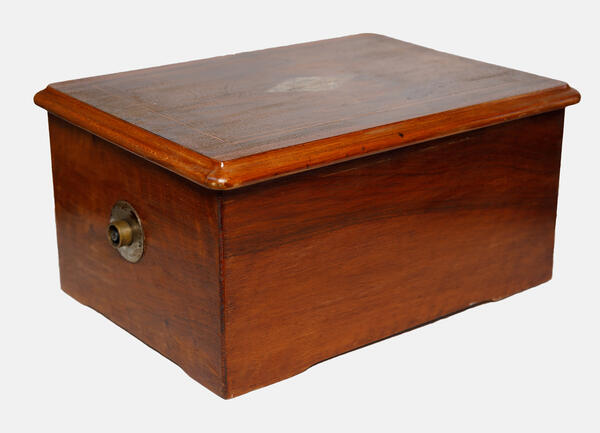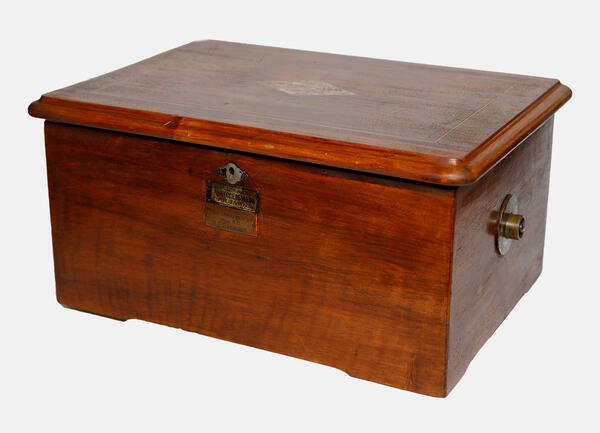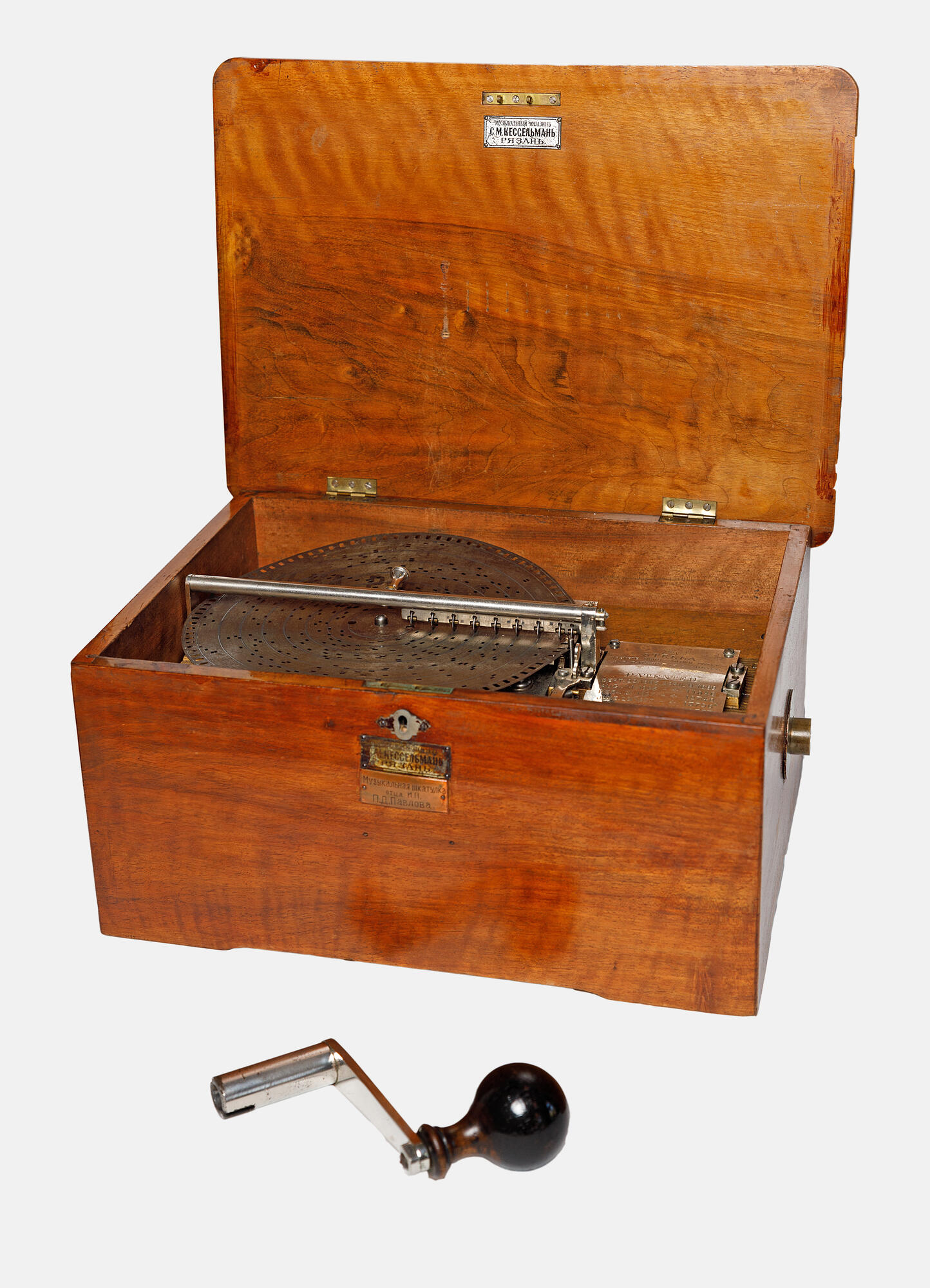


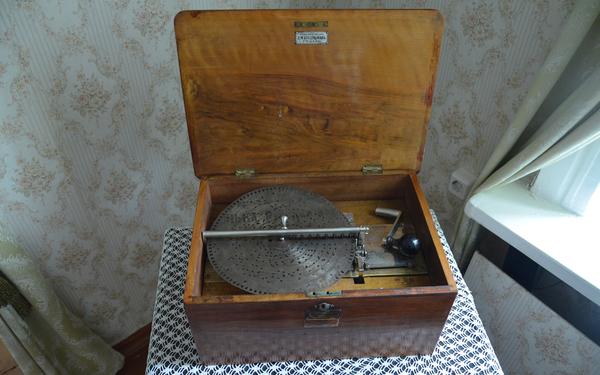
The living room of the Pavlov family estate houses a music box — a wooden box with a lid. On the inside of the lid, there is an inscription that reads, “S.M. Kesselman’s music store”. The box was manufactured in Switzerland and bought in Ryazan. The Stella company produced music boxes of various configurations and types, including pocket and at-home versions, simple and finely decorated instruments. “Shkatula”, the Russian word for a music box, appeared as early as the 16th century when it was used to describe a sturdy box with a leather or iron cover designed for storing and transporting dishes, bottles, papers, and various valuable possessions.
The music box in the house of Pyotr Dmitriyevich Pavlov was mechanical and had to be spring wound to play records. A hand crank was used to wind the disk: the crank was inserted into the opening on the side of the box and slowly rotated. The box could be wound up easily and, despite its old age, has been preserved in good working condition.
The music box was accompanied by a set of records with 19th-century tunes. A record was made in the form of a thin and flexible metal disk with holes and a notch along the outer edge for stopping. A disk was mounted on a special device and had seven tracks, each with a special arrangement of the punched holes. They plucked the tines of a musical comb tuned to certain sounds. The name of the tune is inscribed on the record in this music box: “Night. A Russian song”.
From early childhood, Ivan Petrovich Pavlov loved and understood music, especially classical and church music. The scientist attended theatrical plays and Italian operas, including performances by Angelo Masini, Mattia Battistini, and Enrico Caruso. Ivan Pavlov also enjoyed the music of Russian opera singers, including Nikolay Figner, Feodor Chaliapin, and Leonid Sobinov.
At one of the hospital meetings, Ivan Pavlov said,
The music box in the house of Pyotr Dmitriyevich Pavlov was mechanical and had to be spring wound to play records. A hand crank was used to wind the disk: the crank was inserted into the opening on the side of the box and slowly rotated. The box could be wound up easily and, despite its old age, has been preserved in good working condition.
The music box was accompanied by a set of records with 19th-century tunes. A record was made in the form of a thin and flexible metal disk with holes and a notch along the outer edge for stopping. A disk was mounted on a special device and had seven tracks, each with a special arrangement of the punched holes. They plucked the tines of a musical comb tuned to certain sounds. The name of the tune is inscribed on the record in this music box: “Night. A Russian song”.
From early childhood, Ivan Petrovich Pavlov loved and understood music, especially classical and church music. The scientist attended theatrical plays and Italian operas, including performances by Angelo Masini, Mattia Battistini, and Enrico Caruso. Ivan Pavlov also enjoyed the music of Russian opera singers, including Nikolay Figner, Feodor Chaliapin, and Leonid Sobinov.
At one of the hospital meetings, Ivan Pavlov said,