The Cretaceous period, or Chalk is the last period of the Mesozoic era. It began 145 million years ago and ended 66 million years ago. It was the longest period of the Mesozoic era and lasted for about 79 million years.
The name comes from writing chalk stone, which is extracted from sedimentary deposits of this period, which were formed by large accumulations of fossil invertebrates of marine organisms. Shells in shallow water covered its bottom in several layers, and as a result they turned into chalk.
The Cretaceous climate was noticeably colder compared to the previous Jurassic period. At first, its average temperature across the planet dropped by five degrees. This led to the formation of pole ice caps, but after a while it got warmer, winter temperatures even in the coldest zones of the globe fluctuated around + 4 ° C on average. Towards the end of the period, the greenhouse effect caused by spillovers gave rise to an even greater increase in temperature.
In the Cretaceous period, the contemporary territory of the Belgorod region was covered by the sea. Among the animals that inhabited the Cretaceous Sea, a special place belongs to rhizopods — a group of protozoa, of which the mass of white chalk is composed. The most significant among marine invertebrates in the Cretaceous period were cephalopods. Insects of the Cretaceous period, as well as all kinds of worms, also felt good. The first lobsters and other predatory crustaceans such as crabs and shrimps appeared in coastal seas and oceanic zones.
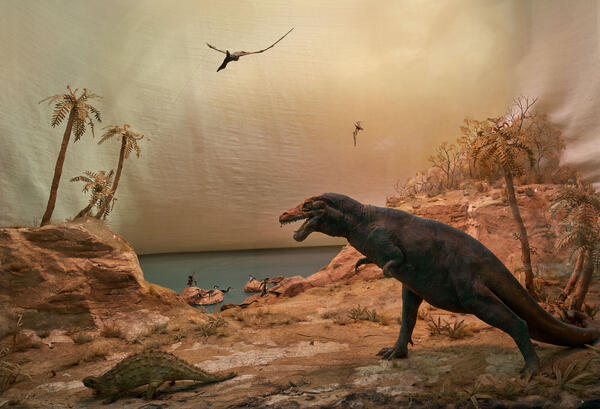
Vertebrates of the Cretaceous period were distinguished by the fact that reptiles reigned supreme among them. Among them were crawling ones, and walking on four limbs, and moving on two hind limbs, and waterfowl and flying hymenoptera. All of them incessantly devoured both huge masses of green spaces and themselves, meanwhile, increasing in numbers, until, incomprehensibly, in the upper Maastricht stage of the Cretaceous period, they died out everywhere.
Over time, the first snakes appeared. Some of them grew to gigantic sizes and hunted mainly in the aquatic environment, in coastal or river basins. And in the depths of the sea, fish with a hard-boned skeleton developed. Mammals of the Cretaceous period weighed no more than half a kilogram and rarely exceeded the size of an ordinary rat. The niche of large predators was occupied by reptiles: ichthyosaurs, plesiosaurs, mosasaurs. Birds also developed widely, the first species of which appeared in the Jurassic period. In the Cretaceous period, there were already highly organized and specialized formations among them.