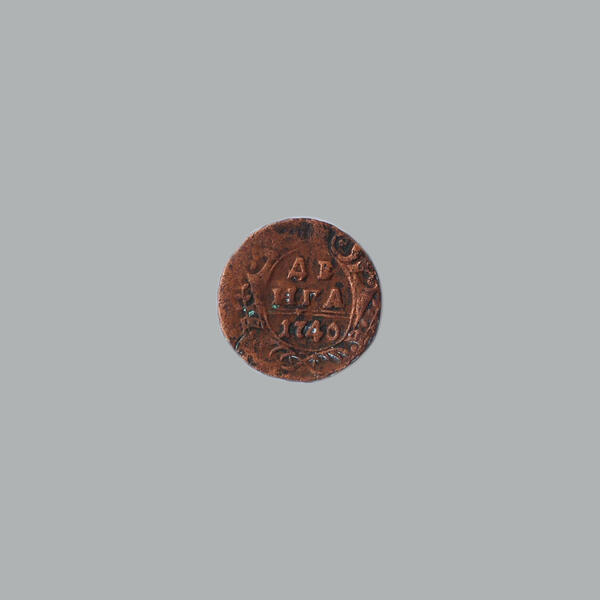
The numismatic collection of the Karasuksky Regional Museum includes a round, solid copper coin, with a face value of a denga, issued in 1740. Coins such as these were in circulation under Anna Ivanovna, the fourth daughter of Ivan V, who was a brother and co-regent to Peter I. They continued to be used under Elizabeth of Russia.
The denga’s obverse shows the simple State coat of arms used by the Russian Empire in the first half of the 18th century. The eagle doesn’t have a shield on its chest or the ribbon of the order of Saint Andrew. Three crowns rest on top of it, whilst it holds an orb and scepter in its talons. The central imperial crown is large and covered, that is, it has a cap within it. The coin’s reverse has the face value displayed over two lines and the date of issuance - 1740. Two lines separate the two pieces of text. As for framing, there are branches on the side and crossed branches at the bottom. Due to the exhibit’s condition, it is not possible to see what type of branches these are, but on other coins from the same production run, it is possible to say that it is a leafy branch. On both sides of the denga coin, the image has shifted to one direction or another during production. On the reverse it is shifted to the right, whilst on the obverse - to the left.
The coin’s edge, or rim, is latticed, made up of criss-crossed cuts. This type of edge design makes forgery significantly more difficult. Usually the design on the edge was made with a specialist milling machine - the coin was rolled with a lot of strength between two steel rails with notches sticking out of them.
The denga is considered to be one of the most common coins of the imperial era, as it was regularly issued between 1730 and 1754. During that time, only the two-headed eagle would change between different versions. This coin has the so-called ‘Yekaterinburgski’ eagle, which was stamped onto coins between 1737 and 1741. The ‘Yekaterinburgski’ eagle differentiates itself from other eagles on the State coat of arms due to its large and wide crown, and triangular body shape. The feathers down the eagle’s side are long and straight. Throughout the whole production run, a total of 17,065,800 coins like this were minted at the Yekaterinburg Mint.
Russian Imperial copper coins between 1730 and 1754 were minted at the Yekaterinburg, Moscow Red and Kadashyovsky mints, and also at the Plaschilnaya mill, a temporary mint on the river Yauza. A ten-ruble copper to coin ratio was used for these coins, meaning that one pood (16.3 kilograms) of copper would be turned into exactly ten rubles of one particular coin type.
The denga’s obverse shows the simple State coat of arms used by the Russian Empire in the first half of the 18th century. The eagle doesn’t have a shield on its chest or the ribbon of the order of Saint Andrew. Three crowns rest on top of it, whilst it holds an orb and scepter in its talons. The central imperial crown is large and covered, that is, it has a cap within it. The coin’s reverse has the face value displayed over two lines and the date of issuance - 1740. Two lines separate the two pieces of text. As for framing, there are branches on the side and crossed branches at the bottom. Due to the exhibit’s condition, it is not possible to see what type of branches these are, but on other coins from the same production run, it is possible to say that it is a leafy branch. On both sides of the denga coin, the image has shifted to one direction or another during production. On the reverse it is shifted to the right, whilst on the obverse - to the left.
The coin’s edge, or rim, is latticed, made up of criss-crossed cuts. This type of edge design makes forgery significantly more difficult. Usually the design on the edge was made with a specialist milling machine - the coin was rolled with a lot of strength between two steel rails with notches sticking out of them.
The denga is considered to be one of the most common coins of the imperial era, as it was regularly issued between 1730 and 1754. During that time, only the two-headed eagle would change between different versions. This coin has the so-called ‘Yekaterinburgski’ eagle, which was stamped onto coins between 1737 and 1741. The ‘Yekaterinburgski’ eagle differentiates itself from other eagles on the State coat of arms due to its large and wide crown, and triangular body shape. The feathers down the eagle’s side are long and straight. Throughout the whole production run, a total of 17,065,800 coins like this were minted at the Yekaterinburg Mint.
Russian Imperial copper coins between 1730 and 1754 were minted at the Yekaterinburg, Moscow Red and Kadashyovsky mints, and also at the Plaschilnaya mill, a temporary mint on the river Yauza. A ten-ruble copper to coin ratio was used for these coins, meaning that one pood (16.3 kilograms) of copper would be turned into exactly ten rubles of one particular coin type.