Patterned knitting is one of the most common women’s crafts of the Khanty and Mansi peoples. The traditions of this craft have been preserved to this day almost in its original form. Knitting techniques and patterns are passed on from generation to generation in the Khanty families, and it is only the yarn composition and the palette of available shades that have changed.
Among the indigenous peoples of the North, researchers distinguish two types of women’s stockings ― “hansan wei” and “yutlan wei”. The top of the hansan wei stocking is decorated with a pattern along the entire length. In the upper part, there are large and complex patterns, and in the lower part, there are three rows of smaller and simpler ones.
The upper part of the yutlan wei stockings is knitted in the same way as that of hansan wei, and the lower part is made of white threads, without decorating it with a pattern. When such a stocking is put on, its middle part is folded, and the unornamented part is hidden inside the folds. Such stockings are considered festive.
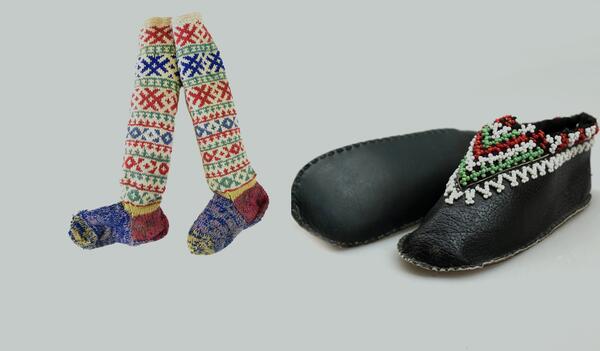
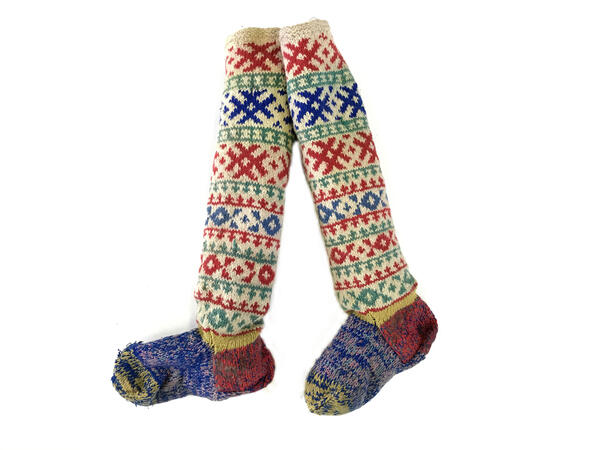
The museum houses the stockings of the first type, hansan wei, the fully ornamented ones. They are quite long, reaching up to the knee. The top is decorated with horizontal stripes of varying width. Such patterns are called ribbon patterns, and each of them has its own name. The top of the boot is decorated with a wide ornament. The sock of such a stocking is either left monochromatic, or decorated with alternating colored stripes and zigzags.
In the old days, only black, white and gray yarn was used for knitting, but over time colored yarn began to be used too. The basis of traditional stockings was made of white sheep wool, and patterns were created from yarn dyed with aniline or vegetable colors, mainly red and blue.
The upper part of the stockings was created based on a traditional Khanty elastic band, which was knitted with threads of two contrasting colors. Thus the stocking fitted the leg tightly, but not too tight. Knitting an elastic band could be circular ― with five needles ― or linear — with two. The top, like the entire stocking, was knitted with a stockinette stitch, with five needles.
Craftswomen learnt the main patterns still in their childhood. In the process of knitting, they could change the patterns as they liked, but in order to make the “right” stockings, it was necessary to meet the three conditions: the traditional color, shape and technology.
Among the indigenous peoples of the North, researchers distinguish two types of women’s stockings ― “hansan wei” and “yutlan wei”. The top of the hansan wei stocking is decorated with a pattern along the entire length. In the upper part, there are large and complex patterns, and in the lower part, there are three rows of smaller and simpler ones.
The upper part of the yutlan wei stockings is knitted in the same way as that of hansan wei, and the lower part is made of white threads, without decorating it with a pattern. When such a stocking is put on, its middle part is folded, and the unornamented part is hidden inside the folds. Such stockings are considered festive.
The museum houses the stockings of the first type, hansan wei, the fully ornamented ones. They are quite long, reaching up to the knee. The top is decorated with horizontal stripes of varying width. Such patterns are called ribbon patterns, and each of them has its own name. The top of the boot is decorated with a wide ornament. The sock of such a stocking is either left monochromatic, or decorated with alternating colored stripes and zigzags.
In the old days, only black, white and gray yarn was used for knitting, but over time colored yarn began to be used too. The basis of traditional stockings was made of white sheep wool, and patterns were created from yarn dyed with aniline or vegetable colors, mainly red and blue.
The upper part of the stockings was created based on a traditional Khanty elastic band, which was knitted with threads of two contrasting colors. Thus the stocking fitted the leg tightly, but not too tight. Knitting an elastic band could be circular ― with five needles ― or linear — with two. The top, like the entire stocking, was knitted with a stockinette stitch, with five needles.
Craftswomen learnt the main patterns still in their childhood. In the process of knitting, they could change the patterns as they liked, but in order to make the “right” stockings, it was necessary to meet the three conditions: the traditional color, shape and technology.