

#1
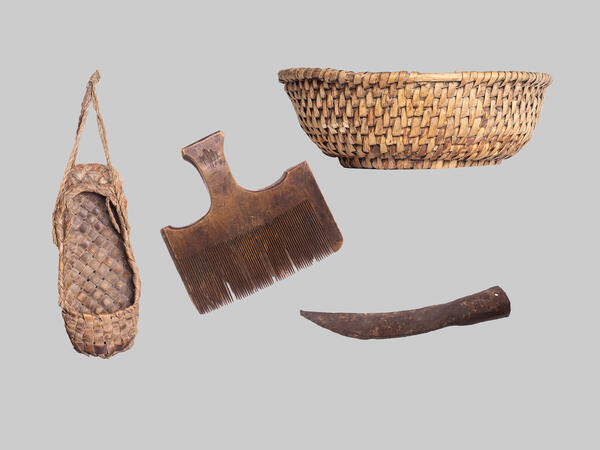
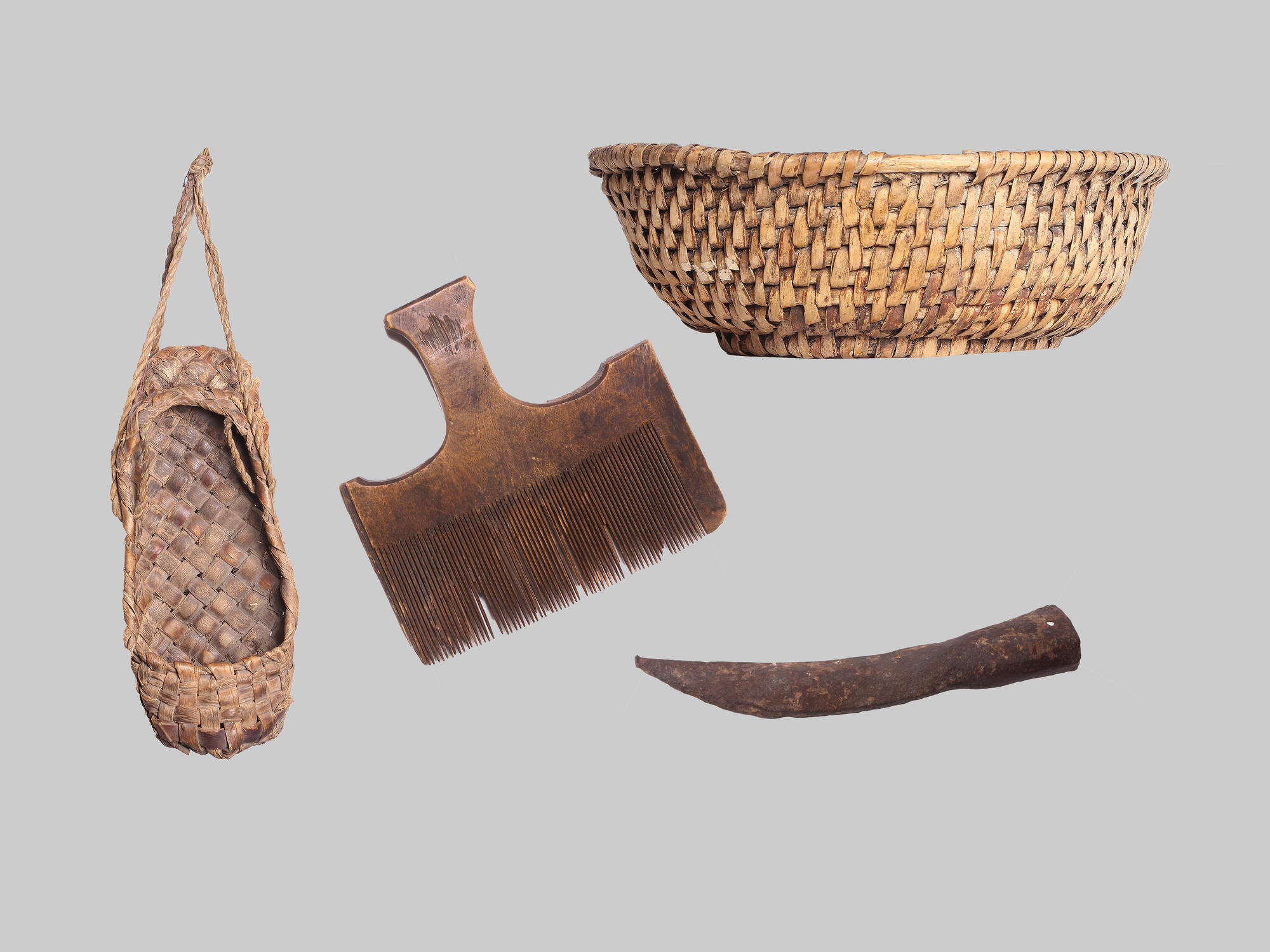
Flax heckling comb, Bast bowl, Bast shoes, Plowshare
#13
#14
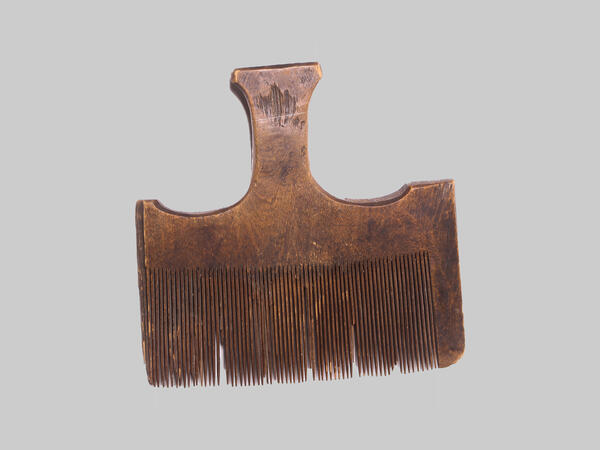
Flax heckling comb
#18
There is a belief that flaxen linen was first produced in ancient India about 9 thousand years ago. Nowadays, flax is not only used in clothes manufacturing, but also in making sackcloth, ropes, sailcloth, fishing nets, and flaxseeds (linseeds) are used to make flaxseed (linseed) oil.
At the close of the 17th century–early 19th century, the flax cost was high. In addition, the government encouraged growing flax in the peasant farms. However, by the end of the 19th century, flax prices started collapsing rapidly. The size of flax growing lands also decreased as a result of the fast growth of the timber industry.
Back in the old days, in order to make flax into the linen, a great amount of time and effort, along with many specific tools, was required. It was necessary to pull the flax stems, tie it in sheaves and ret until autumn or winter. Afterward, the sheaves were taken out of the water, dried in a banya (a steam bath with a wood stove), and scutched, so that the flax fibers become soft. After that, heckling could start.
A heckling comb was used in order to heckle flax tow (refined fiber) in preparation for spinning. One of such tools is displayed in the museum exhibition. A heckling comb is a rectangle wooden blade with long teeth and a flat handle sharp-edged downwards. One comb had 30 to 90 deep teeth. They were used to fix the flax tow.
Flax fibers were heckled differently depending on the region. For instance, they were heckled 2–4 times in the mid-Volga and North-East governorates. In other regions, they were heckled only one time.
When hand-spinning, the separate fibers were placed longitudinally and twisted helically into a long durable thread. In the old days, the ability to spin was considered a woman’s virtue, because one had to be extremely agile to pull out a thread of perfect width. Most skilful spinners could make not more than 300 meters of linen yarn working from dusk to dawn. No less than 20 thousand meters of flax fiber was required in order to get at least 15 meters of linen.
The simplest and the most popular spinning tools in the 17th — 20th centuries were spinning wheels. They were made of different types of wood. For example: the spindle was made out of birchwood, the base was made out of either aspen or linden wood, while the heckles were cut out of hardwood.
At the close of the 17th century–early 19th century, the flax cost was high. In addition, the government encouraged growing flax in the peasant farms. However, by the end of the 19th century, flax prices started collapsing rapidly. The size of flax growing lands also decreased as a result of the fast growth of the timber industry.
Back in the old days, in order to make flax into the linen, a great amount of time and effort, along with many specific tools, was required. It was necessary to pull the flax stems, tie it in sheaves and ret until autumn or winter. Afterward, the sheaves were taken out of the water, dried in a banya (a steam bath with a wood stove), and scutched, so that the flax fibers become soft. After that, heckling could start.
A heckling comb was used in order to heckle flax tow (refined fiber) in preparation for spinning. One of such tools is displayed in the museum exhibition. A heckling comb is a rectangle wooden blade with long teeth and a flat handle sharp-edged downwards. One comb had 30 to 90 deep teeth. They were used to fix the flax tow.
Flax fibers were heckled differently depending on the region. For instance, they were heckled 2–4 times in the mid-Volga and North-East governorates. In other regions, they were heckled only one time.
When hand-spinning, the separate fibers were placed longitudinally and twisted helically into a long durable thread. In the old days, the ability to spin was considered a woman’s virtue, because one had to be extremely agile to pull out a thread of perfect width. Most skilful spinners could make not more than 300 meters of linen yarn working from dusk to dawn. No less than 20 thousand meters of flax fiber was required in order to get at least 15 meters of linen.
The simplest and the most popular spinning tools in the 17th — 20th centuries were spinning wheels. They were made of different types of wood. For example: the spindle was made out of birchwood, the base was made out of either aspen or linden wood, while the heckles were cut out of hardwood.
#19
Полное наименование предмета: Flax heckling comb
Дата создания: the early 20th century
Техника: wood
Владелец коллекции: Mariinsk History Museum
Размеры: 21×21×2 cm
Дата создания: the early 20th century
Техника: wood
Владелец коллекции: Mariinsk History Museum
Размеры: 21×21×2 cm
#12
Bast bowl
#15
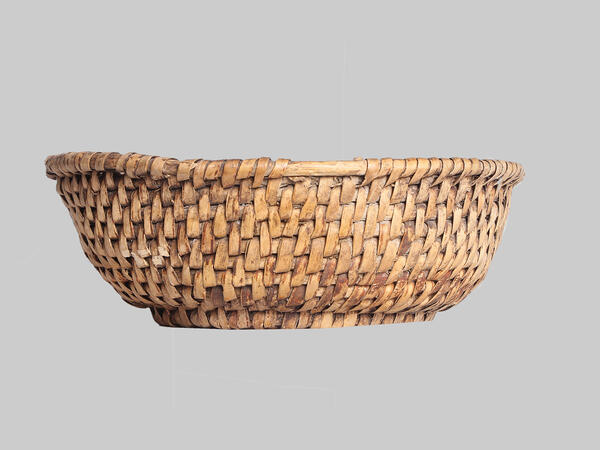
Bast bowl
#20
Siberia territory settlement began more than five centuries ago. The history of Mariinsk is closely connected with the development of Siberian land. The museum houses a whole collection of personal belongings and household items of the settlers. One of these exhibits is a bast bowl made in the beginning of the 19th century. It was used to store and carry food.
Bast bowls were inexpensive, light and relatively firm. This material was extracted from deciduous trees, most often linden, and in order not to damage the bast, craftsmen had to know the structure of the trunk pretty well.
The tree trunk is formed by wood that grows annual rings, i.e. growth rings. The middle of the trunk is sturdier than the rest of it. It is called the heartwood, or duramen. Closer to the edge there is a sapwood, the living, softer wood. The outside of the trunk is protected by the bark. Between the bark and the sapwood there is a thin layer producing cells: during the warm season, they create layers of wood inside the trunk and bark cells outside. This most important layer of cells for the tree and its surroundings is called the bast.
The linden bark can be easily stripped from the tree starting from spring up to the end of July, when the sap ascent stops. However, it was not common to do it in spring: makers waited for a thicker layer by midsummer. If women started to gather bast, the linden trees were not felled. The bast was picked from a standing tree by making notches near the root and above the head as far as the hands could reach. The cut bark was rolled into skeins: the bands were twisted with the bast side out and the bark inside. The skeins were tied with thin strips of the same bast and put together with the linden blanks into the boat.
After arriving home, the makers soaked these skeins in water near the shore. To keep them from floating away, they were pressed with rocks. The place for soaking was shallow and quiet. Later, the skeins were dragged on the shore and unraveled. The resulting ribbons of bark were hung along wooden walkways on special poles for drying and mending nets, i.e. field stands.
Well-soaked bast could be easily separated from the bark. It was usually done with bare hands without any tools, and a knife was used to remove the coarse fibers. Thick and wide multi-layered bast ribbons were divided into equal strips and arranged in different bundles depending on the quality and length of the fibers. The finished ribbons were used to create dishes, bast shoes and other household items.
Bast bowls were inexpensive, light and relatively firm. This material was extracted from deciduous trees, most often linden, and in order not to damage the bast, craftsmen had to know the structure of the trunk pretty well.
The tree trunk is formed by wood that grows annual rings, i.e. growth rings. The middle of the trunk is sturdier than the rest of it. It is called the heartwood, or duramen. Closer to the edge there is a sapwood, the living, softer wood. The outside of the trunk is protected by the bark. Between the bark and the sapwood there is a thin layer producing cells: during the warm season, they create layers of wood inside the trunk and bark cells outside. This most important layer of cells for the tree and its surroundings is called the bast.
The linden bark can be easily stripped from the tree starting from spring up to the end of July, when the sap ascent stops. However, it was not common to do it in spring: makers waited for a thicker layer by midsummer. If women started to gather bast, the linden trees were not felled. The bast was picked from a standing tree by making notches near the root and above the head as far as the hands could reach. The cut bark was rolled into skeins: the bands were twisted with the bast side out and the bark inside. The skeins were tied with thin strips of the same bast and put together with the linden blanks into the boat.
After arriving home, the makers soaked these skeins in water near the shore. To keep them from floating away, they were pressed with rocks. The place for soaking was shallow and quiet. Later, the skeins were dragged on the shore and unraveled. The resulting ribbons of bark were hung along wooden walkways on special poles for drying and mending nets, i.e. field stands.
Well-soaked bast could be easily separated from the bark. It was usually done with bare hands without any tools, and a knife was used to remove the coarse fibers. Thick and wide multi-layered bast ribbons were divided into equal strips and arranged in different bundles depending on the quality and length of the fibers. The finished ribbons were used to create dishes, bast shoes and other household items.
#21
Полное наименование предмета: Bast bowl
Дата создания: the early 19th century
Техника: weaving
Владелец коллекции: Mariinsk History Museum
Размеры: 27×27×10 cm
Дата создания: the early 19th century
Техника: weaving
Владелец коллекции: Mariinsk History Museum
Размеры: 27×27×10 cm
#11
Bast shoes
#16
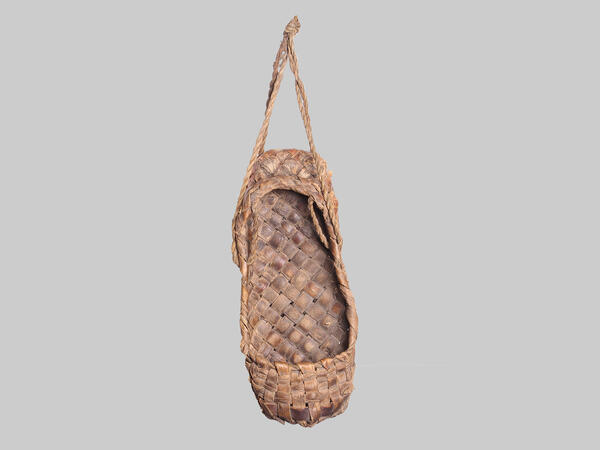
Bast shoes
#22
One of the first mentions of bast shoes is found in The Tale of Bygone Years (Primary Chronicle), a document created by Nestor the Chronicler in the 1110s. Until the 1930s, bast shoes were popular footwear in Eastern Europe and especially in rural areas.
Bast shoes, similar to those in the museum’s collection, were made using the technique of oblique weaving from linden bast. This material was harvested in spring or fall: the bark was cut into long strips, rolled up, and kept dry in the entryway or in the attic. Before weaving, the bast was soaked in water for 24 hours or steamed in an oven.
Then, the wide pieces were cut into narrow strips and a top layer of bark was peeled off. About 300 pairs of bast shoes could be made from 40–60 bast bunches, in each there were 50 straws. The weaving speed was different for different craftsmen, but on average, one craftsman could make from two to ten pairs per day.
Six prepared strips were used to form the basis of the bast shoe — weaves, it was woven from heel to toe. When the shoe head was ready, the bast was pulled on a special shoetree and then, the sides were woven — “ushniki”, as well as fastenings for latchets — “zapyatniki”. For durability, the sole was levered up with a second layer of bast. For this, a tool was used — a flat curved awl — “kochedyk”. Both bast shoes were usually weaved using one shoetree, and therefore in a pair, the left bast shoe did not differ from the right one. Finished shoes were cut from the shoetree and tapped to straighten the weaving and shape the bast shoe.
On average, one pair of bast shoes was worn for one or two weeks, so they were made for future use for several dozen: a peasant wore out from 50 to 60 pairs per year. If the sole was rubbed, it was repaired by picking it again with a kochedyk. Usually, bast shoes were worn with footwraps, and they were attached to the leg with latchets — laces twisted from the same bast as the shoes.
Bast shoes were the shoes of the poorest strata of the population of Russia, since the material for their weaving was available, the technique was simple, and the shoes themselves were practical and quite comfortable to wear. Whole settlements, and sometimes even regions, were engaged in bast shoes weaving.
Since bast shoes have ceased to be used in everyday life, the technology of their manufacture began to be forgotten. Nowadays, bast shoes are weaved only to order, most often for members of folklore ensembles or as souvenirs.
Bast shoes, similar to those in the museum’s collection, were made using the technique of oblique weaving from linden bast. This material was harvested in spring or fall: the bark was cut into long strips, rolled up, and kept dry in the entryway or in the attic. Before weaving, the bast was soaked in water for 24 hours or steamed in an oven.
Then, the wide pieces were cut into narrow strips and a top layer of bark was peeled off. About 300 pairs of bast shoes could be made from 40–60 bast bunches, in each there were 50 straws. The weaving speed was different for different craftsmen, but on average, one craftsman could make from two to ten pairs per day.
Six prepared strips were used to form the basis of the bast shoe — weaves, it was woven from heel to toe. When the shoe head was ready, the bast was pulled on a special shoetree and then, the sides were woven — “ushniki”, as well as fastenings for latchets — “zapyatniki”. For durability, the sole was levered up with a second layer of bast. For this, a tool was used — a flat curved awl — “kochedyk”. Both bast shoes were usually weaved using one shoetree, and therefore in a pair, the left bast shoe did not differ from the right one. Finished shoes were cut from the shoetree and tapped to straighten the weaving and shape the bast shoe.
On average, one pair of bast shoes was worn for one or two weeks, so they were made for future use for several dozen: a peasant wore out from 50 to 60 pairs per year. If the sole was rubbed, it was repaired by picking it again with a kochedyk. Usually, bast shoes were worn with footwraps, and they were attached to the leg with latchets — laces twisted from the same bast as the shoes.
Bast shoes were the shoes of the poorest strata of the population of Russia, since the material for their weaving was available, the technique was simple, and the shoes themselves were practical and quite comfortable to wear. Whole settlements, and sometimes even regions, were engaged in bast shoes weaving.
Since bast shoes have ceased to be used in everyday life, the technology of their manufacture began to be forgotten. Nowadays, bast shoes are weaved only to order, most often for members of folklore ensembles or as souvenirs.
#23
Полное наименование предмета: Bast shoes
Дата создания: the mid-19th century
Техника: weaving
Владелец коллекции: Mariinsk History Museum
Размеры: 27×12×5 cm
Дата создания: the mid-19th century
Техника: weaving
Владелец коллекции: Mariinsk History Museum
Размеры: 27×12×5 cm
#10
Plowshare
#17
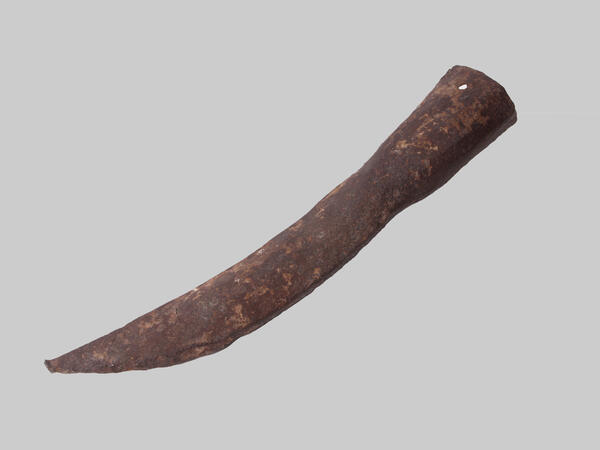
Plowshare
#24
The Moscow-Siberian Highway ran near Archekas Mountain on the Kiya River, where an ancient Selkup settlement was located, and later the village of Kiya (now Mariinsk) appeared. Until the very opening of the Trans-Siberian Railway in the 1890s, the highway was the main transport link of the empire. Voluntary resettlers, travelers and artisans were the first to travel along it. First of all they were attracted by a new and, as they used to say then, ‘unknown country’, that is the vast territories of the Khanate of Sibir, rich in valuable fur peltries. At the end of the 16th century, after the successful campaign of the cossack ataman and leader of the Moscow army Yermak Timofeyevich against the Siberian Khan (leader) Kuchum, Siberia finally joined the Russian state.
Already by the end of the 17th century, the number of Russians in these areas exceeded the number of different-tribe local population. Millions more Russian peasants migrated to Siberia in a relatively short period after the reform in 1861. Historian Boris Nolde noted:
Already by the end of the 17th century, the number of Russians in these areas exceeded the number of different-tribe local population. Millions more Russian peasants migrated to Siberia in a relatively short period after the reform in 1861. Historian Boris Nolde noted:
#25
It remains a mystery how, in a country without roads or other means of communication, the news about vast and fertile lands waiting for their owners spread so rapidly.
#26
The settler peasants began to cultivate the Siberian land. They sowed rye, millet, barley, oats, buckwheat, wheat, flax, and hemp. In the end of the 18th century, peasants started to plant potatoes. They also grew rutabagas, turnips, radishes, cabbages, carrots, beets, cucumbers, pumpkins, beans, onions, and much more.
In the old day, a plow, or a sokha, was used for agricultural works. The sokha was a tool with a wide working part equipped with two iron plowshares (cutting parts) and an iron shovel. The working part was connected to the plowshare, in which the horse was harnessed. One of these metal plowshares is displayed at the collection of the museum.
Sokha was a simple device. Peasants usually made it themselves, so its appearance might differ from village to village. There was even a proverb: ‘From one sokha to another, plow to plow, horse to horse, summer to summer are not alike.’ Thanks to its versatility and accessibility, the sokha remained the main tool for tillage until the 1930s.
In the old day, a plow, or a sokha, was used for agricultural works. The sokha was a tool with a wide working part equipped with two iron plowshares (cutting parts) and an iron shovel. The working part was connected to the plowshare, in which the horse was harnessed. One of these metal plowshares is displayed at the collection of the museum.
Sokha was a simple device. Peasants usually made it themselves, so its appearance might differ from village to village. There was even a proverb: ‘From one sokha to another, plow to plow, horse to horse, summer to summer are not alike.’ Thanks to its versatility and accessibility, the sokha remained the main tool for tillage until the 1930s.
#27
Полное наименование предмета: Plowshare
Дата создания: the early 18th century
Техника: metal
Владелец коллекции: Mariinsk History Museum
Дата создания: the early 18th century
Техника: metal
Владелец коллекции: Mariinsk History Museum
Размеры: 43×10×7 cm
#9
Ministry of Culture of the Russian Federation
read morehide
00:00
00:00
1x
Flax heckling comb, Bowl, Shoes, Plowshare
Collection
Exhibition
0
 Point your smartphone camera to open in the app
Open in app
Share