The heart-shaped glass inkwell from the museum’s collection used to belong to Lydia Avilova — a Russian writer and an acquaintance of Anton Chekhov. This inkwell is likely to be a present from Chekhov himself.
Lydia Avilova was born into a noble family of modest means in Tula Governorate on June 15, 1864. She graduated from a gymnasium in Moscow and, together with her husband, moved to St. Petersburg where her literary career began. While visiting the house of Sergey Khudekov, her brother-in-law and the publisher of “Peterburgskaya Gazeta” (St. Petersburg Newspaper), she got acquainted with many representatives of the literary elite, including Anton Chekhov. Lydia Avilova described their first meeting in 1889 in the following manner,


Heart-shaped glass inkwell
Creation period
the late 19th — early 20th century
Place of сreation
the Russian Empire
Dimensions
12,5x12,4x5,5 cm
Technique
metal, glass; molding, blowing
Exhibition
0
Open in app#10
#11
How difficult it is sometimes to explain and even to perceive the true meaning of some happening. And as a matter of fact nothing did actually happen. We simply looked closely into each other’s eyes. But how much there was in the look we had exchanged! I felt as if something had burst in my soul, as if some rocket had exploded there brightly, joyfully, triumphantly, rapturously. I had no doubt that Chekhov felt the same, and we looked at each other surprised and happy.
#12
In 1890, Lydia Avilova started publishing short stories in St. Petersburg newspapers and magazines. Later, her first collection came out under the title “Lucky Man and Other Stories”. Avilova’s art reflected her impressions and memories of her life in the family estate which was so dear to her. In 1906, together with her family, the writer returned to Moscow where she published her new books, including “The Power and Other Stories”, “The Son. A Short Story”, “The First Grief and Other Stories”, “Human Nature”, “Splendid Life. Kamardin”.
Lydia Avilova had profound respect for Anton Chekhov and repeatedly turned to him for advice. Chekhov appreciated Avilova’s literary talent, reviewed her manuscripts, and helped her get published. They met rarely but stayed in touch until the end of the writer’s life.
After Chekhov’s death, Lydia Avilova published memoirs titled “Chekhov in My Life” which sparked controversy. Its authenticity was challenged by the writer’s sister Maria Chekhova but confirmed by Ivan Bunin who was well acquainted with both Chekhov and Avilova.
There are 31 known letters of Anton Chekhov to Lydia Avilova. She got rid of her own letters. There are only three left, in which she wrote about publishing a collection of stories for wounded soldiers in 1904. Later, she said, #13
Without revisiting them, I threw them into a stove. I deeply regret having done so. However, I could not help asking myself over and over again: why did he collect and treasure these letters?
#15
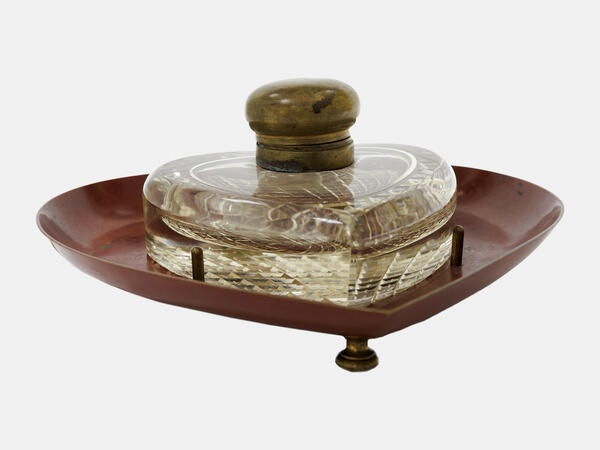
Heart-shaped glass inkwell
#14
Ministry of Culture of the Russian Federation
read morehide
00:00
00:00
1x
Heart-shaped glass inkwell
Creation period
the late 19th — early 20th century
Place of сreation
the Russian Empire
Dimensions
12,5x12,4x5,5 cm
Technique
metal, glass; molding, blowing
Exhibition
0
 Point your smartphone camera to open in the app
Open in app
Share