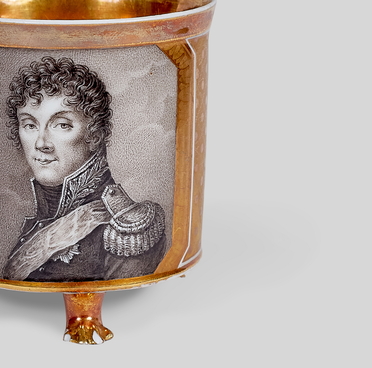
Porcelain was invented in China around the 7th century. For a long time, it was exported only to Asia and the Middle East. Gradually some porcelain wares started to appear in Europe as well, brought home by travelers from distant countries.
In the early 16th century, Portuguese merchants delivered the first big shipment of products made of the precious material. At that time, the Europeans did not know the porcelain manufacturing secrets, and the so-called “white gold” was extremely expensive.
Many European rulers wished to get wise to the secret of porcelain. German craftsmen were the first to find a solution to this difficult problem. They were employed by Augustus II the Strong, Elector of Saxony, in the early 18th century.
As a result of numerous experiments, the scientist, mathematician, and physicist Ehrenfried Walther von Tschirnhaus and the court alchemist Johann Friedrich Böttger managed to develop porcelain. They built a kiln that was able to maintain the high temperatures required for firing porcelain.
In 1710, the famous Meissen factory was established at Albrechtsburg Castle. The composition of porcelain and bright paints was closely guarded, but, in spite of this, other porcelain factories appeared very soon.
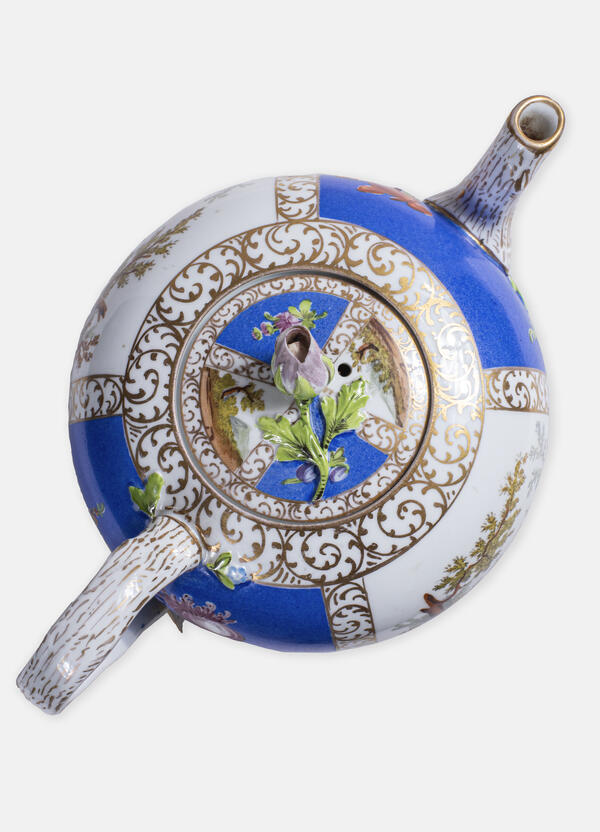
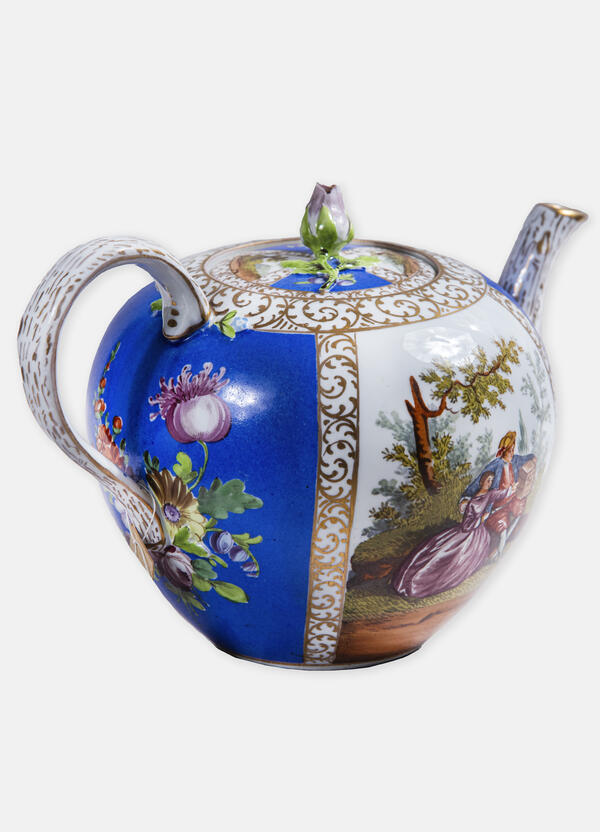
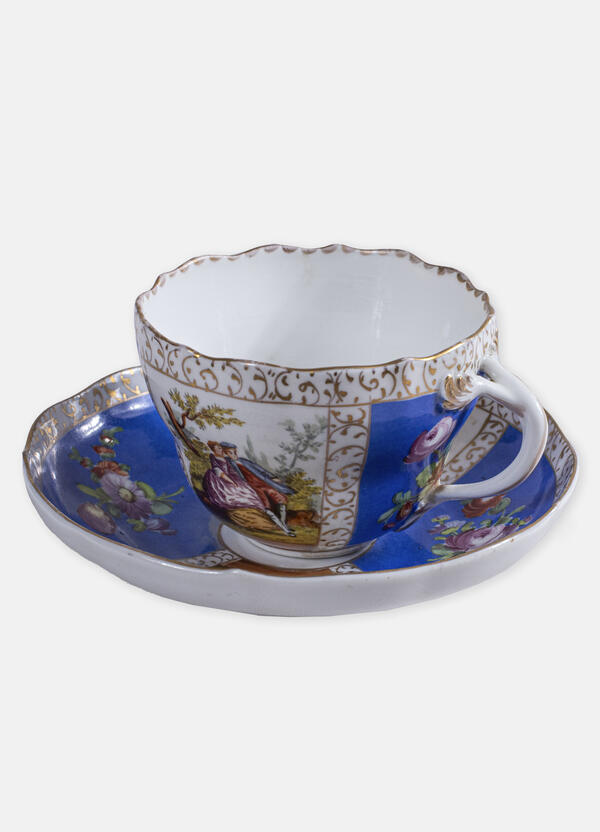
The tea set from the museum’s collection was designed in the traditional Meissen style. The decoration of all pieces is based on using a combination of bright, high-contrast colors. White areas with romantic scenes alternate with bright blue areas with colorful flower bouquets. They are separated by bands with gilded plant scroll patterns.
The handles of the teapot and the milk jug, as well as the spout of the teapot, are painted with a gilded tree bark pattern. The cup’s handles are shaped like two intertwined stems and attached to the bottom of the cup with leaves. The lids of the Meissen factory products were often decorated using molded figurines of people or various fruits.
Lids were often crowned with porcelain rosebuds. The tea set displayed at the exhibition is an example of this trend. The rose was crafted manually by assembling individual petals while the porcelain was still soft and malleable. After that, the rose was attached to the product which was then fired in the kiln.
In the early 16th century, Portuguese merchants delivered the first big shipment of products made of the precious material. At that time, the Europeans did not know the porcelain manufacturing secrets, and the so-called “white gold” was extremely expensive.
Many European rulers wished to get wise to the secret of porcelain. German craftsmen were the first to find a solution to this difficult problem. They were employed by Augustus II the Strong, Elector of Saxony, in the early 18th century.
As a result of numerous experiments, the scientist, mathematician, and physicist Ehrenfried Walther von Tschirnhaus and the court alchemist Johann Friedrich Böttger managed to develop porcelain. They built a kiln that was able to maintain the high temperatures required for firing porcelain.
In 1710, the famous Meissen factory was established at Albrechtsburg Castle. The composition of porcelain and bright paints was closely guarded, but, in spite of this, other porcelain factories appeared very soon.
The tea set from the museum’s collection was designed in the traditional Meissen style. The decoration of all pieces is based on using a combination of bright, high-contrast colors. White areas with romantic scenes alternate with bright blue areas with colorful flower bouquets. They are separated by bands with gilded plant scroll patterns.
The handles of the teapot and the milk jug, as well as the spout of the teapot, are painted with a gilded tree bark pattern. The cup’s handles are shaped like two intertwined stems and attached to the bottom of the cup with leaves. The lids of the Meissen factory products were often decorated using molded figurines of people or various fruits.
Lids were often crowned with porcelain rosebuds. The tea set displayed at the exhibition is an example of this trend. The rose was crafted manually by assembling individual petals while the porcelain was still soft and malleable. After that, the rose was attached to the product which was then fired in the kiln.