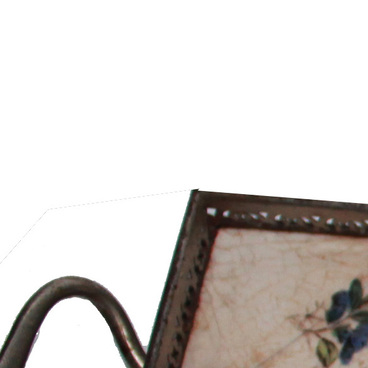
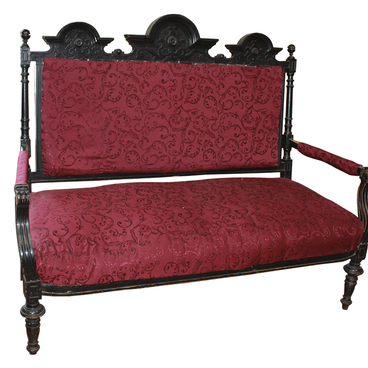
The side table in the merchant’s drawing room is adorned with a tea set consisting of a teacup with a saucer, a sugar bowl, and a candy dish. Porcelain exhibits hold a special place in the collection of the Tomsk History Museum. The famous Kuznetsov porcelain, which, among other items, includes teacups and saucers from our collection, is a classic example of typical Russian-produced porcelain of the late 19th century.


Teacup with a saucer
Creation period
Late 19th–early 20th century
Place of сreation
"M. S. Kuznetsov's Partnership for the Production of Porcelain, Faience, and Majolica Items", Russia
Dimensions
6.9 x 8 cm; 14 x 2.4 cm
Technique
Molding, casting, hand painting
Collection
Exhibition
2
Open in app#1
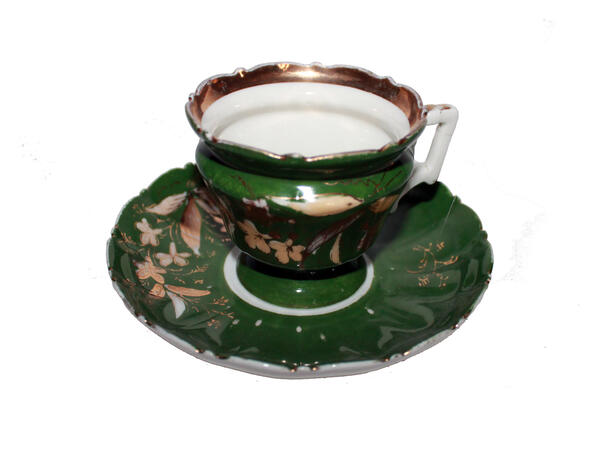
Teacup With a Saucer
#3
#4
“M. S. Kuznetsov”s Partnership for the Production of Porcelain, Faience, and Majolica Items” was one of the largest manufacturers of porcelain and faience in the Russian Empire in the late 19th and the early 20th centuries. The Kuznetsov family was engaged in the production of porcelain for several generations and was considered the industry leader for about a century. Eventually, they managed to drive almost all foreign and domestic competitors out of the Russian market, with their only remaining rival being the Imperial Porcelain Factory. In 1889, the Kuznetsovs' enterprise secured a real monopoly over the production of tableware. Matvey Kuznetsov, who headed the company at the time, acquired a number of bankrupt businesses practically for pennies. Among them was Auerbach’s faience factory.
#5
Kuznetsov established a Partnership with a board based in Moscow and almost twenty branches. In the production process, he placed a particular emphasis on the aesthetic value of the Partnership’s porcelain products. For this reason, the head of the company sent some of his artisans to study at the Stroganov School and collaborated with artists, such as Mikhail Vrubel. The Partnership produced porcelain for a wide range of social strata: its tableware was used for serving food in the imperial palace, taverns, merchant houses, and even peasant huts. Peasants could afford modest dishes painted to imitate those of nobility, while merchants purchased plates and cups decorated with gold finish. The factories continued to operate until 1917, when most businesses were nationalized.
#6
The elegant pairs of teacups and saucers from the collection of the Tomsk History Museum are colored in various shades of green. The items were hand-painted with floral motifs, such as flower buds, leaves, and numerous ringlets decorated with gilding. On the inside, the edge of the cups is decorated with a golden rim.
#7
Tomsk History Museum
read morehide
00:00
00:00
1x
Teacup with a saucer
Creation period
Late 19th–early 20th century
Place of сreation
"M. S. Kuznetsov's Partnership for the Production of Porcelain, Faience, and Majolica Items", Russia
Dimensions
6.9 x 8 cm; 14 x 2.4 cm
Technique
Molding, casting, hand painting
Collection
Exhibition
2
 Point your smartphone camera to open in the app
Open in app
Share