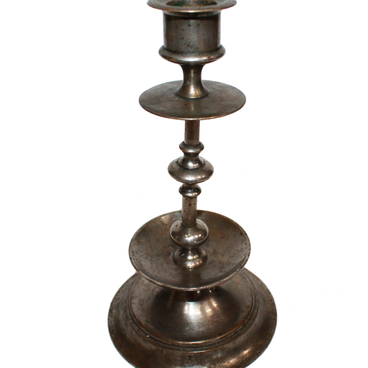
In past centuries, clocks were among the most important design elements of drawing rooms. The wealthier merchants and aristocrats could afford European-made grandfather clocks, while ordinary townspeople had wall clocks with chimes. Oftentimes, their movements were produced in European countries, such as France or Germany; however, clock cases were still built in Russia, as it was cheaper to deliver finished products to the domestic market this way.

Advertisement of the "M. P. Kalashnikov & Son" trading house.
Часы настенные


1 / 3
Wall clock
Creation period
Second half of the 19th century
Place of сreation
Russia, Switzerland
Dimensions
120 х 39.2 х 20.5 cm
Technique
Industrial production
Collection
Exhibition
1
Open in app#1
Wall Clock
#3
#4
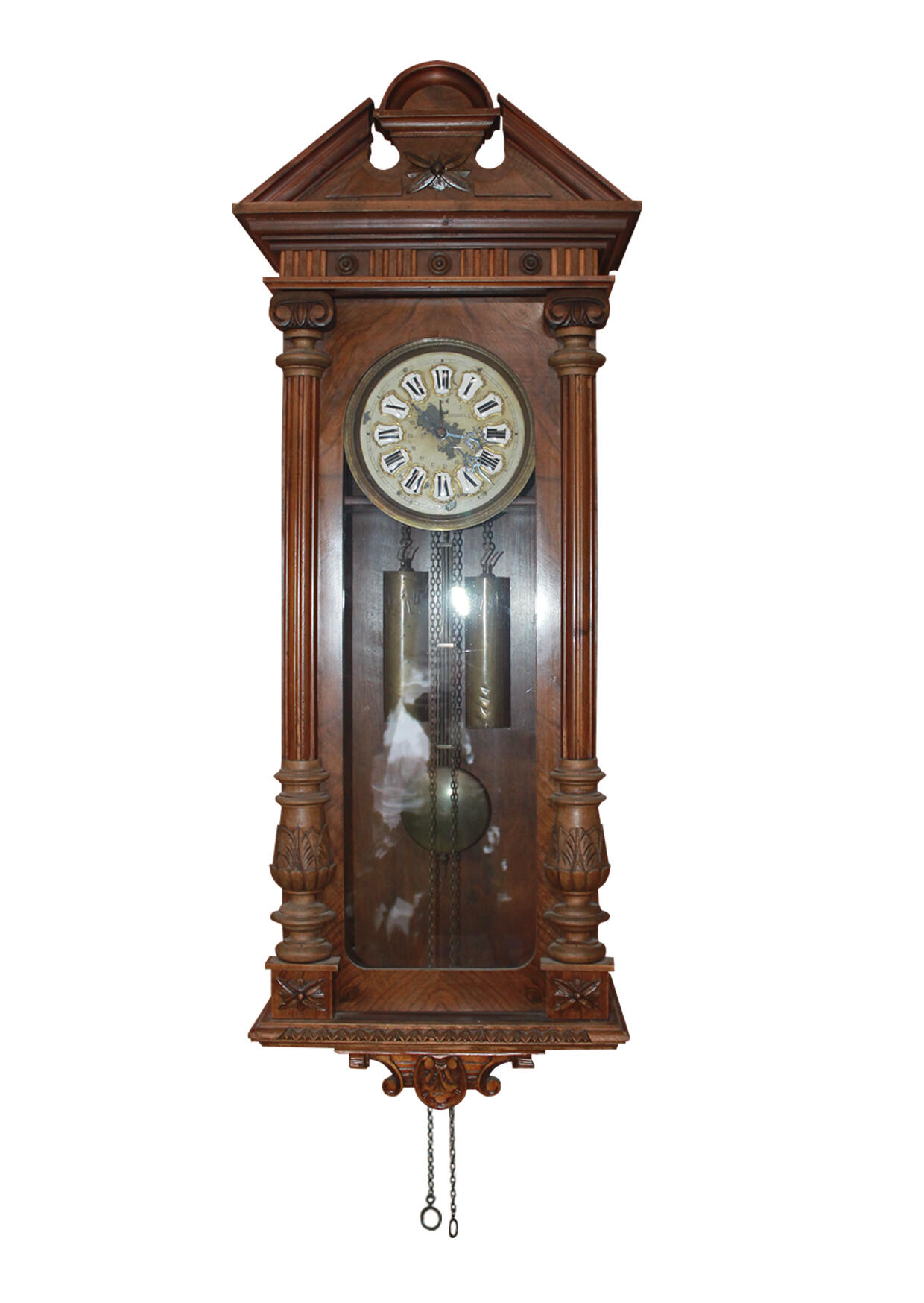
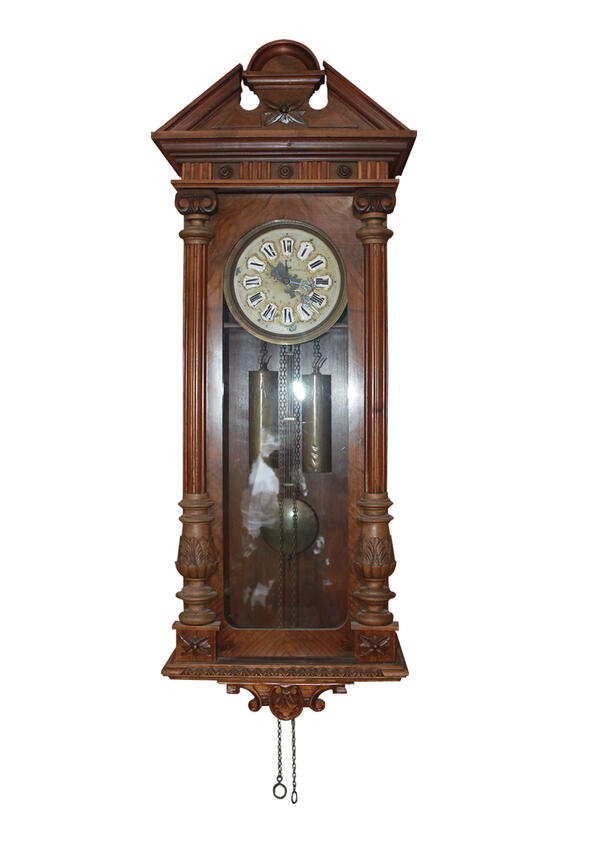
The drawing room of the Tomsk History Museum contains a clock that was created in this very manner about a hundred years ago. The clock face is marked with the print of the famous ‘M. P. Kalashnikov & Son’ trading house, which indicates that the clock was produced in Russia. However, it is also known that the timepiece is fitted with a Swiss-made movement.
#5
The clock was created in Moscow in the second half of the 19th century. Mikhail Kalashnikov (1809–1892), who was a second-guild merchant, established his trading house in 1832. In the mid-1870s, the family business was joined by his son Pyotr, and the company was renamed ‘M. P. Kalashnikov & Son.’ It produced all kinds of timepieces: pocket watches, wall clocks, and floor clocks, as well as sold them, both wholesale and retail. They fitted their products with movements produced by foreign manufacturers (by Lenzkirch, Moser, and others) and marked clock faces with the print ‘Kalashnikov & Son, Moscow, ’ while the cases were, in part, built in their own workshops and, in part, supplied from abroad: like, for instance, pocket watch cases.
#6
Researchers believe that the movement installed in the wall clock from the collection of the Tomsk History Museum was produced by the Swiss brand Moser. Moser supplied movements of this type to Russia from the late 18th to the early 20th centuries, with their design remaining practically the same throughout all this time. In 1828, Johann Heinrich Moser established a St. Petersburg-based trade office, which was engaged in the assembly of clocks from parts imported from the Swiss town of Le Locle.
#7
There is an interesting story associated with the clock: it is said to have been brought to the Museum by one of the descendants of the merchant family. Originally, this item belonged to one of the sons of Yevgraf Kukhterin, a famous Tomsk merchant. He gave it as a wedding gift to a servant girl who worked in their house.
#8
Ministry of Culture of the Russian Federation
read morehide
00:00
00:00
1x
Wall clock
Creation period
Second half of the 19th century
Place of сreation
Russia, Switzerland
Dimensions
120 х 39.2 х 20.5 cm
Technique
Industrial production
Collection
Exhibition
1
 Point your smartphone camera to open in the app
Open in app
Share