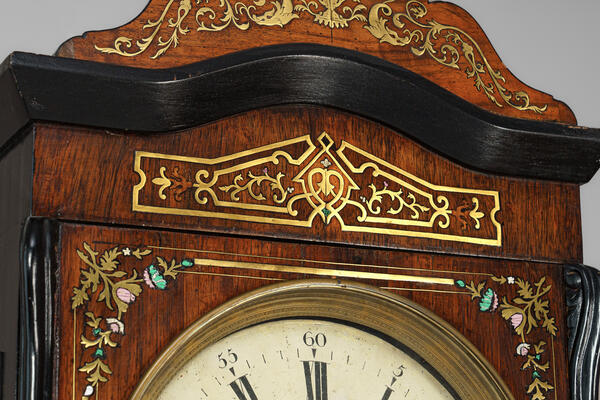
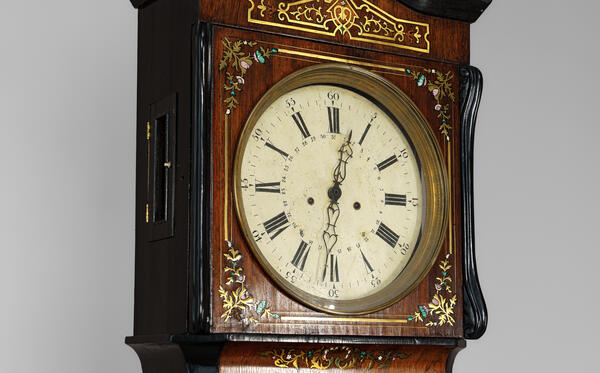
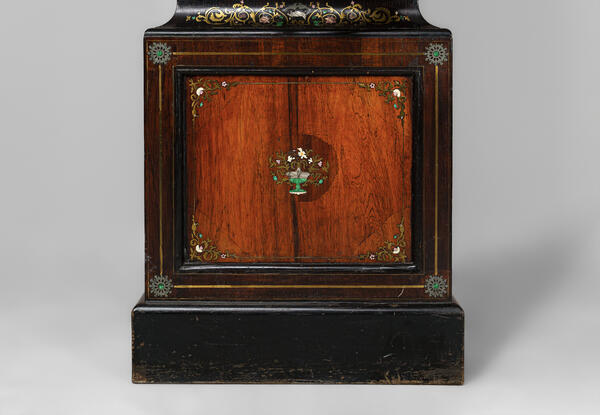
The Lipetsk Regional Museum of Local Lore houses a floor clock produced in the second half of the 19th century.
The clock has a case that consists of three parts: a base, a middle part (the size of the pendulum), and an upper part with a hole for the dial, topped by a pediment. The front side of the case is inlaid with decorations made of yellow metal and green, pink, and white mastic. The front corners of the case have small carvings, and the body of the case (except for the front side) is made from simple wood painted brown and black. In the upper part of the case, there are doors on both sides, making it easy to access the movement. The dial of the displayed clock indicates not only hours and minutes but also the date. In such clocks, this additional arrow had to be adjusted once a month depending on the number of days. The clock was restored in October 1980.
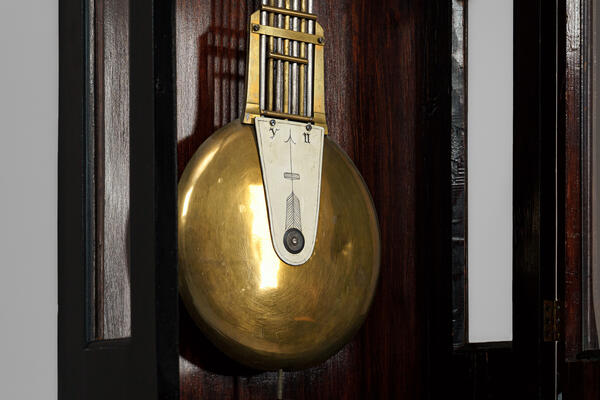
The history of floor clocks can be traced back to the 17th century. In the 1650s and 1660s, they were known as “longcase clocks”, as they had a long case. The clock had a dial on top, and the movement and pendulum were hidden inside the case. These clocks were not tall and not exactly accurate. In 1670, the British clockmaker William Clement discovered a pattern. He found out that a longer pendulum ensured higher accuracy of the clock. As a result, most clocks from that period were equipped with heavy and extremely long pendulums. These long-pendulum clocks showed the time with maximum precision, but they also became much taller — their height reached up to 270 centimeters. The steady ticking of such clocks created a soothing sound. They quickly gained popularity. To give the clock a livelier appearance, the movement of the pendulum was often exposed, covered only with a glass window. In this way, the pendulum served as an additional element of interior décor.