

From the early 18th century, Russian churches kept parish registers, which contained information about births, marriages, and deaths in a parish.
When people were born and information about them was recorded in a register, their number was written in the first column, and the other columns indicated the date of their birth and baptism, their name and sex, as well as the place of residence and class affiliation. If a child was born into a family of serfs, in addition to the names of the parents, the name of their property owner was written down as well. The information about godparents and the priest, who performed the baptism ceremony, was also recorded.
Similar information was recorded at weddings. Witnesses could also write notes in a register if they wished. At the end of each month, scribes counted how many people were born and how many died and got married.
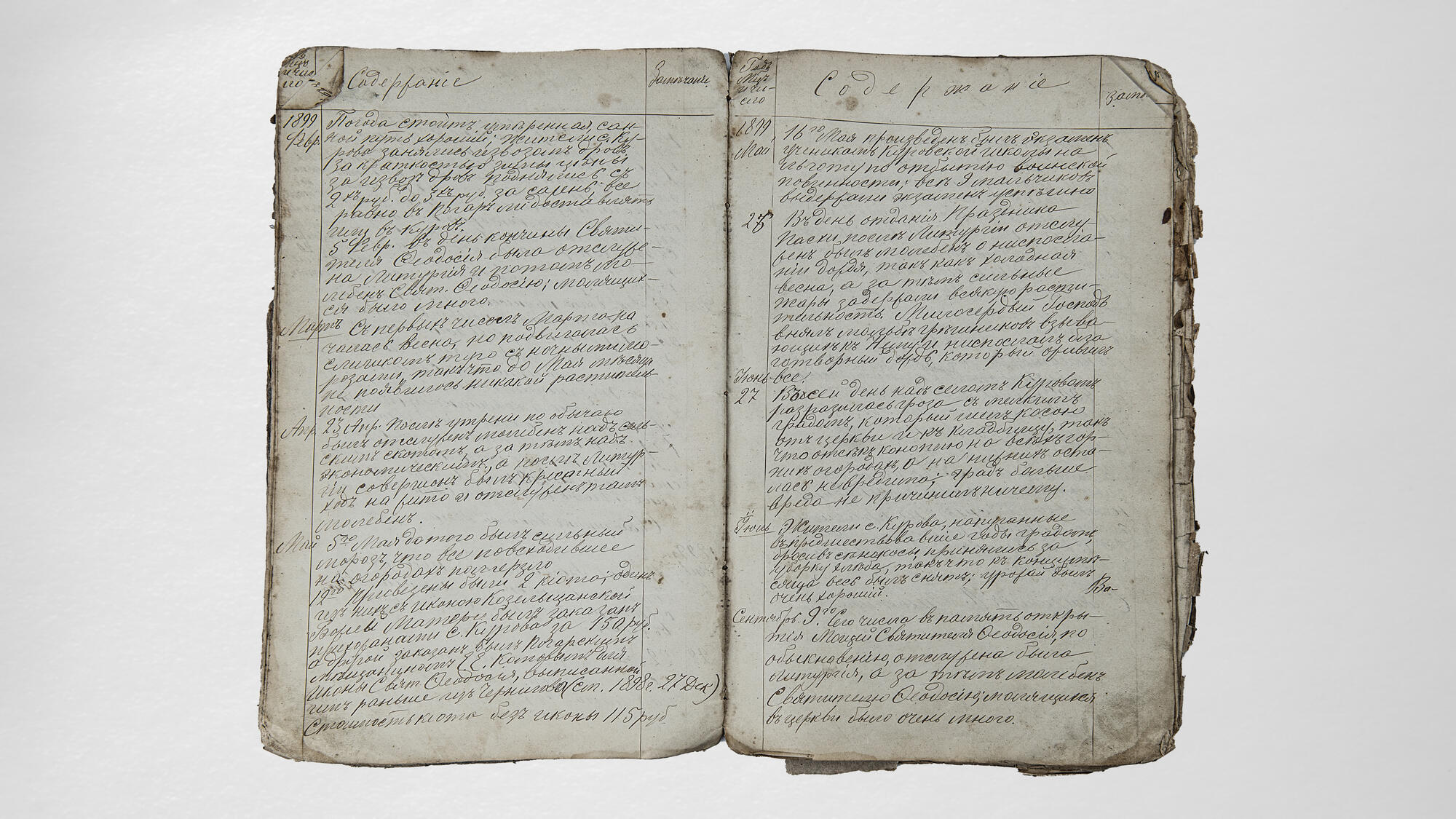
The Radogoshch Museum houses a parish register of the Saint Nicholas Church in the village of Kurovo. Since the mid-17th century, Kurovo was a Cossack village where the Pogar sotnya (company of 100 soldiers) was stationed. After the Cossacks took away Starodub and its surroundings from the Poles, the village was considered independent. Kurovo was subordinate only to sotniks and higher Cossack commanders.
The Saint Nicholas Church in Kurovo was built in 1767. The parish of Saint Nicholas Church was considered the largest in the village. In the early 20th century, it consisted of 193 households or 1247 people.
The register is green and consists of 100 pages. The title page contains an inscription,
When people were born and information about them was recorded in a register, their number was written in the first column, and the other columns indicated the date of their birth and baptism, their name and sex, as well as the place of residence and class affiliation. If a child was born into a family of serfs, in addition to the names of the parents, the name of their property owner was written down as well. The information about godparents and the priest, who performed the baptism ceremony, was also recorded.
Similar information was recorded at weddings. Witnesses could also write notes in a register if they wished. At the end of each month, scribes counted how many people were born and how many died and got married.
The Radogoshch Museum houses a parish register of the Saint Nicholas Church in the village of Kurovo. Since the mid-17th century, Kurovo was a Cossack village where the Pogar sotnya (company of 100 soldiers) was stationed. After the Cossacks took away Starodub and its surroundings from the Poles, the village was considered independent. Kurovo was subordinate only to sotniks and higher Cossack commanders.
The Saint Nicholas Church in Kurovo was built in 1767. The parish of Saint Nicholas Church was considered the largest in the village. In the early 20th century, it consisted of 193 households or 1247 people.
The register is green and consists of 100 pages. The title page contains an inscription,