#1
Glass bottle, Gorka. Upper portion, Brewing Mug, Ceramic milk jug, Two-part wooden table, Women’s blouse, Tripod table (stand) with marble top, Wall clock in a carved wooden case
#18
#2
#3
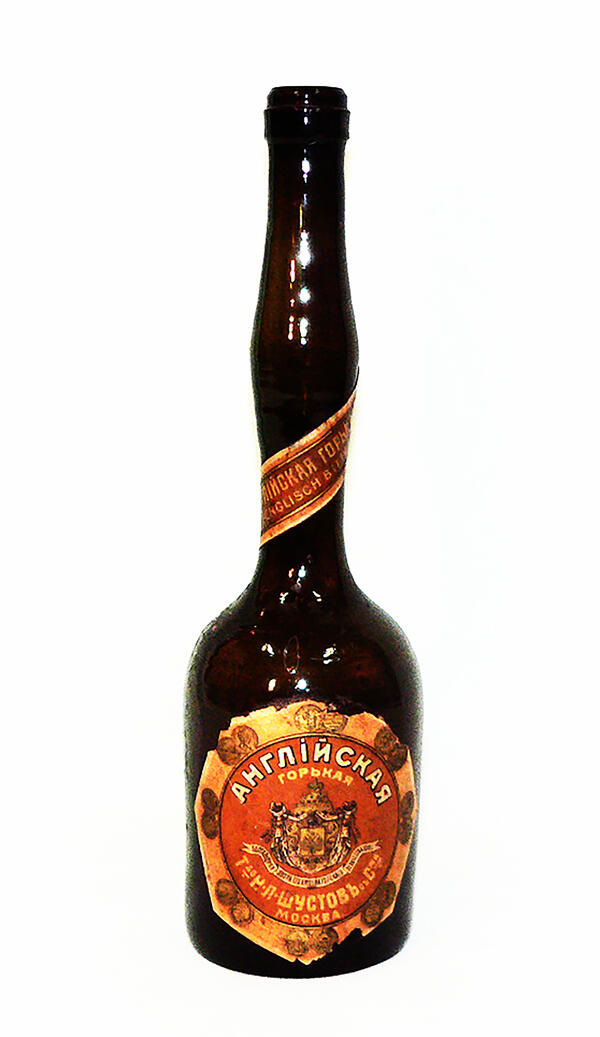
One of the exhibits in the Kótlas Museum is this thin glass bottle with a thin long neck. On the neck, there is a label with the words ‘English bitters’, and on the body, a label reading ‘English bitters of the suppliers of His Imperial Majesty’s Court in 1912. N.L. Shústov’s Partnership with Moscow’. English bitters were poured into these bottles. The volume of the bottle is a quarter of a damask, or 1/40 of a bucket. This is approximately 0.31 liters. The bottle is 24 centimeters high.
The bottle was made specifically for the Shústov and Sons partnership, which produced alcoholic beverages. Its founder was entrepreneur Nikolai Shústov (1813–1898), one of the most prolific alcohol producers during the Russian Empire at the end of the 19th century. The entrepreneur was known for bold advertising of his products. He hired students who, when visiting taverns, demanded to be served Shústov’s vodka. If it was not there, the students started a brawl, which thus increased interest in Shústov vodka. Nikolai Shústov’s father, Leonty Shust, was a merchant of the third guild. He collected recipes for various liqueurs and tinctures, which were kept in monasteries and the houses of some families. He gifted the collected recipes to his son Nikolai.
Bottle
The plant was located on the Bótkin merchants' estate, in the former smithy on Maroséyka. There was one warehouse for storing wheat and another for distillation. Only three people worked at the plant. From this small enterprise the commercial and industrial company N.L. Shústov and Sons became the Supplier to the Court of His Imperial Majesty. It was no small feat to gain this title.
In order to become Supplier to the Court, N.L. Shústov and Sons had to participate for eight years in exhibitions, the list of which was approved by the emperor, to receive awards or (at the very least) mentions in the list of commendations. It was also crucial to not have any serious complaints from buyers. If any applicant violated at least one of the conditions, the countdown for the eight-year probationary period would start over. Nikolai Shústov had been seeking the title of Supplier to the Court for 38 years. The title of was awarded not to the enterprise, but to the owner personally. In the event of a change of ownership, the new owner or heir was required to receive the title again. The title was given only for the supply period. The manufacturer of services or goods, after awarding of the title of Supplier, received the right to depict the small coat of arms of the Russian Empire on their products.
The bottle was made specifically for the Shústov and Sons partnership, which produced alcoholic beverages. Its founder was entrepreneur Nikolai Shústov (1813–1898), one of the most prolific alcohol producers during the Russian Empire at the end of the 19th century. The entrepreneur was known for bold advertising of his products. He hired students who, when visiting taverns, demanded to be served Shústov’s vodka. If it was not there, the students started a brawl, which thus increased interest in Shústov vodka. Nikolai Shústov’s father, Leonty Shust, was a merchant of the third guild. He collected recipes for various liqueurs and tinctures, which were kept in monasteries and the houses of some families. He gifted the collected recipes to his son Nikolai.
Bottle
The plant was located on the Bótkin merchants' estate, in the former smithy on Maroséyka. There was one warehouse for storing wheat and another for distillation. Only three people worked at the plant. From this small enterprise the commercial and industrial company N.L. Shústov and Sons became the Supplier to the Court of His Imperial Majesty. It was no small feat to gain this title.
In order to become Supplier to the Court, N.L. Shústov and Sons had to participate for eight years in exhibitions, the list of which was approved by the emperor, to receive awards or (at the very least) mentions in the list of commendations. It was also crucial to not have any serious complaints from buyers. If any applicant violated at least one of the conditions, the countdown for the eight-year probationary period would start over. Nikolai Shústov had been seeking the title of Supplier to the Court for 38 years. The title of was awarded not to the enterprise, but to the owner personally. In the event of a change of ownership, the new owner or heir was required to receive the title again. The title was given only for the supply period. The manufacturer of services or goods, after awarding of the title of Supplier, received the right to depict the small coat of arms of the Russian Empire on their products.
#26
Full name Glass bottle
Author unknown
Date early 20th century
Technique factory production
Place Moscow, Russia
Dimensions 25,5×6,8 cm
Collection Kótlas Museum of Local Lore
Copyright MUK Kótlas Museum of Local Lore
Author unknown
Date early 20th century
Technique factory production
Place Moscow, Russia
Dimensions 25,5×6,8 cm
Collection Kótlas Museum of Local Lore
Copyright MUK Kótlas Museum of Local Lore
#19
Gorka. Upper portion
#4
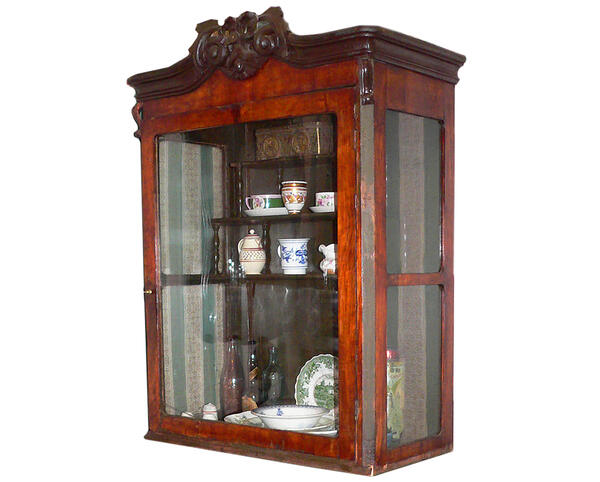
#5
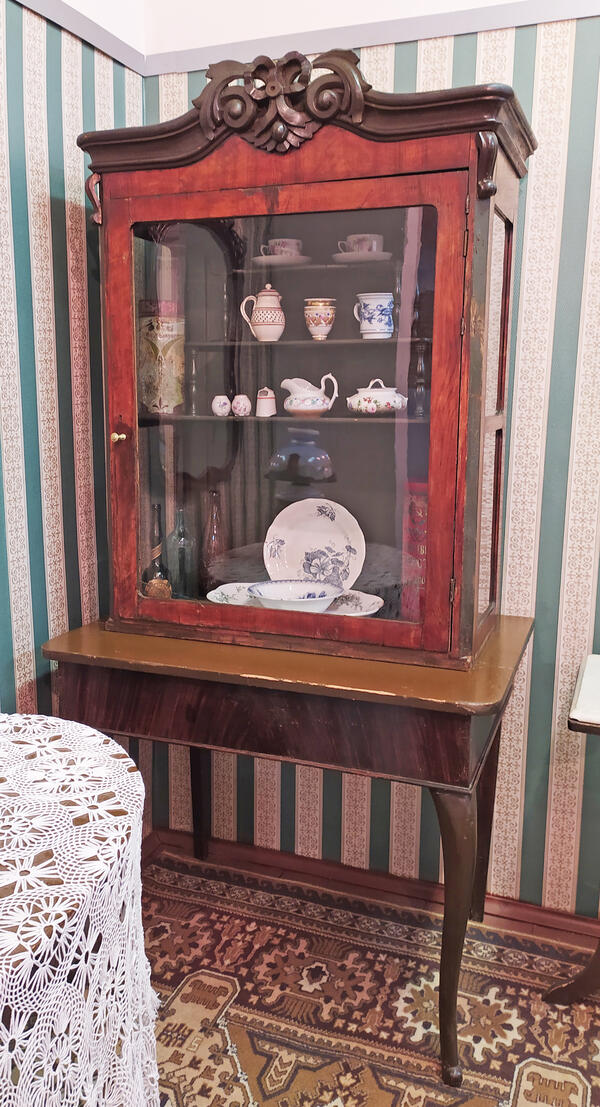
A gorka is a display cabinet for porcelain dishes. This one was part of a set of antique furniture that Nikolai Dedushénko donated to the fund of the Kótlas Museum of Local Lore. The gorka is a small wooden cabinet with glazed side walls and a door, and cut front corners. The plywood back wall of the cabinet was constructed by craftsmen. One large wooden shelf is placed inside the cabinet, on which two wooden shelves were placed on legs, step-by-step, one on top of the other. This design resembles a bookcase. The shelf legs are chiseled.
The craftsmen’s design for the gorka is eclectic; it is a mixture, a combination of different styles. They used baroque elements to decorate the gorka - an elaborate rim at the top of the cabinet, and curls above the door and at the front corners. The casing and its carved decorations are covered with dark brown lacquer. The corners of the gorka and the wood carvings on its top are covered with brown paint. The door rests on four hinges, of which two remain original, the other two having to be replaced. In the gorka there is a metal handle, also replaced during use, and a keyhole. These cabinets typically housed fragile and valuable dishes as well as sweets which were locked from children.
The gorka, like other elements of this collection, was made in the city of Kádnikov, presumably by the cabinetmakers Sokrovín and Orlóv, as well as sourced by the foresters Pópov-Vvedénsky, Stratilátov and Súmkin.
Initially, the owners of this set were the Kádnikov merchants of the first Chetverúkhin guild. Evgény Chetverúkhin’s daughter Alexandra married the Kadnikóvsky mayor and merchant Grigory Flyágin, later having a son, Ivan. Growing up, Ivan married schoolteacher Nadézhda Póstnikova, and after the wedding they lived in the Chetverúkhins’ large two-story house, which they inherited. After the death of Ivan Flyágin, Nadézhda, together with her sister Eléna Póstnikova, also a school teacher, moved to the house of the Odintsóv merchants, the upper floor of which was previously bought by Ivan Flyágin. The house of the Chetverúkhins was sold to the Flyágins, and all the furniture remained with the Póstnikov sisters.
The sisters bequeathed their property to Nikolai Dedushénko, a music teacher, watchmaker and tuner of musical instruments, who worked with them at school. He intended to open a historical memorial apartment for repressed teachers. Nikolay brought some of the antique furniture to Kótlas.
The craftsmen’s design for the gorka is eclectic; it is a mixture, a combination of different styles. They used baroque elements to decorate the gorka - an elaborate rim at the top of the cabinet, and curls above the door and at the front corners. The casing and its carved decorations are covered with dark brown lacquer. The corners of the gorka and the wood carvings on its top are covered with brown paint. The door rests on four hinges, of which two remain original, the other two having to be replaced. In the gorka there is a metal handle, also replaced during use, and a keyhole. These cabinets typically housed fragile and valuable dishes as well as sweets which were locked from children.
The gorka, like other elements of this collection, was made in the city of Kádnikov, presumably by the cabinetmakers Sokrovín and Orlóv, as well as sourced by the foresters Pópov-Vvedénsky, Stratilátov and Súmkin.
Initially, the owners of this set were the Kádnikov merchants of the first Chetverúkhin guild. Evgény Chetverúkhin’s daughter Alexandra married the Kadnikóvsky mayor and merchant Grigory Flyágin, later having a son, Ivan. Growing up, Ivan married schoolteacher Nadézhda Póstnikova, and after the wedding they lived in the Chetverúkhins’ large two-story house, which they inherited. After the death of Ivan Flyágin, Nadézhda, together with her sister Eléna Póstnikova, also a school teacher, moved to the house of the Odintsóv merchants, the upper floor of which was previously bought by Ivan Flyágin. The house of the Chetverúkhins was sold to the Flyágins, and all the furniture remained with the Póstnikov sisters.
The sisters bequeathed their property to Nikolai Dedushénko, a music teacher, watchmaker and tuner of musical instruments, who worked with them at school. He intended to open a historical memorial apartment for repressed teachers. Nikolay brought some of the antique furniture to Kótlas.
#27
Full name Gorka. Upper portion
Author Sokrovin Stratilatov Sumkin
Date late XIX century
Technique carving, varnishing, handmade
Place Kadnikov, Sokol’skij rajon, Vologodskaya oblast', Russia
Dimensions 118×90 cm
Copyright MUK ‘Kótlas Museum of Local Lore’
Collection Kótlas Museum of Local Lore
Author Sokrovin Stratilatov Sumkin
Date late XIX century
Technique carving, varnishing, handmade
Place Kadnikov, Sokol’skij rajon, Vologodskaya oblast', Russia
Dimensions 118×90 cm
Copyright MUK ‘Kótlas Museum of Local Lore’
Collection Kótlas Museum of Local Lore
#20
Brewing Mug
#6
#7
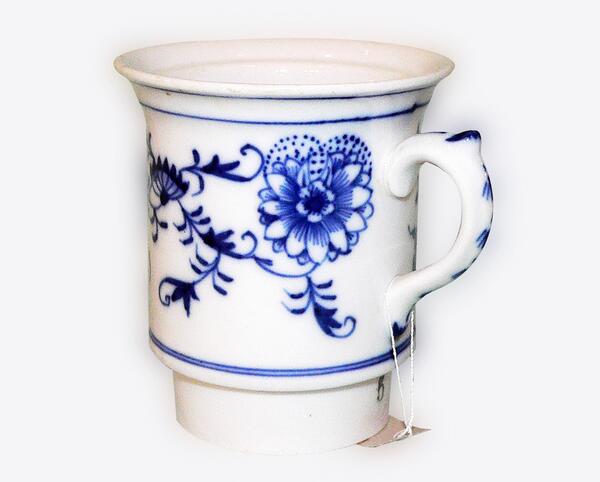
This ceramic brewing mug was given a rectangular shape with a flared top rim by the artisan. It is covered with white glaze and decorated with a deep blue floral pattern in the Gzhel style. The bottom is in the form of a sieve - criss-crossed slots form a kind of weave.
Dishware for brewing tea appeared relatively recently, in the 14th century. Until that time in China, tea leaves were boiled in water in small saucepans. During the reign of the Ming dynasty, people noticed that if you just brew tea with steeped boiling water, rather than boiling the tea itself, then the quality of the finished drink was much better. Thus, in the 14th century, the first teapots appeared in a form in which they exist today. Much later, tea strainers and mugs with slots appeared.
In Russia, by the beginning of the 19th century, a type of tea etiquette had developed. Moscow was the ‘trendsetter’ in terms of tea consumption.
‘Muscovites drank tea in the morning, at noon, and always at four o’clock. At this time in Moscow samovars were boiling in every house. Teahouses and taverns were full, and for a time, life would freeze. They drank it in the evening; they drank it when they felt sad; they drank it for no particular reason, ‘just because.’ They drank it with milk, lemon, jam, and most importantly — with pleasure, and the Muscovite loved tea that was strong, infused and hot, so that he could burn his lips. When ‘Moscow could be seen’ through the liquid tea, the Muscovite delicately refused and could not stand to drink it from the teapot… … But when he, having tipped the glass upside down, put the rest of the sugar on it and thanked it, it meant that tea drinking was over and no persuasion would help. During the tea drinking, the Muscovite watched closely as the tea was poured to him. If the glass was not poured to the top, the guest immediately asked to top it up so that life would be fuller. If the samovar, with its crackling coals, ‘sang songs, ” the superstitious Muscovite rejoiced: this is good. If, when the coals were burnt out, the samovar suddenly began to whistle for no apparent reason, the Muscovite would grab the lid in fright, cover the samovar with it, and start shaking. Having muffled the whistle in this way, the Muscovite was then in anxiety and expectation of all kinds of trouble for a long while. It was considered the worst omen if the samovar broke apart or came “unsoldered”. In this case, one must be sure to expect trouble.’
A description of Moscow tea drinking in the last century was provided by Alexander Vyurkov in his story ‘A Friend of the Family’
In a merchant environment, tea drinking was on a different level. Merchants spent long hours at the tea table and sometimes drank 20 glasses each of ‘merchant-style tea’. Hot tea has also been an indispensable tool during long travels along the roads of Russia. At post stations, both gentlemen and coachmen were treated to tea, so samovars were installed both in the ‘clean’ half of the carriage (for the gentlemen), and in the driver’s compartment. In winter, it was not recommended to consume alcoholic beverages on the road, since during severe frosts, intoxication could lead to tragedy, whereas tea invigorated, warmed, and cheered.
Dishware for brewing tea appeared relatively recently, in the 14th century. Until that time in China, tea leaves were boiled in water in small saucepans. During the reign of the Ming dynasty, people noticed that if you just brew tea with steeped boiling water, rather than boiling the tea itself, then the quality of the finished drink was much better. Thus, in the 14th century, the first teapots appeared in a form in which they exist today. Much later, tea strainers and mugs with slots appeared.
In Russia, by the beginning of the 19th century, a type of tea etiquette had developed. Moscow was the ‘trendsetter’ in terms of tea consumption.
‘Muscovites drank tea in the morning, at noon, and always at four o’clock. At this time in Moscow samovars were boiling in every house. Teahouses and taverns were full, and for a time, life would freeze. They drank it in the evening; they drank it when they felt sad; they drank it for no particular reason, ‘just because.’ They drank it with milk, lemon, jam, and most importantly — with pleasure, and the Muscovite loved tea that was strong, infused and hot, so that he could burn his lips. When ‘Moscow could be seen’ through the liquid tea, the Muscovite delicately refused and could not stand to drink it from the teapot… … But when he, having tipped the glass upside down, put the rest of the sugar on it and thanked it, it meant that tea drinking was over and no persuasion would help. During the tea drinking, the Muscovite watched closely as the tea was poured to him. If the glass was not poured to the top, the guest immediately asked to top it up so that life would be fuller. If the samovar, with its crackling coals, ‘sang songs, ” the superstitious Muscovite rejoiced: this is good. If, when the coals were burnt out, the samovar suddenly began to whistle for no apparent reason, the Muscovite would grab the lid in fright, cover the samovar with it, and start shaking. Having muffled the whistle in this way, the Muscovite was then in anxiety and expectation of all kinds of trouble for a long while. It was considered the worst omen if the samovar broke apart or came “unsoldered”. In this case, one must be sure to expect trouble.’
A description of Moscow tea drinking in the last century was provided by Alexander Vyurkov in his story ‘A Friend of the Family’
In a merchant environment, tea drinking was on a different level. Merchants spent long hours at the tea table and sometimes drank 20 glasses each of ‘merchant-style tea’. Hot tea has also been an indispensable tool during long travels along the roads of Russia. At post stations, both gentlemen and coachmen were treated to tea, so samovars were installed both in the ‘clean’ half of the carriage (for the gentlemen), and in the driver’s compartment. In winter, it was not recommended to consume alcoholic beverages on the road, since during severe frosts, intoxication could lead to tragedy, whereas tea invigorated, warmed, and cheered.
#28
Full name Brewing Mug
Author unknown
Date end of XIX century
Place Russia
Technique factory production
Dimensions 10,5×11,3 cm
Collection Kótlas Museum of Local Lore
Copyright MUK “Kótlas Museum of Local Lore”
Author unknown
Date end of XIX century
Place Russia
Technique factory production
Dimensions 10,5×11,3 cm
Collection Kótlas Museum of Local Lore
Copyright MUK “Kótlas Museum of Local Lore”
#21
Ceramic milk jug
#8
#9
A milk jug, or a creamer, is a special vessel for milk or cream, and one of the obligatory items of a tea or coffee service. They are usually pear-shaped. Milk jugs are designed to store and serve milk or cream during tea drinking.
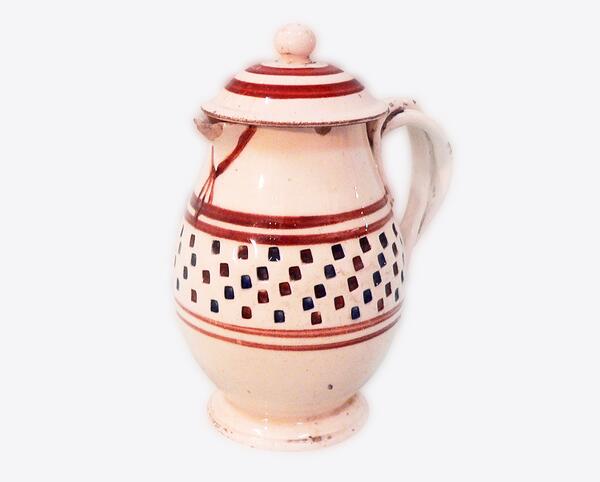
An unknown master made this milk jug, from the collection of the Kotlas Museum of Local Lore, in the form of a white pourer with a small spout and a lid. The ceramic handle looks like two intertwined braids. The jug itself is modestly decorated with stripes and squares.
Milk jug
Specialized vessels for serving milk have existed for at least several millennia. Studies of samples of ancient dishes led to the conclusion that the inhabitants of the British Isles have been drinking milk for six thousand years. Experts came to this conclusion after examining the fragments of vessels found in more than a dozen settlements of the first farmers and pastoralists using spectrometry, gas chromatography and isotope analysis.
Previously, it was mistakenly believed that at such an early stage in the development of mankind, livestock was raised only for meat and skins, and people were estimated to have consumed milk starting much later. Moreover, it is possible to establish that the distant ancestors used dishes much like a modern milk jug exclusively for storing milk and for nothing else. In the Middle East, the ban on the use of the same dishes for meat and dairy products is reflected in the religious norms of Judaism. Such customs have a practical meaning — the use of special vessels for milk protected it from premature spoilage.
Modern milk jugs appeared in Britain when the British began adding milk and sugar to tea in the 1720s. The appearance of milk jugs lagged behind other elements of the tea set - they became widespread only in the 1740s. Then, creamers of silver on three legs (a design with one leg was in demand until 1730 and returned after 1760) became popular as gifts. Sets consisting of a teapot, sugar bowl, and milk jug made in the same style spread during the time of King George III, although some examples were occasionally found before. Nowadays, a milk jug is almost always included in modern tea sets.
An unknown master made this milk jug, from the collection of the Kotlas Museum of Local Lore, in the form of a white pourer with a small spout and a lid. The ceramic handle looks like two intertwined braids. The jug itself is modestly decorated with stripes and squares.
Milk jug
Specialized vessels for serving milk have existed for at least several millennia. Studies of samples of ancient dishes led to the conclusion that the inhabitants of the British Isles have been drinking milk for six thousand years. Experts came to this conclusion after examining the fragments of vessels found in more than a dozen settlements of the first farmers and pastoralists using spectrometry, gas chromatography and isotope analysis.
Previously, it was mistakenly believed that at such an early stage in the development of mankind, livestock was raised only for meat and skins, and people were estimated to have consumed milk starting much later. Moreover, it is possible to establish that the distant ancestors used dishes much like a modern milk jug exclusively for storing milk and for nothing else. In the Middle East, the ban on the use of the same dishes for meat and dairy products is reflected in the religious norms of Judaism. Such customs have a practical meaning — the use of special vessels for milk protected it from premature spoilage.
Modern milk jugs appeared in Britain when the British began adding milk and sugar to tea in the 1720s. The appearance of milk jugs lagged behind other elements of the tea set - they became widespread only in the 1740s. Then, creamers of silver on three legs (a design with one leg was in demand until 1730 and returned after 1760) became popular as gifts. Sets consisting of a teapot, sugar bowl, and milk jug made in the same style spread during the time of King George III, although some examples were occasionally found before. Nowadays, a milk jug is almost always included in modern tea sets.
#29
Full name Ceramic milk jug
Author unknown
Date early XX century
Technique firing, glazing
Place Russia
Dimensions 14×10 cm
Copyright MUK ‘Kótlas Museum of Local Lore’
Collection Kótlas Museum of Local Lore
Author unknown
Date early XX century
Technique firing, glazing
Place Russia
Dimensions 14×10 cm
Copyright MUK ‘Kótlas Museum of Local Lore’
Collection Kótlas Museum of Local Lore
#22
Two-part wooden table
#10
#11
The collection of the Kotlas Museum of Local Lore contains this table created at the beginning of the 20th century. Nikolai Dedushénko from Kádnikov, a city in the Sókolsky district of the Vológda region, brought it, along with other antique furniture, to Kótlas and gifted it to the museum.
This piece of furniture belonged to the wealthy Kádnikov merchants of the first guild, the Chetverukhin. The daughter of Evgeny Evgenievich Chetverúkhin, Alexandra, married Kadnikóvsky mayor and merchant Grigóry Fyódorovich Flyágin. They had a son, Ivan. Schoolteacher Nadézhda Ivánovna Póstnikova became his wife, and after the wedding, Ivan Grigórievich and Nadezhda Ivánovna lived in the Chetverúkhins’ large two-story house, which they inherited.
After Nadézhda Ivánovna’s husband died, she lived with her sister Eléna Ivánovna Póstnikova, also a school teacher, in the Odintsóv merchants’ house, the top floor of which had previously been bought by Nadézhda Ivánovna’s husband. The Flyágins sold the Chetverúkhins’ home, and the furniture was inherited by the Póstnikov sisters.
The sisters bequeathed their property to Nikolai Dedushénko, a music teacher, watchmaker and tuner of musical instruments, who worked with them at their school. He was planning to open a historical and memorial apartment for repressed teachers. Nikolai Ivanovich gave a portion of the antique furniture to the Kótlas Museum.
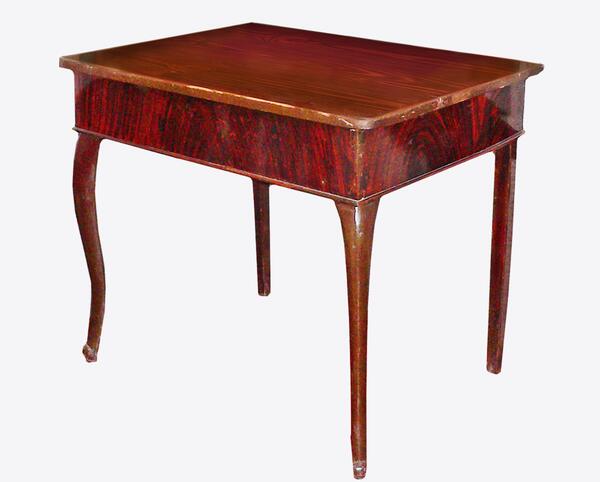
Kádnikov was famous for its masters of wooden art. This furniture may have been made by master cabinetmakers Sokrovín and Orlóv, as well as sourced by foresters Pópov-Vvedénsky, Stratilátov and Súmkin. Craftsmen made this table from expensive wood. It could serve multiple purposes — to be located along the wall as a side table, or as part of a large dining table consisting of two identical tables. For this purpose, there is a metal hook on one of the legs on the inside, and a metal loop on the other leg. Thus, two identical tables could be held together without fear that they would pull apart.
The table is made in a classic style. The frame was fastened with a tenon joint (a style of joint common in woodworking) and two transverse bars. The legs are constructed in different styles — two curved, two more simple straight shapes, with all four tapering downward. After sanding the surface, the table was covered with a dark brown varnish, the legs and the top were painted with brown paint of different shades.
This piece of furniture belonged to the wealthy Kádnikov merchants of the first guild, the Chetverukhin. The daughter of Evgeny Evgenievich Chetverúkhin, Alexandra, married Kadnikóvsky mayor and merchant Grigóry Fyódorovich Flyágin. They had a son, Ivan. Schoolteacher Nadézhda Ivánovna Póstnikova became his wife, and after the wedding, Ivan Grigórievich and Nadezhda Ivánovna lived in the Chetverúkhins’ large two-story house, which they inherited.
After Nadézhda Ivánovna’s husband died, she lived with her sister Eléna Ivánovna Póstnikova, also a school teacher, in the Odintsóv merchants’ house, the top floor of which had previously been bought by Nadézhda Ivánovna’s husband. The Flyágins sold the Chetverúkhins’ home, and the furniture was inherited by the Póstnikov sisters.
The sisters bequeathed their property to Nikolai Dedushénko, a music teacher, watchmaker and tuner of musical instruments, who worked with them at their school. He was planning to open a historical and memorial apartment for repressed teachers. Nikolai Ivanovich gave a portion of the antique furniture to the Kótlas Museum.
Kádnikov was famous for its masters of wooden art. This furniture may have been made by master cabinetmakers Sokrovín and Orlóv, as well as sourced by foresters Pópov-Vvedénsky, Stratilátov and Súmkin. Craftsmen made this table from expensive wood. It could serve multiple purposes — to be located along the wall as a side table, or as part of a large dining table consisting of two identical tables. For this purpose, there is a metal hook on one of the legs on the inside, and a metal loop on the other leg. Thus, two identical tables could be held together without fear that they would pull apart.
The table is made in a classic style. The frame was fastened with a tenon joint (a style of joint common in woodworking) and two transverse bars. The legs are constructed in different styles — two curved, two more simple straight shapes, with all four tapering downward. After sanding the surface, the table was covered with a dark brown varnish, the legs and the top were painted with brown paint of different shades.
#30
Full name Two-part wooden table
Author Sokrovin, Orlov, V.I. Popov-Vvedensky, Stratilatov, Sumkin
Date early 19th century
Technique handmade, varnished
Place Kadnikov, Sokol’skij rajon, Vologodskaya oblast', Russia
Dimensions 98×66 cm
Copyright MUK ‘Kótlas Museum of Local Lore’
Collection Kótlas Museum of Local Lore
Author Sokrovin, Orlov, V.I. Popov-Vvedensky, Stratilatov, Sumkin
Date early 19th century
Technique handmade, varnished
Place Kadnikov, Sokol’skij rajon, Vologodskaya oblast', Russia
Dimensions 98×66 cm
Copyright MUK ‘Kótlas Museum of Local Lore’
Collection Kótlas Museum of Local Lore
#23
Women’s blouse
#12
#13
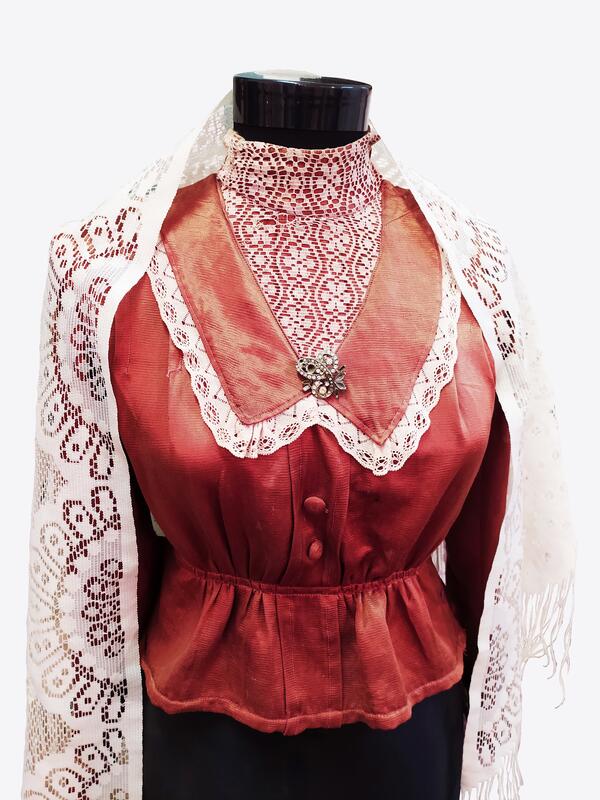
The ‘kazachók’ blouse is a festive fitted top with a stand-up collar and long sleeves. Despite the name, this type of clothing does not belong to the wardrobe of the Cossacks. This blouse presented in the exposition was sewn from a brown factory fabric and was laid on a cotton lining, which duplicates the cut of the blouse. Additionally, a drawstring belt is sewn at the waist. The neckline and lapels are trimmed with lace, and the collar is decorated with a lace ribbon.
Below the collar in the centre of the front panel, there is a fold on which are sewn two buttons covered with the same fabric. Curled cuffs extend upward and form a triangular edge with a sewn button. They are also decorated with lace along the edge; a brown fabric lining is visible on the underside.
Usually ‘kozachkí’ were sewn from the same fabrics as holiday sundresses - from damask, silk, and various adornments. Preference was given to store-bought single-color fabrics in red, blue, brown, cream, pink, and light blue. The most popular was fabric embroidered with designs of vines and flowers. Cotton fabrics were used for lining. The ‘kozachkí’ were trimmed in the same way as sundresses - with gold lace, fringe along the bottom of the sleeves and along the hem.
Despite the fact that an undershirt was worn under the ‘kozachók’, it sits on the figure quite flatteringly. It is possible this style gained great popularity because it helped rural fashionistas to get around the lack of a corset in their wardrobe — a well-cut ‘kozachók’ could create the illusion of a more slender figure. It is apparent from the cut of the blouse that it fits tightly: The cinch at the waist and the reduced distance between the buttons indicate that this was the tightest point of the garment.
At the beginning of the 20th century, some peasant women were already wearing fitted blouses with a high collar over a sundress - in accordance with the new fashion. During this time, the ‘kozachók’ style long remained a part of traditional garb, even when it had fallen out of fashion in the cities. In this period, there were various options for its construction: from taffeta, satin, or chintz. It was typically paired with a skirt or a sundress.
Below the collar in the centre of the front panel, there is a fold on which are sewn two buttons covered with the same fabric. Curled cuffs extend upward and form a triangular edge with a sewn button. They are also decorated with lace along the edge; a brown fabric lining is visible on the underside.
Usually ‘kozachkí’ were sewn from the same fabrics as holiday sundresses - from damask, silk, and various adornments. Preference was given to store-bought single-color fabrics in red, blue, brown, cream, pink, and light blue. The most popular was fabric embroidered with designs of vines and flowers. Cotton fabrics were used for lining. The ‘kozachkí’ were trimmed in the same way as sundresses - with gold lace, fringe along the bottom of the sleeves and along the hem.
Despite the fact that an undershirt was worn under the ‘kozachók’, it sits on the figure quite flatteringly. It is possible this style gained great popularity because it helped rural fashionistas to get around the lack of a corset in their wardrobe — a well-cut ‘kozachók’ could create the illusion of a more slender figure. It is apparent from the cut of the blouse that it fits tightly: The cinch at the waist and the reduced distance between the buttons indicate that this was the tightest point of the garment.
At the beginning of the 20th century, some peasant women were already wearing fitted blouses with a high collar over a sundress - in accordance with the new fashion. During this time, the ‘kozachók’ style long remained a part of traditional garb, even when it had fallen out of fashion in the cities. In this period, there were various options for its construction: from taffeta, satin, or chintz. It was typically paired with a skirt or a sundress.
#31
Full name Women’s blouse
Author unknown
Date late 19th century
Place Russia
Technique sewing, handmade, machine stitch, factory made
Dimensions 123×50 cm
Collection Kótlas Museum of Local Lore
Copyright MUK “Kótlas Museum of Local Lore”
Author unknown
Date late 19th century
Place Russia
Technique sewing, handmade, machine stitch, factory made
Dimensions 123×50 cm
Collection Kótlas Museum of Local Lore
Copyright MUK “Kótlas Museum of Local Lore”
#24
Tripod table (stand) with marble top
#14

#15
The collection of the Kótlas Museum of Local Lore contains this old wooden three-legged table. On a chiseled base with a marble top, it was made by craftsmen in the eclectic style popular during the last quarter of the 19th century. It was used as a stand for figurines, vases, candlesticks, lanterns, or just to decorate the interior.
This table was likely built in the city of Kádnikov by the master cabinetmakers Sokrovin and Orlov, as well as sourced by foresters Pópov-Vvedénsky, Stratilátov, and Súmkin. A thin, aesthetic table leg splits into three legs for stability — shorter, and carved from wood. The craftsmen made the square tabletop in two parts: the lower part is wooden, and the upper tabletop is covered with a marble slab of Italian origin. The craftsmen have rounded the corners of the table top, keeping its square shape. The wooden part of the table was covered with dark brown paint and varnished.
Three-legged tables were popular during the Georgian period of English history from the early 18th century to the first third of the 19th century. During this time, the English master of furniture art Chippendale created examples of high quality mahogany furniture, combining both aesthetic and functionality.
This table belonged to the Chetverúkhin family of merchants of the first guild, who lived in the city of Kádnikov, Vológda province. Evgeny Chetverúkhin’s daughter Alexandra married Kadnikóvsky mayor and merchant Grigory Flyágin. They had a son, Ivan. Ivan would go on to marry a schoolteacher, Nadezhda Póstnikova, after which the newlyweds lived in the Chetverúkhins’ large two-story house, which they had inherited.
After Nadezhda’s husband died, she, together with her sister Elena Póstnikova, also a teacher, moved to a new place of residence — the Odintsóv merchants’ house, the top floor of which had previously been purchased by Ivan Flyágin. They sold the Chetverúkhins’ house, and all the furniture remained with the Póstnikov sisters.
The sisters bequeathed their property to Nikolai Dedushénko, a music teacher, watchmaker and tuner of musical instruments, who worked with them at school. He intended to open a historical memorial apartment for repressed teachers. Later, Dedushénko brought a portion of this antique furniture to Kótlas and donated it to the collection of the local history museum.
This table was likely built in the city of Kádnikov by the master cabinetmakers Sokrovin and Orlov, as well as sourced by foresters Pópov-Vvedénsky, Stratilátov, and Súmkin. A thin, aesthetic table leg splits into three legs for stability — shorter, and carved from wood. The craftsmen made the square tabletop in two parts: the lower part is wooden, and the upper tabletop is covered with a marble slab of Italian origin. The craftsmen have rounded the corners of the table top, keeping its square shape. The wooden part of the table was covered with dark brown paint and varnished.
Three-legged tables were popular during the Georgian period of English history from the early 18th century to the first third of the 19th century. During this time, the English master of furniture art Chippendale created examples of high quality mahogany furniture, combining both aesthetic and functionality.
This table belonged to the Chetverúkhin family of merchants of the first guild, who lived in the city of Kádnikov, Vológda province. Evgeny Chetverúkhin’s daughter Alexandra married Kadnikóvsky mayor and merchant Grigory Flyágin. They had a son, Ivan. Ivan would go on to marry a schoolteacher, Nadezhda Póstnikova, after which the newlyweds lived in the Chetverúkhins’ large two-story house, which they had inherited.
After Nadezhda’s husband died, she, together with her sister Elena Póstnikova, also a teacher, moved to a new place of residence — the Odintsóv merchants’ house, the top floor of which had previously been purchased by Ivan Flyágin. They sold the Chetverúkhins’ house, and all the furniture remained with the Póstnikov sisters.
The sisters bequeathed their property to Nikolai Dedushénko, a music teacher, watchmaker and tuner of musical instruments, who worked with them at school. He intended to open a historical memorial apartment for repressed teachers. Later, Dedushénko brought a portion of this antique furniture to Kótlas and donated it to the collection of the local history museum.
#32
Full name Tripod table (stand) with marble top
Author Sumkin, Stratilatov, Sokrovin, Orlov, Popov-Vvedensky V.I.
Date end of XIX century
Technique carving
Place Kadnikov, Sokol’skij rajon, Vologodskaya oblast', Russia
Dimensions 40×40 cm
Collection Kótlas Museum of Local Lore
Copyright MUK ‘Kótlas Museum of Local Lore’
Author Sumkin, Stratilatov, Sokrovin, Orlov, Popov-Vvedensky V.I.
Date end of XIX century
Technique carving
Place Kadnikov, Sokol’skij rajon, Vologodskaya oblast', Russia
Dimensions 40×40 cm
Collection Kótlas Museum of Local Lore
Copyright MUK ‘Kótlas Museum of Local Lore’
#25
Wall clock in a carved wooden case
#16
#17
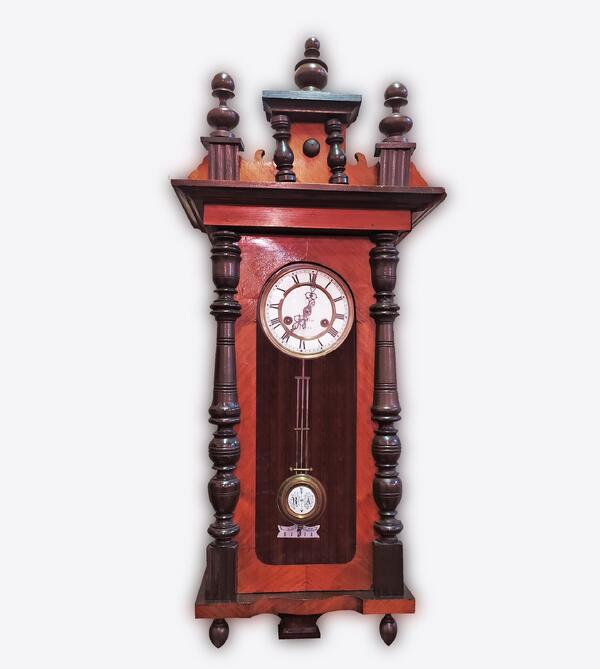
The collection of the Kótlas Museum of Local Lore contains this old clock titled ‘Le Roi à Paris’, which translates as ‘The King of Paris.’ Several German factories were involved in the production of mechanical clocks under this brand, the largest of which were Schlenker-Kienzle, Yunghans, FMS and PHS. Under the brand name ‘Le Roi à Paris’, wall clocks were imported en masse into the Russian Empire at the beginning of the 20th century, because wealthy Russians wanted to have watches in their homes of German quality, but of beautiful French design.
The ‘Le Roi a Paris’ wall clock was in a more inexpensive category, accessible to the general population. It was a spring-wound mechanical clock with enamel dials, vaguely reminiscent of the ‘Vienna Regulators, ” which were high quality clocks produced by Austrians and Germans.
Marking dials with the inscription “Le Roi à Paris” was a marketing ploy with the intention to attract customers. The Germans managed to use the name of this famous French company, in operation since the end of the 18th century, without consequence. It is possible the brand “Le Roi à Paris” was not registered in Germany. The Schlenker-Kienzle company only officially registered the old trademark “Le Roi à Paris” on March 16, 1909. Since then, the inscription “Le Roi à Paris” can be generally be found only on the wall clocks manufactured by Kienzle.
This museum exhibit clock has a wooden case, covered with dark lacquer. The front and side casings are constructed in the form of frames with transparent glass, and the back casing is wooden. The front casing can be opened or locked in the closed position with a folding hook. The craftsmen fitted tailored columns along the side edges of the front casing, and the upper edge of the front casing was covered with a wooden overlay.
On the upper side of the body there is a wide wooden cover, into the front edge of which a wooden pediment is inserted. Inside, a bronze figured plate was attached to the back wall of the clock in the upper portion, on which there are two brackets for fastening the clock mechanism. On the plate there are embossed curls and the emblem of the “DLER GONG” company. The exhibit features a clock face covered with white enamel, with the inscription “Le Roi à Paris”. On the pendulum, the master placed a white enamel insert with the image of an arrow and the letters “R A” against the background of a floral ornament.
The ‘Le Roi a Paris’ wall clock was in a more inexpensive category, accessible to the general population. It was a spring-wound mechanical clock with enamel dials, vaguely reminiscent of the ‘Vienna Regulators, ” which were high quality clocks produced by Austrians and Germans.
Marking dials with the inscription “Le Roi à Paris” was a marketing ploy with the intention to attract customers. The Germans managed to use the name of this famous French company, in operation since the end of the 18th century, without consequence. It is possible the brand “Le Roi à Paris” was not registered in Germany. The Schlenker-Kienzle company only officially registered the old trademark “Le Roi à Paris” on March 16, 1909. Since then, the inscription “Le Roi à Paris” can be generally be found only on the wall clocks manufactured by Kienzle.
This museum exhibit clock has a wooden case, covered with dark lacquer. The front and side casings are constructed in the form of frames with transparent glass, and the back casing is wooden. The front casing can be opened or locked in the closed position with a folding hook. The craftsmen fitted tailored columns along the side edges of the front casing, and the upper edge of the front casing was covered with a wooden overlay.
On the upper side of the body there is a wide wooden cover, into the front edge of which a wooden pediment is inserted. Inside, a bronze figured plate was attached to the back wall of the clock in the upper portion, on which there are two brackets for fastening the clock mechanism. On the plate there are embossed curls and the emblem of the “DLER GONG” company. The exhibit features a clock face covered with white enamel, with the inscription “Le Roi à Paris”. On the pendulum, the master placed a white enamel insert with the image of an arrow and the letters “R A” against the background of a floral ornament.
#33
Full name Wall clock in a carved wooden case
Author unknown
Date early 19th century
Technique carving
Place Germany
Dimensions 95×38 cm
Copyright MUK “Kótlas Museum of Local Lore”
Collection Kótlas Museum of Local Lore
Author unknown
Date early 19th century
Technique carving
Place Germany
Dimensions 95×38 cm
Copyright MUK “Kótlas Museum of Local Lore”
Collection Kótlas Museum of Local Lore
read morehide
00:00
00:00
1x
Bottle, Gorka, Mug, Tables, Wall clock, Blouse
Collection
Exhibition
0
 Point your smartphone camera to open in the app
Open in app
Share